
CRM ROI for Construction: How Builders Maximize Profitability | High Level CRM
CRM ROI for construction is the measurable return a construction firm gains from its Customer Relationship Management investment, calculated by comparing total value gained against total system costs. The industry benchmark sits at $3.10 returned per $1 spent, according to Nucleus Research, though construction firms with strong implementation consistently outperform that figure. Vye Construction reported $2.14M in verified ROI within four months of adopting CRM-integrated estimating software, including 381 hours saved annually and $500K in new revenue. The formal term you will see in financial reporting is “return on investment,” but in the construction context it captures both hard financial gains and operational improvements that reduce cost and error across the project lifecycle.
What is CRM ROI for construction, and how is it calculated?
CRM ROI in construction is defined by a straightforward formula: ROI% = (Total Value Gained minus Total Cost) / Total Cost. The challenge for most contractors is not the math. It is accurately identifying what belongs in each side of the equation.
Total Value Gained draws from multiple sources specific to construction workflows:
- Incremental revenue: New contracts won because faster quoting and better follow-up closed deals that previously slipped through.
- Cost savings: Reduced manual data entry, fewer billing errors, and lower rework costs from cleaner project handoffs.
- Time savings: Hours recovered from automating lead logging, status updates, and client communication.
- Operational efficiencies: Faster response times, shared data across estimating and project management, and fewer cross-team miscommunications.
Total Cost is where many construction firms undercount. Total CRM cost includes software licenses, implementation fees, training time, ongoing maintenance, and the internal staff hours dedicated to data upkeep and system management. Ignoring transition costs and data hygiene work inflates your apparent ROI and sets unrealistic expectations.
For a mid-size general contractor, a realistic cost picture might include $12,000 in annual software fees, $8,000 in implementation and training, and roughly 200 hours of staff time at loaded labor rates. That total cost baseline is what your value gains must exceed to produce a positive return.
Pro Tip: Track your CRM ROI over a defined ramp period, typically 12 to 18 months, rather than expecting immediate payback. Construction firms with longer sales cycles and complex project pipelines need time for workflow changes to produce measurable financial results.
Tools like NetSuite CRM and Method CRM are built with construction-adjacent workflows in mind, making it easier to tag revenue and cost data to specific CRM activities. You can also use a dedicated ROI measurement tool to model your expected return before committing to a platform.
How do real-world construction companies benchmark CRM ROI?
The numbers from actual construction deployments are more instructive than industry averages. Vye Construction’s results are the clearest documented example: 381 hours saved annually, a 42% profit margin on a $3.8M subdivision, and a $1.9M project secured within 24 hours of a bid opportunity. Those outcomes came directly from CRM-integrated estimating that eliminated manual data transfer and accelerated decision-making.
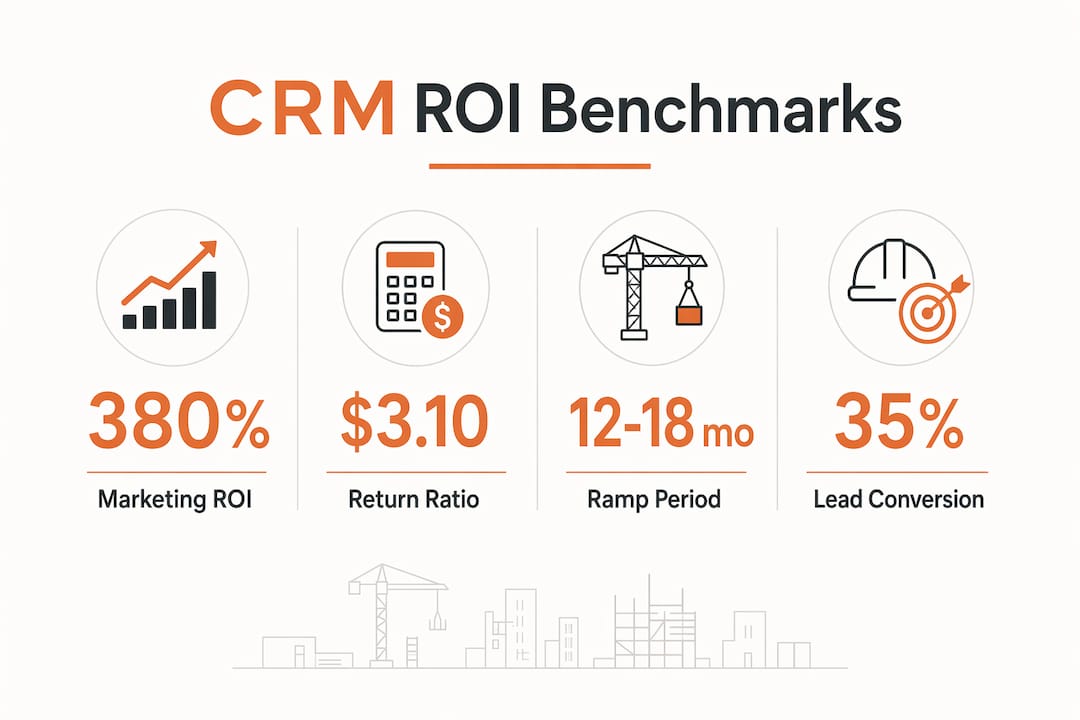
Enterprise construction firms using CRM automation and analytics platforms report marketing ROI of 380 to 420%, with CRM data integration credited for lowering acquisition costs by 15 to 20%. That figure reflects the spillover effect: when CRM data feeds your marketing, every campaign becomes more targeted and less wasteful.
| Benchmark | Reported figure | What it means |
|---|---|---|
| Industry average CRM return | $3.10 per $1 spent | A reasonable baseline for evaluating your own results |
| Vye Construction ROI | $2.14M in 4 months | Demonstrates what fast, well-implemented CRM can produce |
| Enterprise marketing ROI | 380 to 420% | Shows CRM value extends well beyond sales into marketing spend |
| Annual hours saved (Vye) | 381 hours | Translates directly to labor cost reduction and capacity gain |
Variability in these figures comes down to three factors: company size, digital maturity before CRM adoption, and implementation quality. A 10-person residential builder adopting CRM for the first time will have a longer ramp period than a 50-person commercial contractor migrating from a legacy system with clean data.
“CRM ROI benefits are often as much operational as financial, requiring teams to use CRM to change workflows effectively.” — Method CRM Research
That quote captures the core insight. The firms that hit $3.10 or better are not just buying software. They are changing how their teams work, communicate, and make decisions.
What nuances influence CRM ROI outcomes in construction firms?

The gap between projected and realized CRM ROI in construction almost always traces back to the same set of factors. Understanding them before you deploy saves significant time and money.
User adoption is the single largest variable. Poor adoption delays time-to-value regardless of how capable the system is. A CRM that your estimators, project managers, and sales team actually use daily produces ROI. One that sits underutilized after a rushed rollout produces cost with no return. Construction teams are often skeptical of new software, particularly if it adds steps to their current workflow before it removes them.
Integration with existing systems multiplies returns. CRM connected to ERP and project management tools creates a single data source that reduces cross-system rework and delays. When your CRM talks to your estimating software, your accounting platform, and your scheduling tools, you eliminate the manual transfers that consume hours and introduce errors. Without that integration, CRM becomes another silo rather than a connector.
Hidden costs erode ROI if left untracked. Many construction firms underestimate the cost of transition time and data hygiene. Migrating messy contact records, training crews who are not desk-based, and managing the productivity dip during rollout are all real costs that belong in your denominator.
Qualitative benefits are real but require deliberate tracking. Improved client relationships, reduced rework from clearer communication, and higher referral rates do not appear automatically in a spreadsheet. You need to build measurement into your process from day one. Firms that link CRM usage to cycle-time and error-reduction outcomes produce the most defensible ROI figures.
Pro Tip: Before go-live, identify three to five specific workflows you want CRM to change. Measure those workflows before and after. That before-and-after comparison is your most credible ROI evidence, especially for operational benefits that do not show up directly in revenue.
For a deeper look at where CRM adoption breaks down in real construction firms, the common CRM failure patterns documented across Central Coast contractors offer a candid picture of what goes wrong and why.
How can construction businesses improve and maximize their CRM ROI?
Improving CRM ROI in construction is a deliberate process, not a passive outcome. These five steps produce the most consistent results across firms of different sizes and specialties.
-
Set measurable benchmarks before deployment. Define what success looks like in specific terms: lead conversion rate, average quote turnaround time, revenue per estimator, or hours spent on administrative tasks per week. Without a baseline, you cannot measure improvement. Tie each benchmark directly to a business goal, not just a CRM feature.
-
Track both objective and subjective ROI metrics. Objective metrics include revenue added, costs reduced, and hours saved. Subjective metrics include client satisfaction scores, team confidence in data accuracy, and the frequency of repeat business. CRM ROI measurement should focus on outcomes tied to specific business KPIs and track payback periods for accountability. Both types of data tell part of the story.
-
Invest in user adoption from day one. Schedule structured training before go-live, assign internal champions on each team, and build a feedback loop so users can flag friction points quickly. The firms that see the fastest ROI treat CRM adoption as a change management project, not a software installation.
-
Automate the repetitive work first. Automating lead data centralization reduces manual entry, improves quote accuracy, and produces measurable time savings within the first 90 days. Start with the tasks your team finds most tedious and error-prone. Quick wins build momentum and demonstrate value to skeptical team members.
-
Use CRM data to accelerate decision-making. Construction technology ROI includes faster project completion reducing overhead and reduced rework costs. When your CRM surfaces real-time pipeline data, win/loss patterns, and client communication history, your estimators and project managers make faster, better-informed decisions. That speed compounds over a full project year.
For contractors who want a structured framework before purchasing, the CRM buyer’s checklist for construction companies covers the 25 questions that separate a high-ROI deployment from a costly mistake.
Key takeaways
CRM ROI for construction requires tracking both financial returns and operational improvements against the full cost of ownership, including staff time and transition effort.
| Point | Details |
|---|---|
| Use the full ROI formula | Calculate value gained minus total cost, including licenses, training, and staff time. |
| Benchmark against real data | The industry average is $3.10 per $1 spent; top performers like Vye Construction far exceed this. |
| Integration multiplies returns | CRM connected to ERP and project management tools eliminates silos and reduces rework. |
| Adoption drives results | User engagement determines whether CRM produces ROI or just adds cost. |
| Measure before and after | Establish workflow baselines before go-live to produce credible, defensible ROI evidence. |
What I have learned about CRM ROI after years in construction tech
I have watched construction firms spend real money on CRM systems and walk away convinced the technology did not work. In almost every case, the system was not the problem. The problem was treating CRM as a contact database rather than a workflow engine.
The contractors who see the strongest returns are the ones who connect CRM directly to how they win and deliver work. They are not logging calls because the software asks them to. They are using CRM data to decide which leads to pursue, which clients to call before a project goes sideways, and which estimators are closing at the highest rate. That is a fundamentally different relationship with the tool.
The other pattern I see consistently: firms that measure ROI only in revenue miss half the picture. The 381 hours Vye Construction saved annually represent real capacity. That is time your team can spend estimating more projects, managing existing ones better, or simply not working weekends. Operational time savings are financial value. They just require a bit more intention to quantify.
My honest advice is to treat your CRM investment the way you treat a subcontractor relationship. Set clear expectations, hold it accountable to specific deliverables, and review performance on a defined schedule. If you do that, the ROI case becomes obvious within the first year. If you do not, you will spend the second year wondering why the numbers do not add up.
The benefits of CRM for contractors go well beyond sales tracking. The firms that figure that out early are the ones that show up in the case studies.
— Rowena
How Highlevelcrm-rconstructionsolutions helps you capture construction CRM ROI
Highlevelcrm-rconstructionsolutions is built specifically for construction contractors, developed with over 30 years of industry experience. It is not a generic CRM adapted for construction. It is a purpose-built platform with automated lead tracking, custom reporting dashboards, and integrations with the tools your teams already use on-site and in the office.
Contractors using Highlevelcrm-rconstructionsolutions report lead conversion rate increases of up to 35%, with measurable reductions in project management time and administrative errors. The platform connects your sales pipeline, estimating workflow, and client communication in one place, so your team spends less time transferring data and more time closing projects. If you are ready to put real numbers behind your CRM investment, explore the full platform capabilities and see how it fits your operation.
FAQ
What does CRM ROI mean for a construction company?
CRM ROI for construction is the financial and operational return a firm receives from its CRM investment, calculated as total value gained minus total cost divided by total cost. Value includes revenue growth, cost savings, and time recovered from automated workflows.
How do I calculate ROI for a CRM system?
Use the formula: ROI% = (Total Value Gained minus Total Cost) / Total Cost, where total cost includes software fees, implementation, training, and staff time. Track both revenue-based gains and operational improvements like hours saved and error reduction.
What is a realistic CRM ROI benchmark for construction?
The industry average is $3.10 returned per $1 spent, according to Nucleus Research. Well-implemented construction CRM deployments frequently exceed this, as demonstrated by Vye Construction’s $2.14M ROI within four months.
Why does user adoption affect CRM ROI so much?
CRM ROI depends on actual workflow change, not software features. When teams do not use the system consistently, the data stays incomplete and the automation does not trigger, which means the time savings and conversion improvements never materialize.
How long does it take to see CRM ROI in construction?
Most construction firms see measurable ROI within 12 to 18 months, though firms with strong adoption programs and clean data can see results within the first 90 days. Longer sales cycles and complex project pipelines extend the ramp period for some builders.