
How CRM Transforms Bid Tracking for Construction Teams
How CRM improves bid tracking across the construction pipeline
The role of CRM in bid tracking is straightforward: it replaces scattered spreadsheets and missed follow-ups with a single, centralized system that shows every bid, its current stage, and who owns it. For estimators juggling dozens of active opportunities, that visibility alone changes how decisions get made.
Here is what a well-configured CRM delivers for construction bid management:
- Centralized pipeline: Every bid lives in one place, from first contact through award or loss, so nothing slips through the cracks.
- Stage-based tracking: Bids move through defined phases (lead, qualifying, estimating, submitted, awarded), giving your team an accurate picture of workload at any moment.
- Automated follow-ups: Reminders trigger at key intervals so your team responds to leads quickly. Responding quickly correlates to a higher bid win rate, while waiting longer significantly lowers that rate.
- Bid prioritization: Go/no-go filters built into the CRM help estimators focus time on the bids most likely to win.
- Win/loss reporting: Structured data capture lets leadership spot trends and refine strategy over time.
Firms that integrate bid tracking into CRM workflows have eliminated 34% of low-probability bids and improved subcontractor response rates from 41% to 67% within 30 days. Those are not marginal gains. Highlevelcrm-rconstructionsolutions was built specifically for achieving this kind of impact, drawing on more than 30 years of construction experience to configure a system that fits how contractors actually work.
Table of Contents
- 1. How CRM maps and manages the full construction bid lifecycle
- 2. CRM features that give your team real visibility and collaboration
- 3. How CRM data and reporting drive better bid decisions
- 4. Highlevelcrm-rconstructionsolutions: built for construction bid tracking
- 5. How to customize your CRM for your specific bid tracking needs
- 6. Data security and compliance considerations when using CRM for bids
- 7. Training and change management for CRM adoption in bid tracking
- Highlevelcrm-rconstructionsolutions gives construction teams a real bid tracking advantage
- Key Takeaways
1. How CRM maps and manages the full construction bid lifecycle
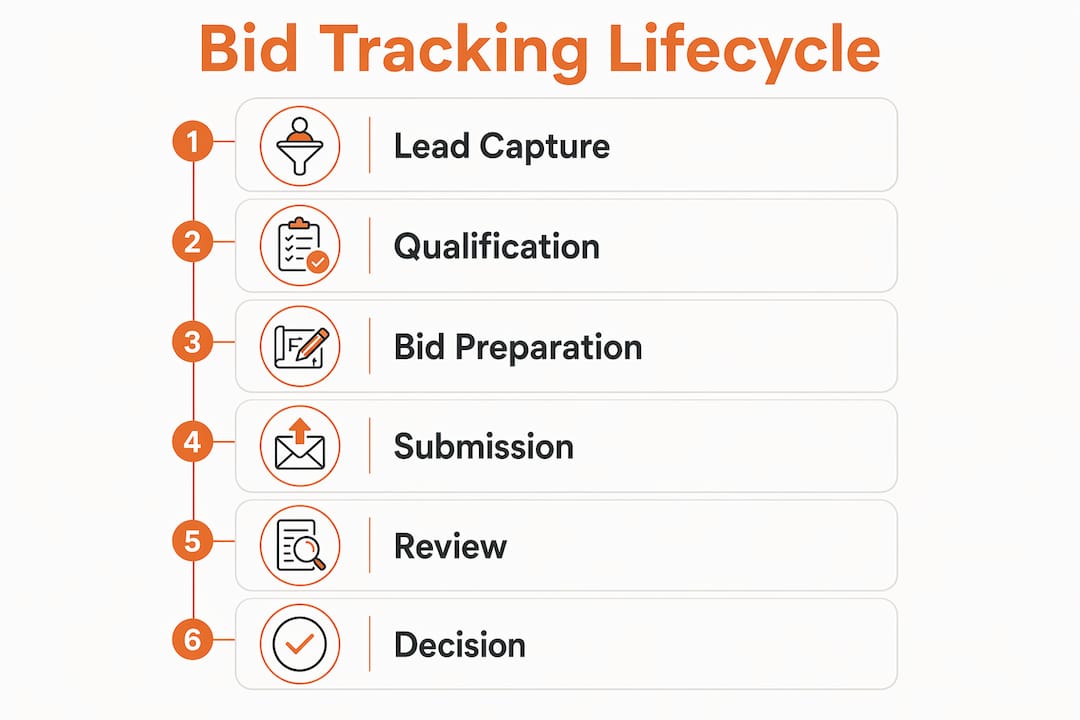
Every construction bid passes through predictable stages, and a CRM built for bid management maps each one as a distinct pipeline phase. That mapping transforms the platform from a contact database into a strategic bid management tool that guides estimators on where to focus.
Typical lifecycle stages tracked inside a construction CRM include:
- Lead capture and qualification: Incoming opportunities are logged with project type, owner, location, and estimated value. Go/no-go scoring filters out poor fits early.
- Pre-qualification and relationship building: The CRM tracks RFQ responses, bonding requirements, and key contacts at the owner and GC level.
- Estimating and proposal preparation: Bid due dates, estimator assignments, and document attachments connect directly to the bid record. The CRM holds status and margin targets; detailed takeoffs stay in your estimating software.
- Submission and follow-up: Automated reminders prevent missed deadlines. Post-submission tasks trigger follow-up calls and check-ins at set intervals.
- Award, loss, or hold: Outcome is recorded with a structured win/loss reason, feeding future reporting.
Mapping bid lifecycle stages into CRM pipeline phases turns the platform into a strategic asset that guides estimators on lead prioritization rather than just storing contact records. Integration with estimating tools like Procore or Buildertrend means bid amounts and margin data sync back to the CRM without manual re-entry, cutting errors and saving hours per bid.
Pro Tip: Set your CRM pipeline stages to mirror your internal bid review process, not a generic sales funnel. When stages reflect your actual workflow, adoption across the estimating team happens faster.
2. CRM features that give your team real visibility and collaboration
Bid tracking software with CRM capabilities for construction teams does more than store data. The right features create shared visibility across estimating, project management, and leadership, so everyone works from the same information.

Real-time pipeline dashboards show bid volume by stage, estimator, project type, and geography. A Kanban-style board lets your team drag bids forward as they progress, making status updates fast and visual. For project managers reviewing workload, that board answers the question “what are we chasing right now?” in seconds.
Stakeholder and contact mapping is where many firms gain an edge. Construction bids are often lost at the relationship level rather than on price. Tracking every decision-maker tied to a bid, including the owner’s rep, the architect, and the GC’s project manager, keeps your team from losing ground when a key contact changes roles. The CRM surfaces who knows whom and flags relationships that have gone quiet.
Collaboration tools within the CRM include:
- Task assignments: Estimators, coordinators, and PMs each see their specific action items tied to a bid record.
- Automated notifications: Alerts fire when a bid deadline approaches, a follow-up is overdue, or a bid status changes.
- Document management: RFPs, addenda, and proposal drafts attach directly to the bid record, so the team always works from the current version.
- Communication logs: Every call, email, and meeting note ties to the bid, giving new team members full context without a handoff meeting.
Long sales cycles in commercial construction mean a bid you submitted in March may not be awarded until September. Communication continuity, maintained through a CRM’s contact and activity history, keeps relationships warm across that gap.
3. How CRM data and reporting drive better bid decisions
Data is only useful if it is structured. A CRM configured for construction bid analysis captures win/loss reasons as dropdown fields rather than free text, which makes the difference between data you can act on and data that just sits there. Free-text loss reasons prevent the aggregation needed to identify patterns, while structured dropdowns let you run a report showing that 40% of your losses in a given quarter came down to price on public sector work.
Pipeline analytics available through a well-built CRM include:
- Bid volume by period: How many bids did your team submit last quarter versus the same period last year?
- Win rate by project type or owner: Which market segments are you winning, and which are you consistently losing?
- Cost per bid: When estimating hours are logged against bid records, leadership can calculate the true cost of pursuing each opportunity type.
- Average bid-to-award cycle: Knowing how long your pipeline takes to convert helps with cash flow forecasting.
Executives value CRM as a single source of truth, consolidating data formerly scattered across spreadsheets and enabling confident forecasting and resource allocation. That consolidation matters most during busy bid seasons when leadership needs to decide whether to add estimating capacity or pass on a project.
Go/no-go scoring built into the CRM uses historical win rate data to weight new opportunities. A project type where your firm wins 60% of bids scores higher than one where you win 15%, and the CRM surfaces that context before your estimator spends 80 hours on a takeoff. That is the practical meaning of data-driven bid prioritization.

4. Highlevelcrm-rconstructionsolutions: built for construction bid tracking
Most CRM platforms were designed for software sales or retail. Highlevelcrm-rconstructionsolutions was built with over 30 years of construction industry experience behind it, which shows up in the specific fields, workflows, and integrations that matter to estimators and project managers.
Users of Highlevelcrm-rconstructionsolutions report a 35% increase in lead conversion rates after adopting automated lead tracking and structured bid workflows.
Construction-specific features include:
- Bid due date tracking with automated reminders tied to estimator calendars.
- Estimator assignment fields so workload is visible across the team at a glance.
- Margin tracking at the bid record level, keeping financial targets front of mind without cluttering the CRM with raw cost data.
- Custom reporting dashboards configured for construction KPIs: win rate, bid volume, pipeline value, and follow-up compliance.
- Integration with industry tools including estimating platforms and project management software, enabling direct bid feed import and automated sub invitations.
The table below shows how bid tracking workflows compare with and without Highlevelcrm-rconstructionsolutions:
| Workflow Step | Without CRM | With Highlevelcrm-rconstructionsolutions |
|---|---|---|
| Lead capture | Manual entry in spreadsheets | Automated intake with go/no-go scoring |
| Bid deadline tracking | Calendar reminders, often missed | Automated alerts tied to bid records |
| Estimator workload visibility | No central view | Real-time dashboard by estimator |
| Follow-up cadence | Ad hoc, inconsistent | Automated sequences at set intervals |
| Win/loss reporting | Manual review, no trend data | Structured dropdowns, instant reporting |
| Integration with estimating tools | Manual data re-entry | Direct sync, no duplicate entry |
| Pipeline forecasting | Guesswork from memory | Live pipeline value with stage weighting |
The proven outcomes for construction firms using a purpose-built CRM go well beyond convenience. When your pipeline is accurate, your go/no-go decisions improve, your estimating team spends time on the right bids, and your close rate reflects that discipline.
5. How to customize your CRM for your specific bid tracking needs
A generic CRM out of the box will not match how your firm pursues work. Customization is where a CRM for bid management goes from useful to indispensable.
Start with your pipeline stages. Map them to your actual internal process, not a default sales funnel. If your firm runs a formal bid review meeting before submission, that is a stage. If you track letters of intent separately from signed contracts, those are distinct stages too.
Custom fields matter just as much. Fields your estimating team uses every day might include project delivery method (design-build, GC, CM at risk), owner type (public, private, repeat client), bid bond requirement, and estimated margin range. These fields enable filtering and reporting that generic CRMs cannot provide without significant workarounds.
Workflow automation can be tailored to your cadence. If your firm follows up on submitted bids at 7, 14, and 30 days, configure those sequences once and let the CRM run them consistently. The same logic applies to pre-bid outreach, subcontractor invitations, and post-award kickoff tasks.
Pro Tip: Before configuring custom fields, interview your top two or three estimators about what information they wish they had at their fingertips during bid review. Build those fields first.
Role-based access is another customization worth planning carefully. Estimators need full edit access to bid records. Project managers may need read access to awarded projects. Executives need dashboard views without the ability to alter pipeline data. Getting permissions right from the start prevents data integrity problems later.
6. Data security and compliance considerations when using CRM for bids
Construction bids contain sensitive financial data, proprietary pricing, client relationships, and sometimes federally regulated project information. The CRM holding that data needs to meet a clear security standard.
Look for CRM platforms that offer role-based access controls, data encryption at rest and in transit, and audit logs showing who accessed or modified a record. For firms pursuing federal or public sector work, compliance with frameworks like FedRAMP or SOC 2 Type II may be a contractual requirement, not just a preference.
Data residency matters for firms working across state lines or on government contracts. Confirm where your CRM provider stores data and whether that location meets any project-specific requirements. Cloud-based CRMs typically publish their data center locations and compliance certifications; if a vendor does not, that is a red flag.
User access management deserves regular review. When an estimator leaves your firm, their CRM access should be revoked immediately and their bid records reassigned. A process for offboarding CRM users is as important as the onboarding process. Many firms set a quarterly access audit as a standing calendar item.
Backup and recovery policies protect against accidental data loss. Confirm your CRM provider’s backup frequency and recovery time objectives before you commit. Losing six months of bid history during a system migration is a recoverable problem only if your vendor has a tested restore process.
7. Training and change management for CRM adoption in bid tracking
The most common reason CRM implementations fail in construction firms is not the software. It is adoption. Estimators who have tracked bids in spreadsheets for a decade will not switch to a CRM just because leadership bought one.
Successful adoption starts with a clear answer to the question every estimator will ask: “What does this do for me?” The answer needs to be specific. Faster follow-up reminders, no more lost bids, a dashboard that shows your win rate by project type. Abstract benefits do not drive behavior change; concrete daily improvements do.
Training should be role-specific. Estimators need to know how to log a bid, update a stage, attach a document, and record a win/loss reason. Project managers need to know how to view the pipeline and pull a report. Executives need to know how to read the dashboard. Running one generic training session for all three groups is a reliable way to confuse everyone.
A phased rollout reduces resistance. Start with one estimator or one project type, work out the configuration issues, and then expand. Firms that try to migrate every bid and every contact at once often overwhelm their teams and end up with incomplete data that undermines confidence in the system.
Designate a CRM champion inside your firm, ideally someone from the estimating team who is respected by peers and genuinely interested in the tool. That person becomes the internal resource for questions, the advocate in team meetings, and the feedback channel back to whoever manages the system. Integrating CRM into your estimating workflow works best when the people doing the estimating feel ownership over how the system is configured.
Highlevelcrm-rconstructionsolutions gives construction teams a real bid tracking advantage
Contractors who have spent years chasing bids through spreadsheets, email threads, and memory know exactly what gets lost in that process. Highlevelcrm-rconstructionsolutions closes that gap with a system built specifically for construction, not adapted from a generic sales tool.
Users report a 35% increase in lead conversion rates after adopting the platform’s automated tracking and structured workflows. With features like bid due date alerts, estimator workload dashboards, margin tracking, and direct integration with construction industry tools, Highlevelcrm-rconstructionsolutions gives your team the visibility to pursue the right bids and the follow-up discipline to win more of them.
This is not a platform you will spend months configuring. It comes with more than 30 years of construction expertise already built into its setup, so the fields, stages, and workflows reflect how construction firms actually operate. Whether you are running a regional specialty contractor or a mid-size GC, the system scales to your bid volume and your team.
See how Highlevelcrm-rconstructionsolutions fits your firm’s bid process at the industries we serve page, and find out what a purpose-built construction CRM can do for your win rate.
Key Takeaways
A CRM built for construction bid tracking centralizes pipeline management, automates follow-ups, and delivers the reporting that turns bid data into better go/no-go decisions.
| Point | Details |
|---|---|
| Speed drives win rate | Responding quickly correlates to a higher bid win rate, while waiting longer significantly lowers that rate. |
| Structured data beats free text | Configuring win/loss reasons as dropdowns enables trend reporting that free-text fields cannot support. |
| Lifecycle mapping is the key | Mapping bid stages into CRM pipeline phases turns the platform into a prioritization tool, not just a database. |
| Low-probability bids cost real money | Firms integrating bid tracking into CRM workflows eliminated 34% of low-probability bids within 30 days. |
| Highlevelcrm-rconstructionsolutions | Built on 30+ years of construction experience, with users reporting a 35% increase in lead conversion rates. |

