
Bid Management Software for Contractors: A 2026 Guide
Bid management software is a digital platform that manages the full lifecycle of construction bidding, from finding opportunities to final submission and post-submission oversight. The industry term you’ll also see is “tender management software,” and the two phrases describe the same category of tool. Most contractors still rely on spreadsheets, email threads, and shared drives to run bids. That approach costs time, creates errors, and caps how many bids you can run at once. This guide explains what bid management software does, how to choose the right type, and how to get real results from it.
What is bid management software and how does it work?
Bid management software is a centralized platform that handles every step of the construction bidding process. Bid and tender management is an end-to-end operational process that covers strategy, planning, writing, review, and submission. That definition matters because most contractors think of bidding as just writing a number and sending it. The software reflects the full scope of that work.
The workflow typically moves through five stages:
- Opportunity identification. The platform scans public and private bid boards, filters by trade or geography, and alerts your team to relevant projects. You stop missing work because nobody checked a portal.
- Invitation to bid (ITB) distribution. You send bid packages to subcontractors directly from the platform. The system tracks who opened the package, who responded, and who declined.
- Subcontractor management. The platform stores sub contact lists, prequalification data, and past performance records. You pull from a vetted database instead of rebuilding it every bid.
- Bid leveling. The software normalizes subcontractor proposals side by side so you can compare apples to apples. This step alone catches scope gaps that cost contractors money on every project.
- Submission and post-bid tracking. The platform logs submission timestamps, tracks addenda, and records win/loss outcomes for future analysis.
Tender management software centralizes bid documents, automates deadlines, and facilitates team collaboration so your estimators focus on winning proposals rather than chasing paperwork.
Pro Tip: Map your current bid process on paper before you touch any software. Identify the two or three steps that eat the most time. Those are the functions you need the platform to solve first.

Bid management software complements your estimating process. It does not replace it. Accurate estimating remains the foundation; the software manages subcontractor outreach, leveling, and compliance around that estimate. Trying to fix a weak estimate with software alone does not work.
What types of bid management software should you consider?
Bid management software falls into four main types, and your choice depends on where your biggest bottleneck sits.
| Type | Core function | Best for |
|---|---|---|
| Bid discovery | Finds and filters bid opportunities from public and private sources | Contractors struggling to find enough work |
| ITB management | Sends bid packages and tracks subcontractor responses | GCs managing large sub networks |
| Bid leveling | Normalizes and compares subcontractor proposals | Estimators dealing with scope gaps |
| Full-lifecycle platform | Covers discovery through post-bid analytics | Mid-size to large contractors running high bid volume |
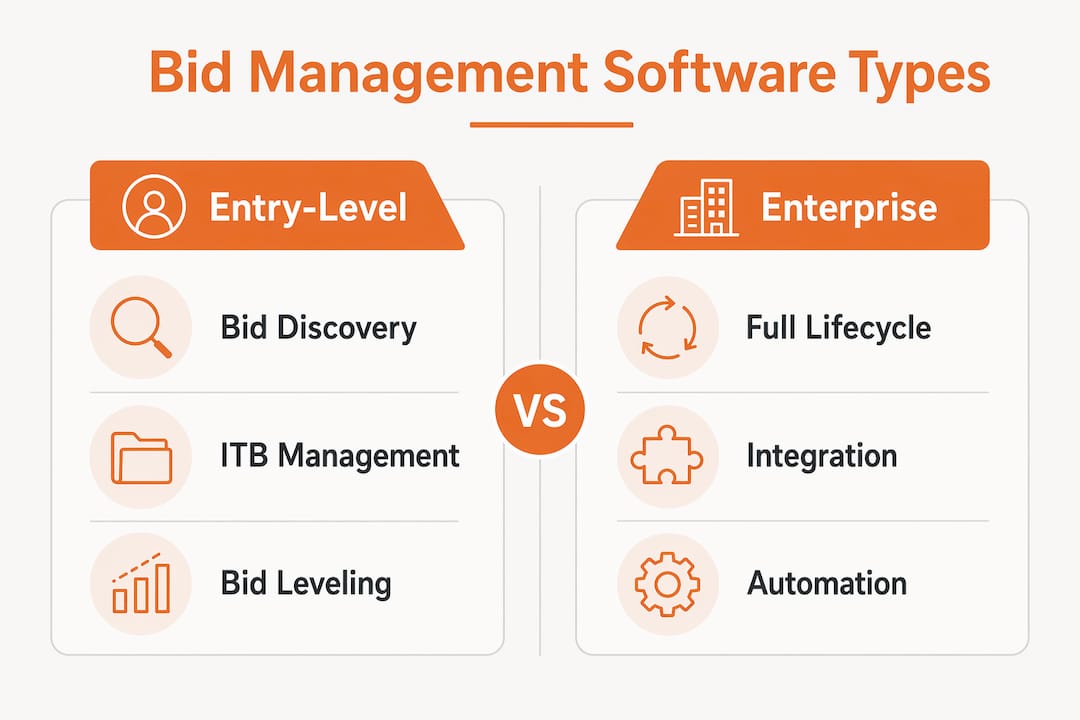
Entry-level field apps often handle one or two of these functions. Enterprise platforms bundle all four with integrations to accounting and project management systems. Neither is automatically better. The right fit depends on your project size, your team’s current pain points, and your budget.
If your team spends most of its time hunting for work, a bid discovery tool solves that problem first. If you manage 30 or more subcontractors per bid, ITB management and leveling tools pay for themselves quickly. If you want one system that handles everything and feeds data into your CRM, a full-lifecycle platform is the right direction.
You can also read about the differences between bids and estimates to clarify which part of your process needs the most attention before you commit to a platform.
What are the real benefits of bid management software?
The benefits of bid management software are measurable, not theoretical. Automated bid management reduces bid preparation time by up to 75% by handling administrative tasks. That time savings means your estimators spend their hours on pricing and scope review, not formatting documents and chasing email replies.
The capacity gain is equally significant. Contractors using automation can double their bid output without adding headcount. That means more opportunities in the pipeline without burning out your team.
Risk reduction is the third major benefit. Digital bid platforms reduce estimation and scope errors by up to 90% through normalized proposal comparison and automated compliance checks. Scope gaps are the most common source of margin erosion on construction projects. Catching them before award protects your profit.
Pro Tip: Track your win rate and average bid turnaround time before you implement any software. You need a baseline to measure ROI. Without it, you’re guessing whether the tool is working.
ROI calculation involves comparing your current bid labor costs and win rates against projected improvements after adoption. Most contractors who track this data find the software pays for itself within the first few months. The key is measuring consistently, not just at launch.
For a broader view of how software investments pay off, the CRM benefits for construction businesses article covers related ROI patterns across the full project lifecycle.
How do you implement bid management software successfully?
Most implementations fail because of process problems, not software problems. Successful adoption depends on change management. You need to map and simplify your manual processes before you automate them. Digitizing a broken workflow just makes the broken workflow faster.
Here are the most common pitfalls and how to avoid them:
- Skipping process mapping. Before you configure anything, document every step your team currently takes on a bid. Identify redundant steps and remove them. Then automate what remains.
- Inconsistent data entry. Without quality data input, analytics features become useless. Assign one person to own data standards. Require won/lost reasons and cost variance notes on every closed bid.
- Treating software as a shortcut. The platform organizes your process. It does not create one. Teams that skip training and jump straight to using the tool see low adoption within 60 days.
- Ignoring post-bid analytics. Win/loss ratios and turnaround times are the metrics that tell you whether your bidding strategy is working. Review them monthly, not quarterly.
A practical implementation timeline looks like this: spend the first two weeks mapping your current process, the next two weeks configuring the platform to match it, and the first full month running live bids with a designated team lead who owns adoption. Fencing and specialty contractors can find additional context on phased implementation in this fencing project management guide, which covers bid system rollout across trade-specific workflows.
Key Takeaways
Bid management software delivers measurable gains in speed, accuracy, and bid volume only when contractors pair it with disciplined process and consistent data input.
| Point | Details |
|---|---|
| Definition matters | Bid management covers the full bid lifecycle, not just writing a price and submitting it. |
| Choose by bottleneck | Select the platform type that solves your biggest pain point: discovery, ITB, leveling, or full lifecycle. |
| Time and capacity gains | Automation cuts bid prep time by up to 75% and can double output without adding staff. |
| Error reduction | Normalized bid leveling reduces scope and estimation errors by up to 90%, protecting your margins. |
| Data quality drives ROI | Consistent input of won/lost data and cost variances makes analytics features actually useful. |
Why bid management is an operations problem, not a software problem
I’ve watched contractors buy expensive platforms and see zero improvement in their win rates six months later. The software wasn’t the problem. Their process was.
Bid management is an operational process, not just bid writing. That distinction is the one most contractors miss. When you treat bidding as a writing task, you focus on the proposal document. When you treat it as an operational process, you focus on the system that produces consistent, accurate proposals at volume. The software supports the second approach. It cannot create it.
The contractors I’ve seen get the most out of these tools share one habit: they track everything. Win rates, turnaround times, sub response rates, cost variances. Metrics-driven decision making is what separates teams that improve their bidding year over year from teams that stay flat. The software gives you the data. You have to use it.
My honest advice is to resist the urge to automate everything on day one. Pick the one function that costs your team the most time right now. Get that working well. Then expand. Contractors who try to flip their entire bid process in a single month almost always end up reverting to spreadsheets by month three.
— Rowena
How Highlevelcrm-rconstructionsolutions supports your bidding process
Winning more bids requires more than a submission platform. It requires a system that connects your bid pipeline to your lead tracking, project follow-up, and client communication in one place.
Highlevelcrm-rconstructionsolutions was built with over 30 years of construction experience behind it. It offers automated lead tracking, custom reporting dashboards, and workflows designed specifically for contractors. Some users report lead conversion rate increases of 35% after integrating their bid and CRM workflows. The platform connects bid activity directly to project management, so nothing falls through the cracks between winning a job and starting it. See the full range of contractor solutions available for your trade and project type.
FAQ
What does bid management software do?
Bid management software handles the full construction bidding process, from finding opportunities and distributing bid packages to leveling subcontractor proposals and tracking submissions. It reduces manual administrative work and improves bid accuracy.
How is bid management different from bid writing?
Bid management covers the entire operational process including strategy, planning, subcontractor coordination, review, and submission. Bid writing is just one step within that larger process.
What are the four types of bid management software?
The four main types are bid discovery, ITB management, bid leveling, and full-lifecycle platforms. The right choice depends on where your team’s biggest bottleneck sits.
How long does it take to see ROI from bid management software?
Most contractors see measurable ROI within the first few months when they track baseline metrics before implementation and maintain consistent data entry after launch.
Can bid management software replace an estimator?
No. Bid management software manages the process around an estimate but cannot replace accurate cost estimating. Poor estimates produce losing bids regardless of how well the submission process runs.

