
Construction Bid vs. Estimate: A Contractor’s Guide | High Level CRM - R. Construction Solutions
A construction estimate is a flexible, internal calculation of projected project costs, while a construction bid is a formal, fixed-price offer submitted externally to win a contract. Getting the construction bid versus estimate explained correctly is not just a terminology exercise. Mixing up these two documents creates real legal and financial exposure. Bills exceeding original estimates by 30–50% without client approval are among the most common triggers for contractor disputes in the U.S. Understanding which document you are producing, and when, protects your business and your client relationships.
What is a construction estimate and how is it used?
A construction estimate is an internal cost projection that covers labor, materials, equipment, overhead, and contingencies. It is not a promise. It is a planning tool that can be revised as the project scope becomes clearer.
Estimates come in three main forms:
- Preliminary estimate: Produced early in design, often from square footage or historical data. Accuracy is low, but it gives the owner a budget range.
- Detailed estimate: Built from complete drawings and specifications. It breaks down every cost line by line and is the basis for a final bid.
- Quantity-based estimate: Uses a formal quantity takeoff, measuring every material and labor unit from the plans. This is the most accurate form before a bid is submitted.
Estimates are not legally binding as a final price. That said, they must stay reasonable. Correct terminology prevents thousands of dollars in disputes annually. If you hand a client a document labeled “estimate” but price it like a fixed bid, you create confusion about what is negotiable.
When to use an estimate versus a bid: Use an estimate during pre-construction, design development, or owner budgeting phases. Use a bid when the scope is fully defined and you are competing for a contract.

Pro Tip: Label every document clearly. Write “Preliminary Estimate — Subject to Change” or “Formal Bid — Fixed Price” at the top. That single line prevents most terminology disputes before they start.
What is a construction bid and how does it work?
A construction bid is a formal, external proposal submitted in response to a Request for Proposal (RFP) or Invitation to Bid (ITB). Once a client accepts a bid, it becomes legally binding. The price, scope, and schedule are fixed unless a formal change order modifies them.
The construction bidding process follows a defined sequence. Here is how it works in practice:
- Receive the bid documents. Review the drawings, specifications, and contract terms before committing to bid.
- Conduct a go/no-go assessment. Strategic evaluation goes beyond price. Assess your crew capacity, current workload, and expertise before pursuing a project.
- Complete the quantity takeoff. Measure every material and labor unit from the plans. Errors here compound through every step that follows.
- Solicit subcontractor quotes. Start outreach within 24–48 hours of deciding to pursue a project. Waiting until the last week forces rushed, inaccurate numbers.
- Level the subcontractor bids. Compare quotes on equal scope before selecting the lowest price.
- Apply markup and finalize pricing. Build in overhead, profit, and risk contingency.
- Submit before the deadline. Late bids are disqualified without exception.
Bid day checklist essentials:
- Confirm all subcontractor quotes are received and leveled
- Verify the bid form matches the owner’s required format
- Double-check your bond and insurance certificates are current
- Confirm your license number is included where required
- Submit via the specified method, whether digital portal or sealed envelope
Pro Tip: A qualified subcontractor list can cut your outreach time to as little as 20 minutes per trade. Build and maintain that list between bids, not during them.
Key differences between bids and estimates
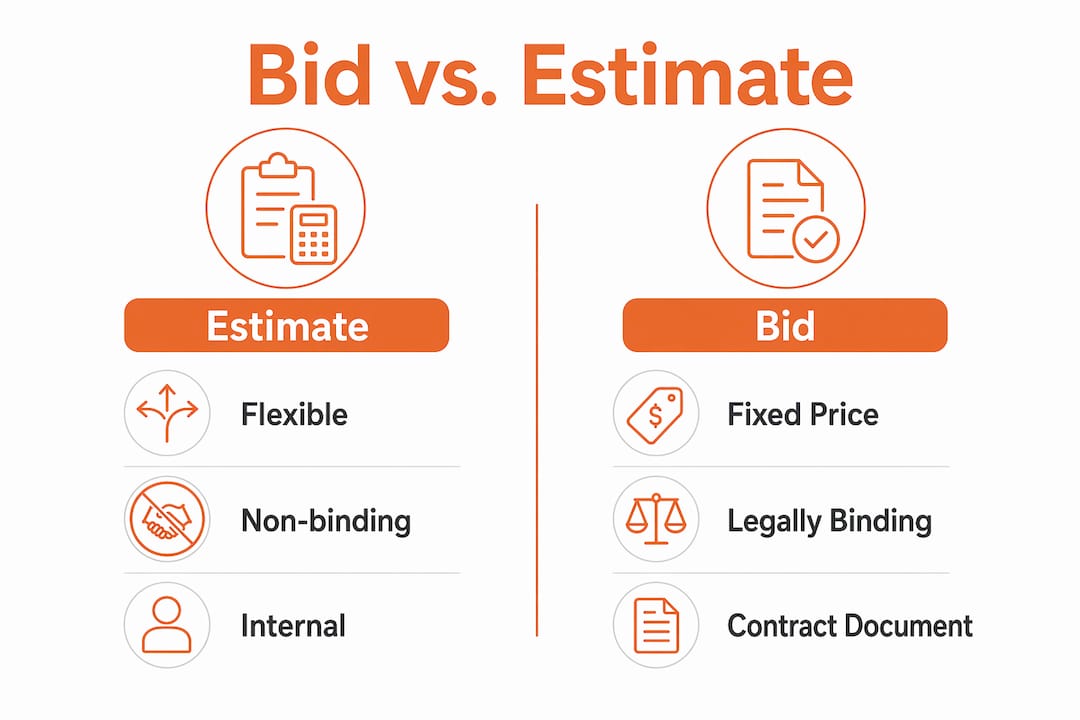
The difference between a bid and an estimate touches three distinct areas: legal standing, financial risk, and project management.
Legal implications
An estimate carries no binding obligation on price. A bid, once accepted, is a contract. Most U.S. states recommend written contracts for jobs above $500–$1,000. If you submit a bid and the client accepts it in writing, you are committed to that price regardless of cost increases, unless a change order is executed.
Financial risk
Estimates allow flexibility. If material prices shift or scope grows, you can revise the estimate before a bid is submitted. A bid locks in your numbers. That means every pricing error in your estimate becomes a real loss once the bid is accepted.
“Takeoff, estimates, and bids form an unbroken dependency chain. Errors in early quantity takeoff compound throughout estimates and lead to losing bids or unprofitable jobs.”
Impact on change orders and client communication
Clients who receive an estimate often expect the final price to be close to that number. Clients who receive a bid expect the price to be exact. Mixing up these documents creates misaligned expectations. When a project runs over budget, the first question is always: “Was that a bid or an estimate?” If you cannot answer clearly, you are in a dispute.
| Factor | Estimate | Bid |
|---|---|---|
| Legal binding | Not binding | Binding on acceptance |
| Price flexibility | Adjustable as scope develops | Fixed to defined scope |
| Primary audience | Internal planning, owner budgeting | External, client-facing proposal |
| Document trigger | Design phase, pre-construction | Defined scope, RFP or ITB |
| Change order exposure | Low, scope still fluid | High, any change requires formal order |
The most common misunderstanding is treating a detailed estimate as a bid. A detailed estimate is still an internal document. It becomes a bid only when you formalize it, attach contract terms, and submit it to a client as a fixed-price offer.
Best practices for accurate estimates and competitive bids
Accuracy in estimating construction costs starts with the quantity takeoff. Takeoff accuracy is critical to reliable estimates and competitive bids. A 5% error in your takeoff can mean the difference between winning a profitable job and losing money on every unit installed.
Subcontractor quote management:
- Solicit at least 3 quotes per trade as a minimum standard
- For high-value or high-risk trades, collect 5–6 quotes to improve leveling data
- Never select a subcontractor on price alone before leveling the scope
Bid leveling normalizes multiple subcontractor quotes to a single scope baseline. Without it, you are comparing apples to oranges. One sub may exclude mobilization, another may exclude cleanup. Selecting the lowest number without leveling creates scope gaps that turn into costly change orders.
Markup versus margin: the most expensive math error in construction:
| Pricing Method | Cost | Markup Applied | Actual Margin |
|---|---|---|---|
| 25% markup on $100,000 | $100,000 | $25,000 | 20% |
| 33% markup on $100,000 | $100,000 | $33,000 | 25% |
| 50% markup on $100,000 | $100,000 | $50,000 | 33% |
A 25% markup on costs does not yield a 25% profit margin. It yields approximately 20%. Contractors who confuse markup with margin systematically underprice their work. Over a full year of projects, that gap erodes profitability in a way that is hard to recover from.
Pro Tip: Always calculate your target margin first, then back-calculate the required markup. If you need a 25% margin, apply a 33% markup to your costs. Use construction-specific tools that handle this math automatically to remove human error from your pricing.
Key Takeaways
A construction estimate is a flexible planning tool, while a bid is a fixed-price legal commitment. Confusing the two costs contractors money, clients, and contracts.
| Point | Details |
|---|---|
| Estimates are not binding | Label estimates clearly to set correct client expectations and avoid price disputes. |
| Bids are legally binding | Once accepted, a bid locks in price and scope; change orders are the only path to adjustment. |
| Takeoff accuracy drives everything | Errors in quantity takeoff compound through estimates and produce losing or unprofitable bids. |
| Markup is not margin | A 25% markup yields roughly 20% margin; calculate target margin first, then set markup accordingly. |
| Bid leveling prevents scope gaps | Normalize all subcontractor quotes to the same scope before selecting the lowest price. |
What I’ve learned from years of watching bids go wrong
The most expensive mistake I see contractors make is not a math error. It is a communication error. A contractor hands a client a detailed estimate, the client treats it as a fixed price, and six weeks later the invoice is 40% higher. Nobody wins that argument.
The fix is simple but rarely practiced consistently. Every document you send a client should state its status in plain language. “This is a preliminary estimate based on current scope. Final pricing will be provided in a formal bid once drawings are complete.” That sentence alone has saved more contractor-client relationships than any contract clause.
The second pattern I see constantly is contractors skipping the go/no-go step. They receive an RFP, assume they can handle it, and spend 40 hours building a bid for a project that would stretch their crew past capacity. Bid strategy must include resource capacity assessments, not just price competition. Winning a job you cannot staff properly is worse than losing the bid.
Technology has changed this process significantly. Contractors who use a construction workflow platform to manage their estimate-to-bid pipeline catch errors earlier, communicate more clearly with clients, and submit bids with more confidence. The contractors still doing this in spreadsheets and email threads are leaving money on the table every single bid cycle.
— Rowena
How Highlevelcrm-rconstructionsolutions supports your estimate-to-bid workflow
Accurate estimates and competitive bids require organized data, fast subcontractor communication, and clear client records. Highlevelcrm-rconstructionsolutions was built with over 30 years of construction experience behind it, specifically to address the gaps that generic tools miss.
The platform centralizes your subcontractor contacts, automates bid solicitation tracking, and gives you custom reporting dashboards that show where your estimates and bids stand at any moment. Contractors using Highlevelcrm-rconstructionsolutions report lead conversion rate increases of 35%. That kind of result comes from having accurate numbers and clear communication at every stage of the bid cycle. Explore the full CRM features and FAQs to see how the platform fits your estimating and bidding workflow.
FAQ
What is the difference between a bid and an estimate?
A construction estimate is a flexible, internal cost projection used during planning. A bid is a formal, fixed-price offer submitted to a client that becomes legally binding on acceptance.
Is a construction estimate legally binding?
A construction estimate is not legally binding as a final price. However, bills that exceed the original estimate by 30–50% without prior client approval commonly trigger disputes and legal action.
How many subcontractor quotes should I get per trade?
The minimum standard is 3 quotes per trade. For high-value or high-risk trades, collecting 5–6 quotes provides better leveling data and reduces the risk of selecting a subcontractor who cannot perform.
What is bid leveling and why does it matter?
Bid leveling normalizes multiple subcontractor quotes to the same scope baseline. Without it, you risk selecting a low-priced quote that excludes key work items, which creates scope gaps and costly change orders after award.
What is the difference between markup and margin in construction bidding?
Markup is the percentage added to your costs. Margin is the percentage of the final price that is profit. A 25% markup on costs yields approximately 20% margin, not 25%. Confusing the two leads to systematic underpricing across every project you bid.