Commercial Construction Reporting: Project Management & Financial Control | High Level CRM - R.
Commercial construction reporting is the systematic process of tracking, documenting, and communicating project progress, costs, risks, and contractual obligations across every phase of a commercial build. Without it, project managers lose visibility into cost overruns before they become irreversible, stakeholders make decisions on outdated data, and legal disputes go undefended. This guide covers what commercial construction reporting actually involves, the core report types you need, how job costing ties into financial control, and the frameworks that separate reactive teams from proactive ones.
What is commercial construction reporting and why does it matter?
Commercial construction reporting, known in project controls as construction project reporting, is the structured capture and communication of critical project data to support decision-making, financial control, and contractual compliance. It is not simply paperwork. Construction reporting is a decision-support mechanism that transforms raw field data into insights that drive resource allocation and risk management.
The stakes are real. Nearly 60% of construction firms face cash flow challenges worsened by poor financial reporting integration. That figure reflects a systemic failure to connect field activity with financial systems, not just a bookkeeping problem. When your site data and cost data live in separate silos, you are always managing yesterday’s project.

Effective reporting covers four core functions: progress tracking against schedule, cost control against budget, risk identification and mitigation, and stakeholder communication. Each function depends on a different set of reports, and each report serves a different audience, from field supervisors to bonding companies to owners.
What are the main types of commercial construction reports?
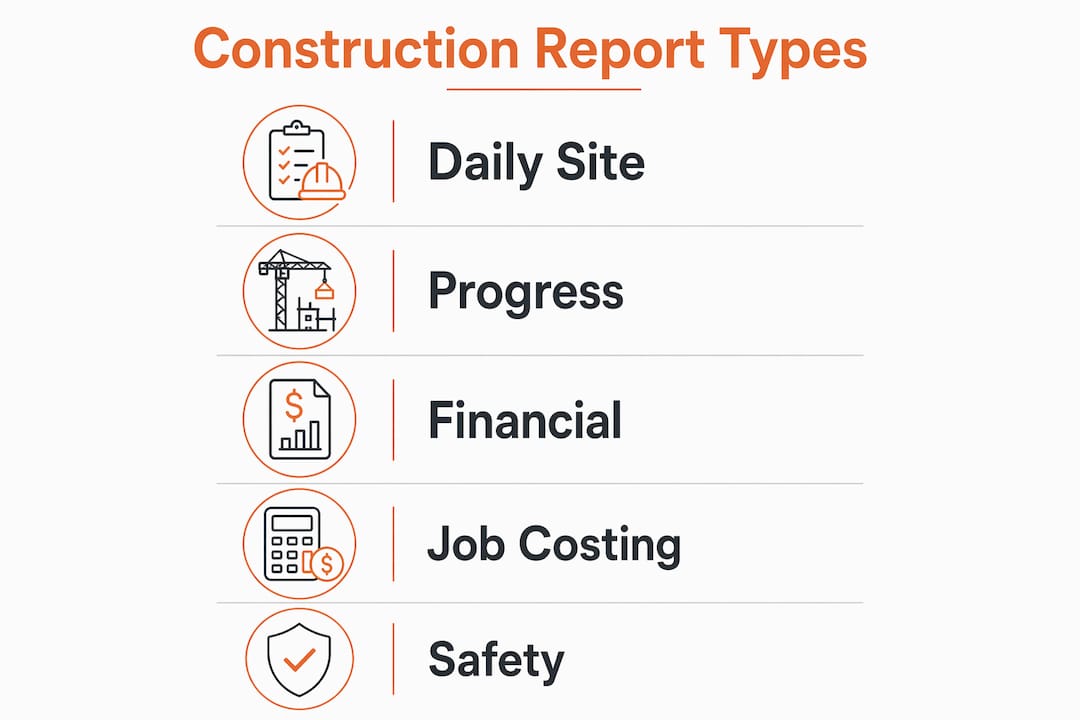
Commercial projects generate several distinct report categories, each with a specific purpose, audience, and frequency. Understanding the full commercial building report overview helps you prioritize which reports demand the most rigor.
Here is a comparison of the core report types used in commercial construction:
| Report type | Frequency | Primary audience | Key data points |
|---|---|---|---|
| Daily site report | Daily | Site supervisor, PM | Labor hours, equipment, weather, incidents |
| Progress report | Weekly/monthly | Owner, PM, lender | Schedule status, milestones, percent complete |
| Safety report | Weekly | Safety officer, owner | Incidents, near-misses, inspections, corrective actions |
| Quality report | Per inspection | QA/QC team, owner | Deficiencies, test results, punch list items |
| Financial/WIP report | Monthly | CFO, bonding company, lender | Cost to date, percent complete, projected margin |
| Claims/commercial report | As needed | Legal, PM, owner | Delay events, change orders, contract compliance |
Daily site reports carry more weight than most project managers realize. Contemporaneous records documented on the day of events provide critical evidence in inspections, arbitration, and court proceedings. A daily log written three weeks after the fact is nearly worthless in a dispute.
Progress reports serve a different function. They translate raw schedule data into a narrative that owners and lenders can act on. A well-written progress report does not just list completed tasks. It flags schedule risks, explains variances, and recommends corrective actions before the next reporting period.
Financial reports, particularly Work-in-Progress (WIP) reports, sit at the intersection of project management and corporate finance. Inaccurate WIP reports can cause bonding and credit issues, which directly threatens your ability to bid future work. Accuracy here is not optional.
How does job costing integrate with construction financial reporting?
Job costing is the financial backbone of commercial construction reporting. It is the process of tracking every dollar spent on a project against a specific cost code, then comparing that spend to the original estimate and the revised forecast.
Job costing answers four critical questions every week: How much have we spent to date? How does that compare to budget? What is our estimate at completion (EAC)? And what is our projected margin? These four questions, answered accurately and consistently, give project managers the financial visibility they need to intervene before a project goes underwater.
Job cost categories in commercial construction typically include:
- Labor: Direct field labor hours multiplied by burdened labor rates
- Materials: Purchased materials tracked against material budgets by cost code
- Subcontractors: Committed costs, invoiced amounts, and retainage balances
- Equipment: Owned or rented equipment costs allocated to the project
- Overhead: Allocated general conditions and indirect project costs
The frequency of reporting matters as much as the accuracy of the data. Weekly job cost reports are crucial to detect margin issues early. Monthly reporting often comes too late to prevent cost overruns. By the time a monthly report surfaces a problem, you may have already lost two to four weeks of corrective action time.
Job cost data also feeds directly into WIP reports and company-level financial statements. If your cost codes are inconsistent or your subcontractor invoices are not matched against committed costs, your WIP schedule will misrepresent project health to your bonding company and lender.
Pro Tip: Set a weekly deadline for all cost entries, subcontractor invoice approvals, and labor hour submissions. A job cost report is only as accurate as the data feeding it. One week of missing entries can distort your EAC by a significant margin on a large commercial project.
For a deeper look at where job costing goes wrong in the field, the breakdown of common job costing mistakes in trade contracting is worth reviewing before you finalize your cost code structure.
What are the best practices for improving construction reporting accuracy?
The most effective framework for organizing construction reporting operations is the Project Reporting Operations (PRO) model. The PRO framework structures the reporting cycle into five phases that reduce manual errors and align stakeholders around a single version of project truth.
- Capture: Collect raw data at the source. Field supervisors log daily activity, foremen submit labor hours, and subcontractors submit progress updates. The capture phase sets the quality ceiling for everything downstream.
- Compile: Aggregate captured data into structured reports. This is where templates, cost code alignment, and data validation happen. Manual compilation at this stage is the single largest source of reporting errors.
- Circulate: Distribute reports to the right stakeholders at the right time. A safety report sent to the owner two weeks late is not a safety report. It is a liability.
- Consume: Stakeholders review and act on report findings. This phase requires that reports are formatted for their audience. A lender reads a WIP schedule differently than a site superintendent reads a daily log.
- Continuous Improvement: Review reporting processes after each project phase. Identify where data was late, inaccurate, or misunderstood, and adjust templates and workflows accordingly.
Automated, integrated platforms eliminate many of the manual errors common in the Compile and Circulate phases. Cloud-based construction management tools that connect field data to financial systems give project managers real-time visibility rather than a snapshot that is already 30 days old.
Financial reports disconnected from field operations are often too late to prevent overruns. Real-time integration between cost data and site execution is what separates proactive project management from reactive damage control.
Standardized templates and workflows also protect margins by keeping all stakeholders working from the same facts. When your field team uses one format and your accounting team uses another, reconciliation becomes a weekly fire drill.
Pro Tip: Never compile a financial report manually from multiple spreadsheets if a connected platform is available. Manual compilation introduces transcription errors, version conflicts, and time delays that compound across a project’s lifecycle. Even a basic integration between your project management software and your accounting system reduces these risks substantially.
What challenges do project managers face in construction reporting?
Even experienced project managers run into recurring reporting problems on commercial projects. Recognizing the warning signs early is the difference between a correctable variance and a project loss.
Common warning signs and their corrective actions include:
- Delayed data submissions: Field teams submit daily logs days after the fact. Fix this by making same-day submission a contract requirement for foremen and subcontractors, with a defined escalation path for non-compliance.
- Disjointed systems: Cost data lives in one platform, schedule data in another, and field reports in email threads. Fix this by mapping your data flows and identifying where a single integration would eliminate the most manual handoffs.
- Inaccurate financial tracking: Subcontractor invoices are approved without matching against committed costs. Fix this by implementing a three-way match process: purchase order, delivery confirmation, and invoice.
- Stakeholder misalignment: The owner’s representative and the project manager are working from different versions of the progress report. Fix this by establishing a single distribution list and a locked report format that cannot be edited after circulation.
- Failure to update estimates: Profit leaks accumulate when project managers do not revise their EAC as conditions change. Fix this by requiring a formal EAC update every time a change order is executed or a significant scope variance is identified.
The legal dimension of these challenges is often underestimated. Commercial reports function as legal evidence and contract compliance records. A contemporaneous daily log documenting a weather delay, a changed condition, or an owner-directed acceleration is your primary defense in a dispute. Teams that treat daily reporting as optional administrative work discover its value only after a claim goes to arbitration.
Understanding how integrated CRM systems address cash flow tracking and project communication can help you close the gap between field operations and financial reporting faster than building custom integrations from scratch.
Key takeaways
Effective commercial construction reporting requires weekly job costing, standardized templates, real-time data integration, and contemporaneous field documentation to protect margins and support legal compliance.
| Point | Details |
|---|---|
| Report types serve distinct roles | Daily logs, WIP reports, and safety reports each target different audiences and require different data inputs. |
| Weekly job costing is non-negotiable | Monthly cost reporting arrives too late to prevent overruns; weekly EAC updates catch margin issues early. |
| PRO framework structures the cycle | Capture, Compile, Circulate, Consume, and Continuous Improvement reduce errors and align stakeholders. |
| Contemporaneous records carry legal weight | Daily reports written on the day of events are admissible evidence in disputes and arbitration. |
| Integration eliminates manual error | Connecting field data to financial systems removes the transcription and version errors that distort WIP reports. |
Why reporting is the most undervalued skill in commercial construction
I have worked alongside project managers who could read a set of drawings in minutes but struggled to explain their own WIP schedule to a bonding agent. That gap costs contractors real money, and it is more common than the industry admits.
The conventional view treats reporting as administrative overhead, something you do after the real work is finished. That framing is wrong. A well-maintained job cost report is a management tool. It tells you where your project is headed before you arrive there. A daily log is not just a record. It is your legal defense, your change order support, and your proof of performance.
What I have seen work consistently is treating the reporting cycle the same way you treat a safety program. You build it into the culture, you train people on it, and you hold the team accountable for it. When a foreman understands why their daily log matters to the project’s financial outcome, they fill it out completely. When they think it is just paperwork for the office, they fill it out minimally.
The technology has improved dramatically. Platforms that connect field activity to financial systems in real time have removed most of the excuses for late or inaccurate reporting. The remaining barrier is discipline, and that starts with project leadership setting the standard on day one of a project.
My advice: review your last three projects and count how many times a reporting failure contributed to a cost overrun, a delayed change order, or a dispute. The number will be higher than you expect. That is your business case for investing in better reporting processes.
— Rowena
How Highlevelcrm-rconstructionsolutions supports your reporting workflow
Highlevelcrm-rconstructionsolutions was built with over 30 years of construction experience behind it, which means the reporting and tracking features reflect how commercial projects actually run, not how software developers imagine they run. The platform centralizes financial data, subcontractor communications, and project reporting into a single dashboard, so your team stops reconciling spreadsheets and starts managing projects.
Contractors using Highlevelcrm-rconstructionsolutions report significant reductions in project management time and errors, with some users seeing lead conversion rate increases of 35%. If you are ready to connect your field operations to your financial reporting without building custom integrations, explore the full CRM features and FAQs to see how the platform fits your workflow. You can also review the industries we serve to see how other commercial contractors are using it today.
FAQ
What is commercial construction reporting?
Commercial construction reporting is the systematic documentation and communication of project progress, costs, safety, and contractual compliance on commercial building projects. It serves as both a management tool and a legal record throughout the project lifecycle.
How often should job cost reports be generated?
Job cost reports should be generated weekly, not monthly. Weekly reporting catches margin issues and cost variances early enough to take corrective action before they compound into project losses.
What is a WIP report in construction?
A Work-in-Progress (WIP) report tracks cost to date, percentage of completion, and projected margin for active projects. Lenders and bonding companies rely on WIP reports to assess financial health, and inaccurate WIP schedules can affect your bonding capacity.
Why do daily site reports matter legally?
Daily site reports documented on the day of events serve as contemporaneous evidence in disputes, arbitration, and court proceedings. They support delay claims, changed condition notices, and contract compliance defenses in ways that reconstructed records cannot.
What tools improve commercial construction reporting accuracy?
Integrated cloud platforms that connect field data to financial systems, such as construction management software paired with a purpose-built CRM like Highlevelcrm-rconstructionsolutions, reduce manual compilation errors and give project managers real-time cost visibility. Standardized report templates and automated distribution workflows further reduce errors across the reporting cycle. For trade contractors, reviewing job costing fundamentals before selecting a platform helps you match the tool to your actual cost tracking needs.