
Construction CRM Benefits for Chicago Contractors Explained
A construction CRM is defined as a customer relationship management system built specifically for the workflows, sales cycles, and project relationships that define the construction industry. For Chicago contractors, the construction CRM benefits explained in this article cover everything from lead response speed to project delay reduction, giving you a clear picture of what this software actually does for your bottom line. Highlevelcrm-rconstructionsolutions reports that contractors using purpose-built CRM systems save up to 15 hours weekly on administrative tasks, with ROI appearing within 3 to 6 months of full adoption. In a market as competitive as Chicagoland, that efficiency gap is the difference between winning bids and watching them go to the contractor down the street.
How does a construction CRM improve lead management for Chicago contractors?
Lead management is where most Chicago contractors lose money without realizing it. A lead comes in from a Google ad or referral, sits in an inbox for two hours, and by the time someone follows up, the homeowner or developer has already booked a competitor. Responding within 5 minutes dramatically increases lead conversion rates. Waiting beyond one hour reduces your chances of reaching that lead to near zero.
A construction CRM automates the first touch. The moment a lead submits a form, calls your office, or sends a text, the system triggers an immediate response sequence across email, SMS, and phone. You never rely on a team member remembering to follow up. The CRM tracks every interaction, timestamps every touchpoint, and flags leads that have gone cold.
Inconsistent follow-up is the largest cause of lost leads in construction, not low demand. Automated multi-touch sequences fix that by keeping your company visible through the entire decision window, which for larger commercial projects can stretch weeks.
Here is what a CRM-driven lead process looks like in practice:
- Instant acknowledgment: An automated text or email goes out within 60 seconds of a new inquiry, confirming receipt and setting expectations.
- Scheduled follow-up sequence: The system queues calls, texts, and emails at set intervals so no lead ages past 24 hours without contact.
- Lead scoring: Contacts are ranked by engagement level, so your sales team focuses on the hottest opportunities first.
- Pipeline visibility: Every lead sits in a visual board showing exactly where it stands, from first contact to signed contract.
Pro Tip: Track your speed-to-first-touch metric daily. Review leads older than one hour every morning to catch follow-up gaps before they become lost jobs.
In what ways does construction CRM software boost project efficiency and reduce delays?
77% of construction projects experience significant delays tied directly to poor communication. That statistic means the majority of jobs running late in Chicago are not delayed because of weather or material shortages. They are delayed because the right information did not reach the right person at the right time.

A construction CRM centralizes all project communication in one place. Subcontractors, project managers, clients, and office staff all access the same real-time data. No one is working from a week-old email thread or a phone call that was never documented.
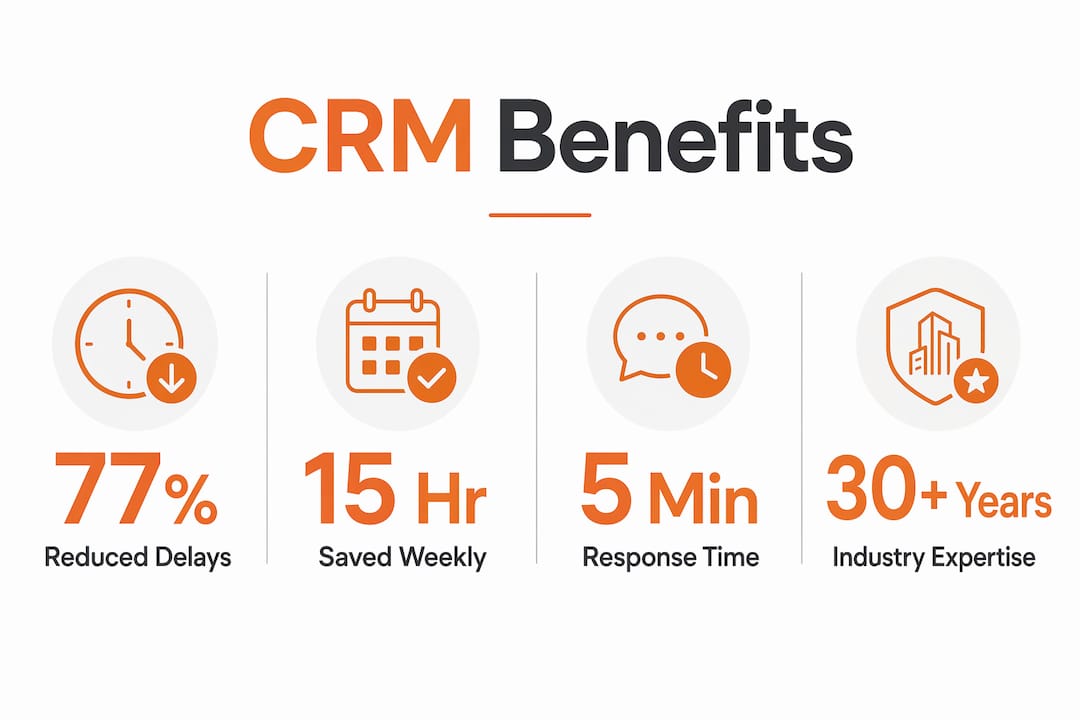
The efficiency gains are measurable. One general contractor documented in a US Tech Automations case study saw PM reporting time drop from 52 hours to 11 hours per week within 90 days of automating client progress updates. That is 41 hours per week returned to actual project management.
Here is how a construction CRM reduces project delays step by step:
- Centralized document storage: Contracts, permits, change orders, and inspection reports live in one location accessible by all authorized parties.
- Milestone tracking: The system flags upcoming deadlines and overdue tasks automatically, so nothing slips through without notice.
- Subcontractor coordination: Insurance certificates, scheduling conflicts, and scope confirmations are tracked in the CRM rather than scattered across texts and emails.
- Automated client updates: Progress reports go out on a set schedule without a PM manually writing each one, reducing client anxiety and inbound calls.
- Change order management: Requests are logged, approved, and documented inside the system, creating a clear paper trail that protects you in disputes.
Pro Tip: Mobile access is the single biggest driver of field team adoption. Choose a CRM with a strong mobile interface so your crew can update job status, upload photos, and flag issues directly from the job site without returning to the office.
What makes construction-specific CRMs different from generic CRM software?
Generic CRM platforms like those built for software sales or retail are designed around short sales cycles and simple one-to-one customer relationships. Construction does not work that way. Construction sales cycles run 6 to 18 months, involve multiple decision-makers, and require tracking relationships with owners, architects, engineers, subcontractors, and suppliers simultaneously.
This is where the concept of XRM, or extended relationship management, becomes relevant. A construction-specific CRM uses custom data models that reflect how your business actually operates. Instead of a generic “contact” and “deal,” you get fields for bid status, project phase, subcontractor insurance expiration, change order history, and contract value.
| Feature | Generic CRM | Construction CRM |
|---|---|---|
| Sales cycle support | Short (days to weeks) | Long (6 to 18 months) |
| Relationship types | Contact and deal | Owner, architect, sub, supplier |
| Document tracking | Basic file storage | Contracts, permits, change orders |
| Reporting | Revenue pipeline | Project margin, bid conversion |
| Industry integrations | General software tools | Construction-specific platforms |
The practical result is faster adoption and faster ROI. When your team opens the CRM and sees fields that match their daily work, they use it. When they open a generic platform and spend 20 minutes trying to map a bid to a “deal stage,” they abandon it.
Pro Tip: Before selecting any CRM, ask the vendor to show you how it handles subcontractor insurance tracking and change order documentation. If those workflows require heavy customization, the platform was not built for construction.
How do centralized dashboards and automated reporting add value for Chicago construction firms?
Executives at construction firms spend over 1,300 hours yearly assembling reports from disconnected spreadsheets, accounting software, and project management tools. A centralized CRM dashboard eliminates that effort by pulling all data into one view updated in real time.
For a Chicago general contractor managing five to fifteen active projects, this means knowing bid pipeline value, project margin by job, outstanding change orders, and team workload from a single screen. No more waiting for a Monday morning report that reflects data from Friday afternoon.
AI-enabled CRM systems take this further. 30% better forecasting accuracy is achievable through AI-driven analysis of historical project data, helping you predict which bids are likely to close and which projects are trending over budget before the problem becomes critical.
Automated client communication also reduces the volume of status calls your office handles. One documented case showed 74% fewer inbound status calls after automating client progress updates. Fewer calls means less interruption for your project managers and a better client experience overall.
“The shift from manual reporting to automated dashboards is not just a time-saver. It is a decision-making upgrade. When your data is current and consolidated, you stop reacting and start planning.” — Highlevelcrm-rconstructionsolutions
The CRM features and reporting tools available in construction-specific platforms give Chicago firms the visibility they need to compete on larger commercial projects where data accuracy directly affects profitability.
What practical steps can Chicago contractors take to maximize CRM benefits?
The biggest mistake contractors make with CRM adoption is trying to do everything at once. Overloading your team with data entry requirements on day one kills adoption before the system has a chance to prove its value.
Start with the minimum viable data set. For each contact, enter a name, project type, and one note about the conversation. For each project, log the address, phase, and primary contact. That is enough to start seeing the pipeline clearly without overwhelming anyone.
From there, build out in phases:
- Week 1 to 2: Set up lead capture forms and connect them to your CRM so new inquiries enter automatically without manual entry.
- Week 3 to 4: Activate automated follow-up sequences for new leads so your response time drops to under five minutes without any manual effort.
- Month 2: Add subcontractor tracking, including insurance expiration dates and scheduling notes.
- Month 3: Build your first reporting dashboard covering bid pipeline, active projects, and weekly lead volume.
Pro Tip: Assign one team member as your CRM champion. This person owns the setup, trains the crew, and monitors adoption metrics weekly. Without a dedicated owner, CRM rollouts stall at 60% adoption and never deliver full value.
Prioritize mobile functionality from the start. Field workers who can update job status from their phones are far more likely to keep records current than those who must return to the office to log notes. Automated lead follow-up combined with mobile access creates a system that works whether your team is in the office or on a job site in Wicker Park.
Key takeaways
Construction CRM systems deliver measurable, documented benefits for Chicago contractors when implemented with a clear plan and the right platform built for the industry.
| Point | Details |
|---|---|
| Speed-to-lead is critical | Responding within 5 minutes dramatically increases conversion; waiting over an hour nearly eliminates it. |
| Communication drives delays | 77% of project delays trace back to poor communication, which centralized CRM directly addresses. |
| Construction CRM differs from generic | Purpose-built platforms handle bids, change orders, and 6 to 18 month sales cycles that generic tools cannot. |
| Dashboards save executive time | Consolidated reporting eliminates over 1,300 hours of manual report assembly per year. |
| Phased adoption drives success | Starting with minimal data entry and expanding by workflow phase maximizes team adoption and ROI. |
Why Chicago contractors can’t afford to wait on CRM adoption
I have spent years working alongside contractors in markets like Chicago, where the pipeline is competitive, margins are tight, and the difference between a growing firm and a stagnant one often comes down to systems, not skill. What I keep seeing is this: contractors who lose bids are not losing them because their work is inferior. They are losing them because their follow-up is slow, their communication is fragmented, and their reporting is always a week behind reality.
The data backs this up. Automated follow-up sequences fix the inconsistency problem that costs contractors paid leads every single week. That is not a technology argument. That is a revenue argument.
What I find most contractors underestimate is the cultural side of CRM adoption. The platform matters less than whether your team actually uses it. A construction-specific CRM wins here because the fields, workflows, and reports match what your people already do. There is no translation layer between the software and the job site.
My honest recommendation: stop evaluating CRMs based on feature lists and start evaluating them based on how fast your crew can get to useful data on a phone. If the answer is more than three taps, the adoption rate will suffer. Chicago contractors who understand CRM for contractors as an operational tool rather than a sales tool are the ones seeing real returns.
Measure two things from day one: speed-to-first-touch on new leads and project delay frequency. If both improve within 90 days, your CRM is working. If they do not, your adoption process needs attention, not your platform.
— Rowena
See how Highlevelcrm-rconstructionsolutions works for Chicago builders
Highlevelcrm-rconstructionsolutions was built with over 30 years of construction industry experience behind it, which means the features you get are the ones contractors in Chicago actually need. Automated lead tracking, mobile-ready project updates, subcontractor management, and custom reporting dashboards are all included without requiring months of configuration.
If you are ready to cut administrative time, respond to leads faster, and get real-time visibility across every active project, explore the platform and see how it fits your operation. You can also review the full CRM features and FAQs to understand exactly what is included before you commit.
FAQ
What is a construction CRM and how does it differ from regular CRM software?
A construction CRM is a customer relationship management platform designed for the long sales cycles, multi-party relationships, and project-based workflows specific to construction. Unlike generic CRM tools, it includes modules for bids, change orders, subcontractor tracking, and project milestone management.
How fast should Chicago contractors respond to new leads?
Lead response under 5 minutes significantly increases the likelihood of conversion. Waiting more than one hour reduces your chances of reaching the lead to near zero, making automated response sequences a practical necessity.
How much time can a construction CRM save per week?
CRM users in construction save up to 15 hours weekly on administrative tasks, with some project managers reducing reporting time from 52 hours to 11 hours per week after automating client updates.
Can a construction CRM reduce project delays?
Yes. Since 77% of construction delays are tied to poor communication, centralizing project information and automating status updates directly reduces the frequency and severity of those delays.
Is a construction CRM worth it for smaller Chicago contractors?
A construction CRM delivers ROI within 3 to 6 months for most users, and the lead management benefits apply regardless of company size. Even a two-person operation loses revenue from slow follow-up, which automated CRM sequences fix immediately.