
HVAC Quote Template and Pricing Guide for Contractors
A winning HVAC quote delivers scope, itemized pricing (labor, materials, equipment, permits, and subcontractors), project timelines, exclusions, and clear acceptance terms in one signed document that converts directly into a work order.
The short version: your client signs or digitally accepts the quote, and that acceptance authorizes you to proceed. Without a signature block and defined validity period, you have a price list, not a contract.
Every HVAC quote must include:
- Unique quote reference number and issue date
- Itemized cost breakdown (labor, materials, equipment, permits, taxes, contingency)
- Defined scope with explicit exclusions and assumptions
- Quote validity period and payment terms
- Warranty statement
- Acceptance/signature block
Table of Contents
- What goes into every HVAC quote?
- How do you price labor, materials, and markup correctly?
- Which estimating method fits your job type?
- How long does it take to prepare and deliver an HVAC quote?
- How do you present a quote that actually wins the job?
- A ready-to-use HVAC quote template
- When should you adopt estimating software or a CRM?
- How does High Level CRM address HVAC quoting bottlenecks?
- What mistakes should you fix before sending a quote?
- How do you follow up and analyze lost bids?
- Key Takeaways
- The real cost of an inconsistent quoting process
- High Level CRM gives your quoting process a real operational backbone
- Useful sources and further reading
What goes into every HVAC quote?
A consistent line-item structure protects your margin and makes disputes easier to resolve. Build every quote around these two layers.
Cost line items:
- Labor: technician hours × burdened rate (wages + payroll taxes + benefits + overhead allocation)
- Materials: vendor price + freight + purchasing overhead + waste factor
- Equipment: purchase or rental cost, amortized into the job
- Permits and inspections: pulled from your local authority having jurisdiction (AHJ) fee schedule
- Subcontractor costs: normalized against your scope baseline before inclusion
- Taxes: applicable sales or use tax on materials per state/province
- Contingency: typically 3–10% of direct costs depending on scope certainty
Administrative and commercial items:
- Scope narrative referencing drawings, specifications, or site visit notes
- Unit rates and takeoff references for commercial bids
- Code and compliance notes (e.g., ASHRAE 90.1, local mechanical code)
- Payment milestones or net terms (Net 30 is standard; progress billing for larger jobs)
- Warranty terms (parts and labor, manufacturer pass-through)
- Change-order process and authorization threshold
How do you price labor, materials, and markup correctly?
Core pricing formulas
Labor unit cost:
Burdened hourly rate × hours per unit = labor cost per line item
Burden typically adds 25–40% on top of base wages when you include payroll taxes, workers’ comp, benefits, and shop overhead.
Landed material cost:
Vendor price + freight + purchasing overhead + waste factor = landed cost
A 5–10% waste factor is standard for ductwork and refrigerant line sets; pipe insulation often runs higher.
Markup to target gross margin:
Markup % = desired gross margin % ÷ (1 − desired gross margin %)
To hit a 35% gross margin, your markup on cost is 53.8%. Many contractors confuse markup with margin, which consistently erodes profit.
Worked example: residential split-system replacement

| Cost Category | Qty | Unit Cost | Extended |
|---|---|---|---|
| Equipment (3-ton split system) | 1 unit | — | — |
| Materials (lineset, disconnect, pad) | 1 lot | — | — |
| Permit and inspection | 1 | — | — |
| Total quoted price | $5,020 |
Pro Tip: Round your final quoted price to a psychologically comfortable number ($5,020 rather than $5,019.73). Odd-cent totals signal a rushed calculation; clean numbers signal confidence.
AI-assisted takeoff tools can significantly reduce manual quantity extraction time, allowing your estimators to spend more time on pricing strategy and less on counting duct segments.
Which estimating method fits your job type?
Choosing the wrong contract structure is one of the fastest ways to lose margin before the work starts.
- Fixed-price (lump sum): Best for defined-scope residential replacements and commercial retrofits with complete drawings. Sample clause: “Contract price is $X, inclusive of all labor and materials described in Exhibit A; changes require a written change order.”
- Time and materials (T&M): Use for service calls, diagnostic work, or emergency repairs where scope is unknown. Sample clause: “Work billed at $X/hr labor plus materials at cost + Y%; no cap unless separately agreed in writing.”
- Unit pricing: Suited to repetitive commercial work (e.g., VAV box installations, rooftop unit replacements across multiple floors). Sample clause: “Unit price of $X per VAV box installed per specification; final quantity reconciled at project close.”
- Cost-plus: Appropriate for design-build or fast-track projects where full scope is undefined at bid time. Requires open-book accounting and an agreed fee percentage.
- Allowance-based: Use when a specific material or equipment selection is pending owner decision. Sample clause: “Owner allowance of $X for equipment selection; contract price adjusts dollar-for-dollar against actual cost.”
Pro Tip: On commercial bids, always specify the change-order authorization threshold in writing (e.g., “changes under $500 may proceed verbally; all others require a signed change order before work begins”). This single clause prevents most billing disputes.
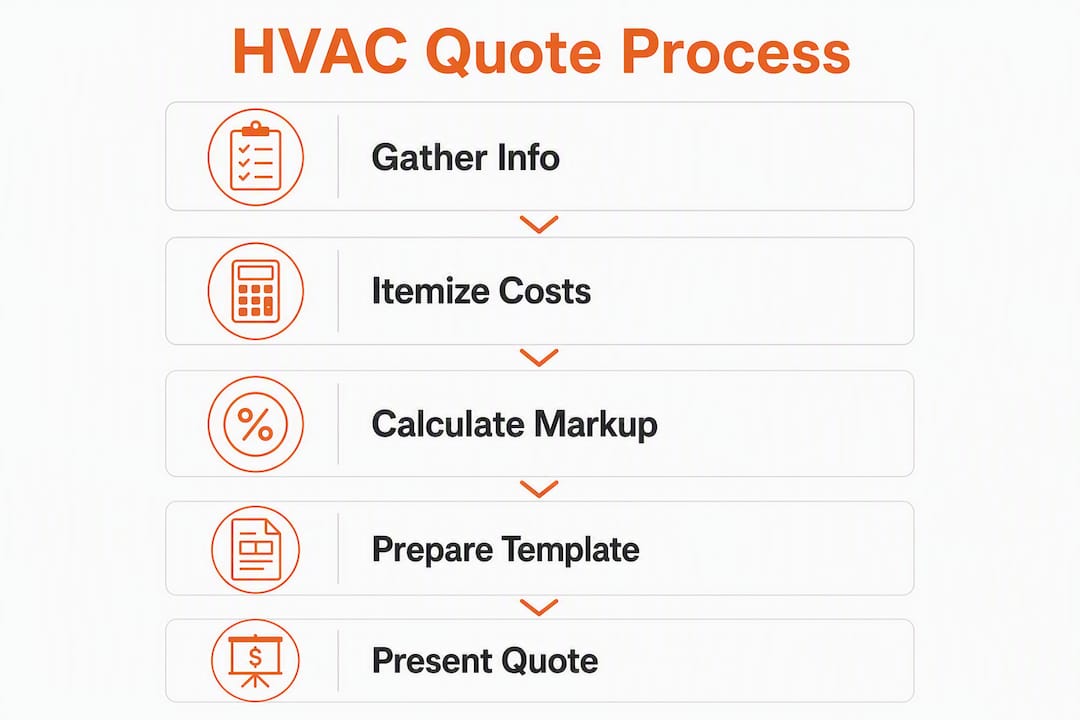
How long does it take to prepare and deliver an HVAC quote?
Turnaround expectations vary by job type, and missing them costs you credibility before the job starts.
- Service or diagnostic quote: same day or within 24 hours of site visit
- Residential replacement or retrofit: 24–48 hours after site assessment
- Light commercial (rooftop units, split systems): 2–5 business days
- Complex commercial or new construction: 5–10 business days after receipt of complete drawings
Validity periods protect you from material price swings. Standard practice:
- Residential quotes: 30 days
- Commercial quotes under $50K: 30–45 days
- Commercial quotes over $50K: 15–30 days with a material escalation clause
Pro Tip: Add a one-line escalation clause to every commercial quote over $25K: “Quoted prices are valid for 30 days from issue date; material costs are subject to adjustment if supplier pricing changes by more than 5% prior to acceptance.”
How do you present a quote that actually wins the job?
Structure and delivery matter as much as price. A quote that is hard to read is easy to reject.
- One-page executive summary up front: total price, scope in plain language, start date, and a clear “Accept” button or signature line
- Attached line-item detail for clients who want to verify the math
- Optional upgrades listed separately (e.g., extended warranty, smart thermostat, UV air purification) so the client can add value without renegotiating the base price
- Financing or maintenance agreement cross-sell as a separate line, not buried in the terms
Delivery format: PDF works for most residential clients. For commercial clients, an interactive proposal (with e-signature and a clickable acceptance) shortens the approval cycle.
Follow-up email template (send at day 3 if no response):
Pro Tip: A two-touch follow-up (email at day 3, phone at day 7) recovers more quotes than any single outreach. Most contractors give up after one attempt.
A ready-to-use HVAC quote template
Use this structure as your starting point. Adapt the line items to your scope.
[Your Company Name] | HVAC Quote Quote #: ____ | Issue Date: ____ | Valid Until: ____ Client: ____ | Site Address: ____ | Prepared By: ____
Executive Summary: Supply and install [system description] at [address] per the attached scope. Total quoted price: $____. Estimated start: ____. Estimated completion: ____.
| Line Item | Qty | Unit | Unit Cost | Extended |
|---|---|---|---|---|
| Labor (installation) | hrs | $ | $ | |
| Equipment | ea | $ | $ | |
| Materials and consumables | lot | $ | $ | |
| Permit and inspection | ea | $ | $ | |
| Subcontractor (if applicable) | lot | $ | $ | |
| Contingency | % | $ | ||
| Total | $ |
Terms and Conditions (excerpt):
- Payment: 50% deposit upon acceptance; balance due upon completion.
- Changes: All scope changes require a written change order signed by both parties before work proceeds.
- Warranty: [X] years labor, manufacturer warranty on equipment.
- Exclusions: Electrical panel upgrades, structural modifications, hazardous material removal unless explicitly listed above.
Acceptance: By signing below, client authorizes [Company Name] to proceed per the terms above.
Client Signature: _______________ Date: _________ Printed Name: _______________ Title: _________
Pro Tip: Store a master version of this template in your CRM or estimating platform so every technician pulls from the same approved format. Version control prevents the “old template” problem that causes pricing errors.
When should you adopt estimating software or a CRM?
Software pays off when manual processes create measurable bottlenecks. Watch for these triggers:
| Operational Signal | Likely Bottleneck | Software Fix |
|---|---|---|
| Quotes take more than 2 days for standard jobs | No pricebook or template library | Flat-rate pricebook + template engine |
| Follow-ups fall through the cracks | No automated reminder workflow | CRM with quote-status automation |
| Win rate unknown | No bid tracking | CRM analytics dashboard |
| Subcontractor bids inconsistent | No bid-leveling process | Estimating platform with scope normalization |
| Multi-location coordination failing | Siloed data | Cloud FSM platform |
The feature checklist that matters most for quoting:
- Flat-rate pricebook or price book library with live pricing alerts
- Takeoff integration (digital measurement tools)
- Quote-to-work-order workflow with e-signature
- Automated follow-up sequences tied to quote status
- Win/loss analytics by scope type and estimator
Recent research from ACCA and Service Nation found shops using a field-service CRM close more maintenance agreements annually and collect invoices faster versus paper tickets or QuickBooks alone. That gap compounds quickly across a full year of bids.
Entry-level tools run $49–$199/month; mid-market FSM platforms run $150–$400/user/month. Evaluate any platform as a three-year total cost of ownership, not just a monthly subscription.
Pro Tip: Avoid feature-bloat — define your current bottleneck first. If quotes go cold before follow-up, you need client-side pipeline automation, not GPS dispatch.
How does High Level CRM address HVAC quoting bottlenecks?
HighLevelCRM-RConstructionSolutions was built on 30+ years of construction industry experience, which means its workflow logic reflects how contractors actually estimate, not how software engineers imagine they do.
Quoting bottlenecks it addresses directly:
- Automated lead capture so no inbound inquiry falls through before a quote is sent
- Quote reminder sequences that trigger follow-ups without manual intervention
- Custom pricebook libraries contractors can update as supplier pricing shifts
- Accounting integrations that pull accepted quotes directly into invoicing
Three questions to decide if it fits your operation:
- Are you losing track of quotes after they leave your inbox?
- Do you lack visibility into which job types win and which lose?
- Is your current tool built for your industry, or adapted from a generic platform?
If you answered yes to two or more, a construction-specific CRM is the right next step. Some users report up to 35% improvement in lead conversion after adopting the platform’s automated quote and follow-up workflows.
Demo prep checklist:
- Pull your last 10 quotes and note which ones were followed up and which were not.
- Identify your current average quote-to-close time.
- Bring a sample estimate and your existing quote template to the demo.
Pro Tip: Establish your automated quote follow-up workflow before increasing lead spend. More leads into a broken follow-up process just means more lost revenue.
What mistakes should you fix before sending a quote?
Pre-send checklist:
- Math cross-checked (subtotals, markup, tax)
- Drawings or site notes referenced by revision number
- Allowances explicitly labeled as estimates, not fixed prices
- Permit responsibility assigned (contractor vs. owner)
- Correct tax rate applied for the job’s jurisdiction
- Validity period stated
- Signature block present
Common red flags that lose jobs or cause disputes:
- Missing scope assumptions (client assumes more than you priced)
- Double-counted labor (setup time included in both mobilization and installation line items)
- Unpriced contingencies (listed as TBD rather than a dollar amount)
- No change-order clause (every verbal scope addition becomes a free add)
- Unclear acceptance mechanics (no signature line, no deposit trigger)
Document all verbal clarifications in writing before the quote goes out. Issue a revised quote rather than an informal email when scope changes.
How do you follow up and analyze lost bids?
Follow-up sequence (7–14 day window):
- Day 1: Send quote with a brief cover note summarizing the value.
- Day 3: Email check-in (use the template from the presentation section above).
- Day 7: Phone call to address questions and confirm receipt.
- Day 14: Final email offering to adjust scope or schedule a call.
KPIs to track in your CRM:
- Quote sent to first client response (target: under 48 hours)
- Quote-to-contract conversion rate by scope type
- Average margin by job category
- Quote-to-contract velocity (days from issue to signed acceptance)
Granular CRM analysis uncovers the causes behind lost bids, letting you design targeted follow-ups and improve win rates over time. Tag every lost bid with a reason code (price, timing, competitor, no response, scope mismatch) and run a short quarterly review. Patterns emerge fast.
Pro Tip: Track “no response” separately from “lost on price.” A quote that went cold is a follow-up problem. A quote that lost on price is a positioning problem. They need different fixes.
Key Takeaways
A complete, signed HVAC quote that includes itemized costs, a validity period, and an automated follow-up sequence is the single most reliable way to improve close rates and protect margin.
| Point | Details |
|---|---|
| Include all seven cost categories | Labor, materials, equipment, permits, subcontractors, taxes, and contingency belong in every quote. |
| Separate markup from margin | Markup on cost and gross margin are different calculations; confusing them consistently erodes profit. |
| Set validity periods on every quote | Residential quotes: 30 days; commercial over $50K: 15–30 days with an escalation clause. |
| Follow up in two touches | Email at day 3, phone at day 7 recovers more quotes than any single outreach attempt. |
| Highlevelcrm-rconstructionsolutions | Contractors using its automated quote and follow-up workflows report 35% improvement in lead conversion. |
The real cost of an inconsistent quoting process
Most estimators know the line items. The gap is almost never technical knowledge. It is process. A contractor who prices accurately but follows up inconsistently, or who sends quotes in three different formats depending on who prepared them, is leaving real money behind on every bid cycle.
The discipline of a standardized quote, a defined validity window, and a two-touch follow-up sequence sounds basic. But across 30+ years of construction industry experience, the pattern is consistent: shops that systematize quoting outperform shops that rely on individual estimator habits, regardless of how talented those estimators are. Speed matters, but repeatability matters more. A quote that goes out in 48 hours in the same format every time, with a follow-up that fires automatically, closes more work than a perfect quote that arrives late and gets no follow-up at all.
High Level CRM gives your quoting process a real operational backbone
Contractors who have standardized their templates and pricing formulas still lose bids when follow-up falls through. Highlevelcrm-rconstructionsolutions closes that gap with automated quote reminders, custom pricebook libraries, and a quote-to-work-order workflow built specifically for construction and HVAC contractors, not adapted from a generic sales tool.
The platform’s construction-specific design means your pricebook, lead tracking, and follow-up sequences work together in one place. Contractors using it report 35% improvement in lead conversion after adoption. Review the full CRM features and FAQs to see which capabilities match your current bottlenecks, then request a tailored demo with your sample estimate and existing quote template in hand.
Useful sources and further reading
The claims and recommendations in this guide draw from the following industry sources:
- ACCA and Service Nation CRM impact data (via PipelineOn) — supports the 26% maintenance close rate and 11-day invoice collection improvement figures
- HVAC estimating software guide | iBeam — source for the 60–90% takeoff time reduction from automation
- Mining HVACR gold with CRM software | ACHR News — supports the lost-bid analysis and reason-code tagging approach
- Why your HVAC company needs a CRM before more leads | Foundari — supports the sequencing advice: automate follow-up before increasing lead spend
- Best CRM for HVAC and contractors | Brevo — source for the feature-bloat warning and bottleneck-first selection guidance
- HVAC estimating software | ConstructionEstimatingInfo — supports bid-leveling and scope normalization practices
- HVAC estimating software 2026 | WorkflowUnity — source for software pricing tiers and the operational-tier matching guidance
- Commercial construction software comparison checklist | R. Construction Solutions — client-sourced evidence for the 35% lead conversion improvement