
Industry-Specific CRM vs. HubSpot for Construction Firms
An industry-specific CRM is defined as a customer relationship management platform built around the workflows, compliance requirements, and integrations of a single vertical. The role of industry-specific CRM versus HubSpot comes down to one core difference: vertical CRMs deliver 90–95% construction-ready functionality out of the box, while generic platforms start closer to 70–80% and require significant configuration to close the gap. That gap is not just a setup inconvenience. For construction firms managing multi-stage bids, subcontractor coordination, and compliance documentation, it translates directly into lost leads, slower projects, and higher operating costs. Highlevelcrm-rconstructionsolutions was built specifically to eliminate that gap for contractors.
What operational advantages do industry-specific CRMs offer construction businesses?
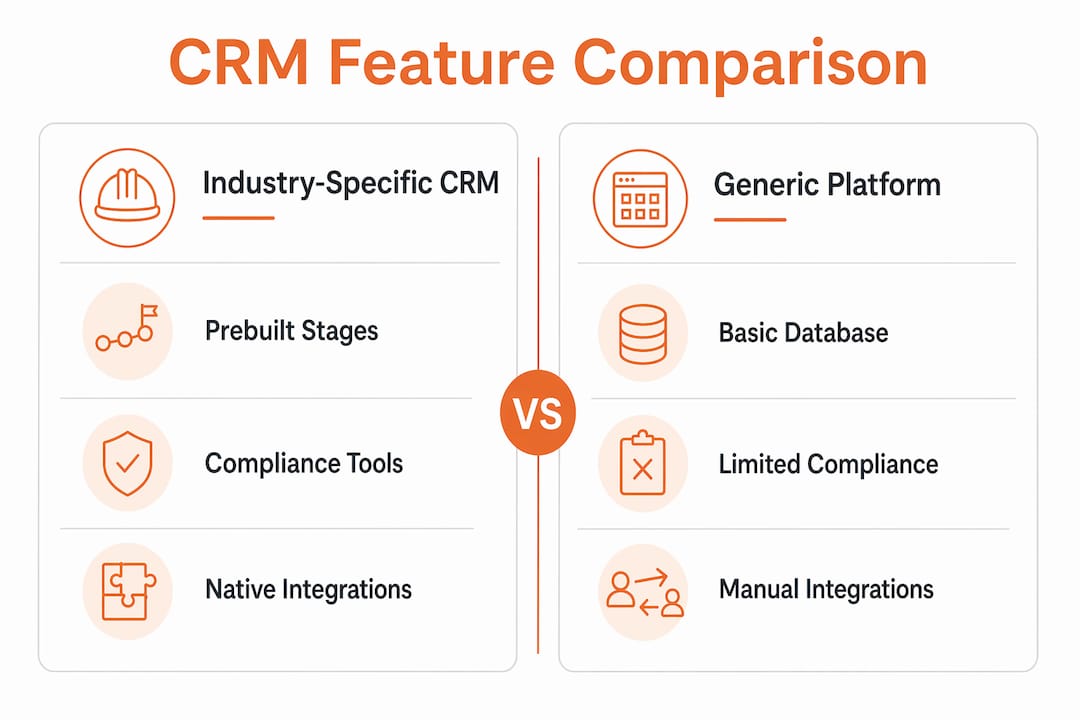
Generic platforms act as foundational databases rather than operational systems for complex construction workflows. That distinction matters because construction sales cycles are not linear. A commercial roofing contractor, for example, tracks site assessments, material lead times, subcontractor bids, permit approvals, and client sign-offs, all running at different speeds on the same project.

Industry-specific CRMs embed these stages as native pipeline logic. You do not build them from scratch. You activate them, train your team on familiar terminology, and start moving leads through a process that mirrors how your business actually works.
Pre-built features that matter most to contractors
- Automated lead tracking tied to project type and trade category
- Built-in compliance modules that reduce regulatory risk without add-ons
- Native integrations with estimating software, scheduling tools, and supplier portals
- Custom reporting dashboards showing job cost, close rate, and pipeline by project type
- Industry terminology throughout the interface, which drives faster team adoption
Compliance tools built in to vertical CRMs speed adoption and reduce risk in regulated trades. Construction is one of the most regulated industries in the United States, and every manual compliance step is a liability.
| Feature | Industry-specific CRM | Generic platform |
|---|---|---|
| Construction pipeline stages | Pre-built | Manual setup required |
| Compliance documentation | Native modules | Third-party add-ons |
| Estimating tool integration | Native or plug-and-play | Custom API work |
| Industry-specific dashboards | Included | Requires configuration |
| Team onboarding time | Shorter due to familiar terms | Longer due to generic UI |
Pro Tip: Before evaluating any CRM, list your five most time-consuming manual tasks. If an industry CRM solves four of them out of the box, the setup investment pays for itself faster than you think.
How does setup and customization time impact CRM choice for construction firms?
Setup time is one of the most misunderstood factors in CRM selection. Industry-specific CRMs average 6–12 weeks to implement, while generic platforms configure in 2–6 weeks. That initial speed advantage for generic tools disappears quickly once you factor in the custom work required to handle construction-specific needs.
Here is what that extended customization actually costs you on a generic platform:
- Developer or consultant hours to build custom pipeline stages
- Ongoing maintenance every time the platform updates its core product
- Integration upkeep as your estimating or scheduling tools release new versions
- Staff retraining when workarounds break or workflows need rebuilding
Integration complexity beyond 5–7 active data sources causes the maintenance burden on generic platforms to grow steeply. Most mid-size construction firms connect their CRM to at least that many systems: accounting software, estimating tools, supplier portals, scheduling apps, and email. Each connection on a generic platform is a custom build you own and maintain.
The long-term picture favors vertical CRMs for growing construction businesses. The upfront build is longer, but the ongoing maintenance load is lower because the platform already understands your industry. Your team spends less time managing the CRM and more time closing jobs.
Pro Tip: Map your current tech stack before choosing a CRM. If you already use more than five tools that need to connect, a generic platform will cost you more in integration maintenance over three years than the subscription price suggests.
When does a generalized platform’s flexibility outweigh vertical CRM specialization?
Generalized platforms do have a legitimate place. The key is knowing exactly when that place applies to your business. Generic platforms excel at flexibility across multiple verticals, which makes them well-suited for specific situations.
Use this numbered checklist to assess your fit:
- Your sales process has fewer than five pipeline stages. Simple processes do not need embedded industry logic.
- You operate across multiple industries or verticals. A multi-trade holding company or construction agency may need platform flexibility over built-in specificity.
- Your team is fewer than ten people. Smaller teams often benefit from the larger community support and faster onboarding of well-known generic platforms.
- You have fewer than five active software integrations. Below this threshold, generic platforms handle connections without excessive maintenance overhead.
- You plan to pivot your business model within 12 months. Generic platforms adapt to structural changes faster because they are not locked to one vertical’s logic.
Construction businesses under $3 million in revenue should still prefer industry-specific tools to avoid costly generic platform configurations. That recommendation holds because smaller contractors often lack the internal IT resources to manage ongoing customization. The cost of hiring outside help to maintain a generic CRM frequently exceeds the price difference between the two platform types.
The complexity threshold for switching from a generic to a vertical CRM is typically when complex sales processes with multiple deal stages require accuracy across asynchronous workflows. A commercial HVAC contractor tracking equipment delivery, installation scheduling, and permit sign-offs simultaneously hits that threshold fast.
What are the total cost implications and long-term ROI differences?
Cost comparisons between CRM types require looking past the monthly subscription line. Vertical CRMs carry lower long-term monthly maintenance costs, typically in the $200–$500 range, compared to the escalating subscription and customization fees that generic platforms accumulate over time.
The break-even point for an industry-specific CRM versus a generic platform typically arrives at 18–24 months. After that point, the savings compound. You stop paying for custom development, reduce integration maintenance, and benefit from a system your team actually uses correctly.
| Cost factor | Industry-specific CRM | Generic platform |
|---|---|---|
| Initial setup investment | Higher | Lower |
| Monthly maintenance cost | $200–$500 | Escalates with customization |
| Integration build cost | Minimal (native) | Significant (custom API) |
| Break-even timeline | 18–24 months | Ongoing accumulation |
| Data ownership | Full | Platform-dependent |
Owning your data and CRM processes is a strategic advantage over renting functionality on a generic platform. Construction firms that own their pipeline data, client history, and job cost records can make better hiring, bidding, and growth decisions. That data does not disappear if you change vendors.
Highlevelcrm-rconstructionsolutions users report lead conversion rate increases of up to 35%. That kind of lift, applied to a firm closing $2 million in annual contracts, represents a return that no generic platform configuration can match without significant additional investment.
Pro Tip: Calculate your current cost of lost leads. If your team misses follow-ups on even two jobs per month, the revenue loss likely exceeds the annual cost difference between a generic and an industry-specific CRM.
Key takeaways
Industry-specific CRMs deliver faster ROI, lower long-term costs, and higher adoption rates for construction firms than generic platforms that require extensive customization to match vertical workflows.
| Point | Details |
|---|---|
| Out-of-the-box functionality | Vertical CRMs deliver 90–95% construction-ready features versus 70–80% for generic platforms. |
| Setup vs. maintenance tradeoff | Longer initial build pays off through lower ongoing maintenance and integration costs. |
| Break-even advantage | Industry CRMs typically reach break-even at 18–24 months with compounding savings after. |
| Compliance and integration | Built-in compliance modules and native integrations reduce risk and manual data handling. |
| When generic platforms fit | Simple pipelines, multi-vertical operations, or teams under ten people may favor generic tools. |
What I’ve learned from watching contractors pick the wrong CRM
I’ve seen construction firms spend six months configuring a generic platform, only to abandon it because the pipeline logic never matched how their estimators actually worked. The mistake is almost always the same: they chose the CRM with the best marketing, not the best fit.
The right starting point is not a feature list. It is one core pain point. Starting with a single pain point and iterating drives better adoption and ROI than large upfront builds. For most contractors, that pain point is lead follow-up. Leads fall through the cracks between the estimating call and the proposal. Fix that first. Build from there.
Platform lock-in is a real concern, and I do not dismiss it. Before committing to any CRM, ask the vendor two questions: who owns the data if you leave, and what does the export process look like? A vendor that hesitates on either answer is telling you something important.
The firms I’ve seen get the most from their CRM are the ones that matched the platform to their existing workflows first, then expanded. They did not try to rebuild their business around the software. Vertical CRMs embed industry best practices that standardize complex processes, which means less structural complexity for your team to manage. That is not a small thing when your project managers are already stretched thin.
My honest recommendation: if you run a construction business with more than five active software tools and more than three pipeline stages, a vertical CRM will serve you better within 18 months. The upfront effort is real, but so is the return.
— Rowena
How Highlevelcrm-rconstructionsolutions supports construction firms with purpose-built CRM
Highlevelcrm-rconstructionsolutions was built on over 30 years of construction industry experience, which means the workflows, dashboards, and integrations reflect how contractors actually operate, not how a generic software team imagined they might.
The platform includes automated lead tracking, job-specific pipeline stages, and native construction workflows that reduce manual data entry from day one. Reporting dashboards show close rates, job cost trends, and pipeline health without requiring custom builds. Contractors who want to see the full feature set and get answers to common implementation questions can review the CRM features and FAQs page. If you want to confirm the platform covers your specific trade, the industries we serve page lists every vertical supported.
FAQ
What is the main difference between an industry-specific CRM and a generic platform?
An industry-specific CRM delivers pre-built workflows, compliance tools, and integrations for a single vertical, while a generic platform offers broad configurability that requires custom setup to match specialized needs.
How long does it take to implement an industry-specific CRM for construction?
Industry-specific CRMs average 6–12 weeks to implement. That timeline is longer than generic platforms upfront, but it eliminates the extended customization work that generic tools require afterward.
When does a generic CRM make more sense for a construction business?
A generic platform fits best when your sales process has fewer than five pipeline stages, your team is small, and you connect fewer than five external tools. Beyond those thresholds, a vertical CRM delivers better long-term value.
What is the typical break-even timeline for an industry-specific CRM?
Break-even compared to a generic platform typically occurs at 18–24 months. After that point, lower maintenance costs and higher team adoption produce compounding savings.
How do industry-specific CRMs handle compliance requirements in construction?
Vertical CRMs include built-in compliance modules designed for regulated trades, reducing the need for third-party add-ons and lowering the risk of documentation errors on job sites.