
Optimize Construction Material Inventory Tracking: A Guide | High Level CRM - R. Construction
Construction material inventory tracking is the systematic process of recording, monitoring, and verifying every material movement on a project site, from delivery through installation. Manual inventory practices cause roughly 17.3% of project delays and errors up to 35%, but digital tracking technologies can reduce both errors and costs by up to 30%. For construction project managers and procurement specialists, that gap between manual and digital is where budgets are won or lost. The methods covered here, including barcodes, RFID, QR codes, cloud platforms, cycle counting, and three-way matching, give you a structured path to accurate, real-time material control.
How to optimize construction material inventory tracking with digital tools
The industry term for what most project managers call “inventory tracking” is perpetual inventory management. It means every transaction, receipt, transfer, issue, and return updates a live record rather than waiting for a periodic count. Getting there requires the right technology stack.

Core tracking technologies compared
Three technologies dominate construction sites today: barcodes, QR codes, and RFID. Each serves a different operational need.
| Technology | Best use case | Key advantage | Limitation |
|---|---|---|---|
| Barcode | High-volume consumables | Low cost, widely supported | Requires line-of-sight scan |
| QR code | Equipment and tool tracking | Stores more data, free to generate | Degrades in harsh conditions |
| RFID | Bulk materials and pallets | Hands-free, batch scanning | Higher hardware cost |
| Cloud WMS | Centralized data management | Real-time visibility across sites | Requires stable connectivity |
Cloud-based warehouse management systems (WMS) sit above all three technologies and centralize data from every scan into one dashboard. Platforms like Procore, Autodesk Construction Cloud, and specialized WMS tools give project managers live stock levels, reorder alerts, and job cost code visibility without waiting for a weekly report. That real-time visibility is what separates reactive ordering from planned procurement.
Mobile scanning devices with offline-first capability are equally critical. Construction sites frequently have dead zones where cellular or Wi-Fi signals drop. Offline-first mobile apps with local queues buffer transactions and sync to the ERP when connectivity returns, preventing duplicate or missing records. Without this feature, a scanner that loses signal mid-count creates exactly the kind of data gap you are trying to eliminate.
ERP integration ties everything together. When your WMS or scanning app posts directly to your ERP, every material receipt, transfer, and issue updates job cost codes in real time. Linking every inventory transaction to related purchase orders and job cost codes prevents phantom stock and improves job costing accuracy. Phantom stock, materials that appear in the system but do not physically exist, is one of the most common causes of last-minute emergency orders and budget overruns.
Pro Tip: Before selecting material tracking software, confirm it supports offline scanning and direct ERP posting. A tool that requires manual export and import between systems adds a reconciliation step that defeats the purpose of digital tracking.
How does disciplined cycle counting improve inventory accuracy in construction?
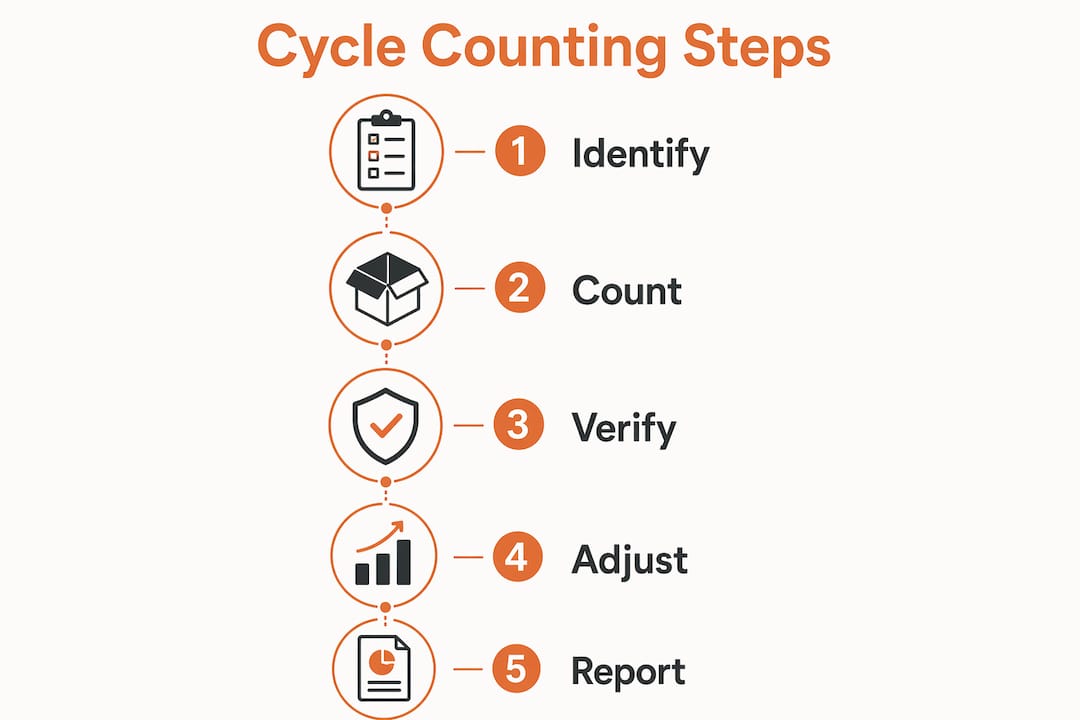
Cycle counting is a perpetual inventory audit method where you count a subset of stock locations on a rotating schedule rather than shutting down operations for a full physical count. Cycle counting can achieve greater than 99% location accuracy when paired with measurable KPIs and continuous improvement loops. That level of accuracy is the foundation of reliable job costing and on-time procurement.
ABC stratification: counting what matters most
ABC stratification divides your inventory into three classes based on value and criticality:
- Class A: High-value or high-criticality materials (structural steel, MEP components). Count weekly or biweekly.
- Class B: Moderate-value materials (lumber, conduit, pipe fittings). Count monthly.
- Class C: Low-value consumables (fasteners, tape, PPE). Count quarterly.
Cycle counting tolerance ranges typically vary from plus or minus 0.5% to 2% by SKU class. A Class A item with a 0.5% tolerance means a single missing structural bolt triggers a recount. A Class C item at 2% tolerance allows minor consumable variance without generating paperwork. These bands prevent you from chasing noise while protecting the materials that actually affect project timelines.
A practical daily cycle count process
- Generate a count list by zone or bin location from your WMS each morning.
- Assign a counter who has no prior knowledge of expected quantities (blind count).
- The counter scans and records physical quantities without seeing system quantities.
- The system compares physical count to system quantity and flags variances outside tolerance.
- A second counter recounts any flagged location to remove human error.
- Investigate root cause for any confirmed variance before posting an adjustment.
- Log the root cause (receiving error, theft, mispost, damage) in the audit trail.
The root cause step is where most teams fail. Posting an adjustment without investigation removes the symptom but not the problem. Variance tolerances and recount governance prevent incorrect adjustments and reduce inventory noise that compounds over time.
Key KPIs to track: location accuracy percentage, recount rate (percentage of counts requiring a second count), variance frequency by SKU class, and variance closure time. Review these monthly on a scorecard and you will see patterns. A rising recount rate in a specific zone usually points to a receiving process problem, not a counting problem.
Pro Tip: Schedule cycle counts at the start of the shift before materials move. Counting a bin while workers are pulling from it produces unreliable results and forces recounts.
What role does receiving process discipline play in inventory control?
The Goods Receipt Note (GRN) is the formal record that materials were physically received in the correct quantity and condition against a purchase order. Three-way matching is the process of verifying that the purchase order, GRN, and supplier invoice all agree before releasing payment. Three-way matching verifies PO, GRN, and invoice before payment release, significantly reducing payment errors and fraud risk.
Most inventory accuracy problems originate at the receiving dock, not in the warehouse. A delivery accepted without scanning, or posted to the wrong job code, creates a discrepancy that cycle counting will eventually find but cannot fix without tracing back to the original transaction. Implementing receiving reports with strict scanning and verification processes generates the GRN evidence required for three-way matching and supports FIFO rotation and correct job coding.
Here is how to implement three-way matching on a construction project:
- Create a purchase order in your ERP with line items, quantities, unit costs, and job cost codes before any material is ordered.
- At delivery, scan each item against the open PO line and record actual received quantity in the WMS to generate the GRN automatically.
- When the supplier invoice arrives, the AP team matches it against the PO and GRN. All three documents must agree on quantity and price.
- Flag any discrepancy as an exception. Hold payment until the exception is resolved with the supplier or corrected in the system.
- Post the GRN to inventory and the invoice to accounts payable only after three-way match confirmation.
“Three-way matching is an essential control preventing payments unless goods receipt and invoice agree with purchase orders.” This process also creates an audit trail that satisfies both financial auditors and project owners requesting cost transparency.
The practical benefit goes beyond fraud prevention. When your receiving data is clean, your cycle counts become faster and your job cost reports become reliable. Procurement specialists who skip this discipline spend hours reconciling invoices at project close. Those who enforce it spend minutes.
How to implement mobile and field-first inventory workflows effectively
Mobile inventory workflows bring the WMS to the worker rather than requiring workers to travel to a fixed terminal. The result is faster transaction posting, fewer manual entry errors, and real-time data from the field. ERP-friendly mobile cycle counting pilots cut count hours by roughly 30 to 40%, expose phantom stock early, and improve overall efficiency.
Start with a pilot, not a full deployment. A pilot scoped to one zone, one material category, or one subcontractor crew gives you fast feedback without risking your entire inventory dataset. During the pilot, measure these KPIs weekly:
- Recount rate: Should drop as workers become familiar with the scanning workflow.
- Exception resolution time: How long from a flagged variance to a posted correction.
- Data sync latency: Time between a field scan and the record appearing in the ERP.
- Transaction post accuracy: Percentage of scans that post to the correct PO line and job code on the first attempt.
Bin locking is a field practice worth adopting early. When a bin is being counted, the system locks it to prevent concurrent transactions that would invalidate the count. Staging area scans, where incoming materials are scanned at a designated staging zone before being moved to final storage, add a second verification point that catches receiving errors before they enter the main inventory.
Pro Tip: Run your mobile pilot during a period of moderate material flow, not at project peak. Piloting during peak activity makes it impossible to separate workflow issues from volume pressure.
QR code scanning workflows are particularly effective for tools and equipment that move between crews. A worker scans out a tool at the start of the shift and scans it back in at the end. The system records custody, location, and duration automatically. This data feeds directly into asset utilization reports and loss prevention tracking, two areas where construction companies consistently lose money without realizing it.
What common mistakes undermine reliable inventory tracking?
Even well-designed systems fail when process discipline breaks down. These are the mistakes that most frequently erode inventory accuracy on construction projects:
- Posting adjustments without root cause investigation. Adjusting a variance without understanding why it occurred guarantees the same error will recur. Every adjustment should carry a reason code.
- Mixing counting and receiving in the same workflow. Counting a bin while a delivery is being received into it produces unreliable data. Separate these activities by time or by bin lock.
- Over-customizing ERP integrations during initial deployment. Custom fields and workflows added before the base system is stable create integration failures that are difficult to diagnose. Deploy standard configuration first, then customize based on real operational data.
- Skipping variance tolerance bands. Without tolerance bands, every minor consumable discrepancy triggers a recount, burning time and reducing team confidence in the system.
- Ignoring monthly scorecard reviews. KPIs collected but never reviewed do not drive improvement. Schedule a 30-minute monthly review of location accuracy, recount rate, and variance frequency with your procurement and warehouse teams.
Inventory errors are a major root cause of construction delays, so optimization starts with data integrity and receiving discipline, not just technology. The best scanner in the world cannot compensate for a team that skips the GRN step or posts adjustments without investigation.
Key takeaways
Effective construction inventory control requires integrating digital tracking tools, disciplined cycle counting, and three-way matching into a single connected workflow, not deploying each in isolation.
| Point | Details |
|---|---|
| Digital tools reduce errors | Barcodes, QR codes, RFID, and cloud WMS cut errors and costs by up to 30% versus manual methods. |
| Cycle counting drives accuracy | ABC stratification with weekly, monthly, and quarterly counts achieves greater than 99% location accuracy. |
| Receiving discipline is foundational | Three-way matching of PO, GRN, and invoice prevents payment errors and keeps inventory data clean. |
| Mobile pilots before full rollout | Scoped pilots measuring recount rate and sync latency reduce deployment risk and expose gaps early. |
| Root cause investigation is non-negotiable | Posting adjustments without investigating variance causes guarantees recurring errors and budget overruns. |
What I have learned from watching inventory systems succeed and fail on real projects
I have reviewed inventory setups across dozens of construction projects, and the pattern is consistent. Teams that invest in RFID scanners or cloud platforms but skip process governance end up with expensive technology producing unreliable data. The technology is not the hard part. The discipline is.
The projects with the best inventory accuracy share one characteristic: they treat cycle counting as a control feedback loop, not a cleanup task. They count regularly, investigate every variance, and review KPIs monthly. The technology, whether it is a barcode system or a full WMS, is just the mechanism. The process is what makes it work.
I also see procurement specialists underestimate the receiving dock. Three-way matching sounds like an accounts payable concern, but it is actually the most important inventory control point on a construction site. Clean receiving data means clean cycle counts, clean job cost reports, and clean supplier relationships. Skipping it to save time at delivery creates hours of reconciliation work at project close.
My advice: start with receiving discipline and a scoped mobile pilot. Get those two right before you expand to full-site deployment. Cross-functional buy-in from procurement, site supervisors, and finance makes the difference between a system that gets used and one that gets abandoned after the first month.
— Rowena
How Highlevelcrm-rconstructionsolutions supports your inventory and procurement workflows
If you are ready to connect your inventory tracking, procurement, and project management into one system, Highlevelcrm-rconstructionsolutions was built for exactly that. Developed with over 30 years of construction experience, it integrates with industry-specific tools to give you real-time material visibility, automated workflows, and custom reporting dashboards that reflect how construction projects actually operate.
Procurement specialists use it to reduce phantom stock and close the gap between field transactions and financial records. Project managers use it to track material status against project milestones without chasing spreadsheets. Explore the construction CRM features that support inventory and procurement control, or visit Highlevelcrm-rconstructionsolutions to see how contractors are cutting project management time and improving cost accuracy.
FAQ
What is the fastest way to improve inventory tracking accuracy?
Start at the receiving dock. Implementing strict GRN scanning and three-way matching between purchase orders, goods receipts, and invoices eliminates the most common source of inventory discrepancies before materials ever reach storage.
How often should construction sites perform cycle counts?
Class A high-value materials should be counted weekly or biweekly, Class B materials monthly, and Class C consumables quarterly. Cycle counting with ABC stratification achieves greater than 99% location accuracy when paired with variance tolerance bands and root cause investigation.
What is three-way matching in construction procurement?
Three-way matching verifies that the purchase order, goods receipt note, and supplier invoice all agree on quantity and price before payment is released. It is the standard accounts payable control for physical goods and significantly reduces payment errors and fraud risk.
Do mobile scanning apps work in areas with no cell signal?
Yes, provided the app is built with offline-first architecture. Offline-first apps with local queues buffer transactions locally and sync to the ERP when connectivity is restored, protecting data integrity in the dead zones common to active construction sites.
What KPIs should I track to measure inventory control performance?
Track location accuracy percentage, recount rate, variance frequency by SKU class, and variance closure time. Review these on a monthly scorecard with your procurement and warehouse teams to identify recurring problem areas and measure improvement over time.