
Reduce Marketing Costs with CRM Automation for Contractors
CRM automation is the most direct method construction businesses have to reduce marketing costs, with operational cost reductions of 20 to 50% achievable within the first year of implementation. That figure represents real dollars: eliminated manual tasks, canceled redundant subscriptions, and ad budgets that stop bleeding into audiences you already converted. The industry term for this practice is marketing automation integration, and it covers everything from syncing lead lifecycle stages to AI-driven ad optimization. For construction business owners and marketing managers, the opportunity is specific. You are running campaigns across Google Ads, Meta, and LinkedIn while managing leads in a CRM that may not talk to any of them. Platforms like Salesforce, HubSpot, and Ryze AI now make that connection direct, measurable, and profitable. The average ROI of $8.71 per $1 spent on CRM automation is not a ceiling. For contractors who get the fundamentals right, it is a starting point.
How to reduce marketing costs with CRM automation: the foundation
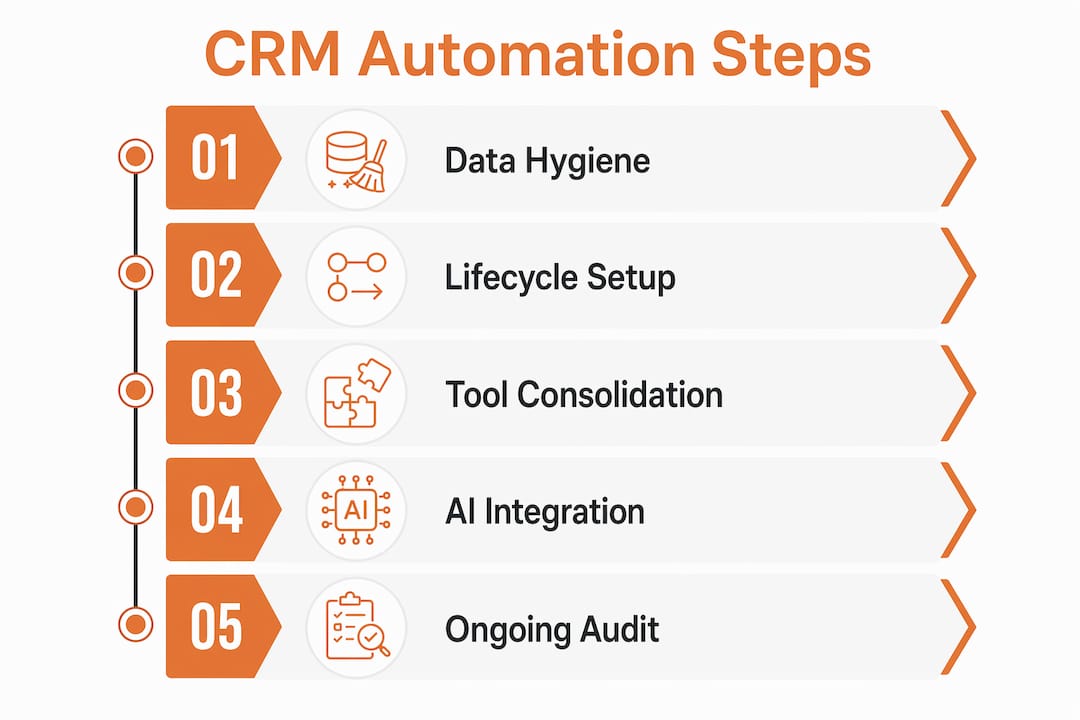
Before you can cut a dollar of marketing spend, your CRM data has to be clean and your lead lifecycle stages have to be consistent. Dirty data is the single most common reason construction companies fail to see returns from automation. If your CRM holds duplicate contacts, outdated project records, or leads with no stage assigned, every automated workflow built on top of that data will produce unreliable results.
The technology stack required to get started is straightforward. You need a CRM platform with native automation capabilities, integrations with your advertising platforms, and defined lifecycle stages that your sales and marketing teams both agree on. Platforms like Salesforce and HubSpot offer these natively. Ryze AI adds a layer of real-time budget optimization on top of existing CRM data. For construction-specific needs, automated lead tracking tools built for the sector reduce the setup time considerably.
Here is what your foundational stack should include:
- CRM platform: Salesforce, HubSpot, or a construction-specific platform like Highlevelcrm-rconstructionsolutions with pre-built contractor workflows
- Ad platform integrations: Google Ads Customer Match, Meta Custom Audiences, LinkedIn Matched Audiences
- AI optimization layer: Ryze AI or native smart bidding tools connected to CRM lifecycle data
- Data hygiene tools: Deduplication rules, required fields at lead entry, and automated stage progression triggers
The table below compares three common CRM options on the features that matter most for cutting marketing expenses in construction:
| CRM Platform | Native Automation | Ad Platform Sync | Construction-Specific Features |
|---|---|---|---|
| Salesforce | Yes (Einstein AI) | Yes (via integrations) | Limited without customization |
| HubSpot | Yes (Workflows) | Yes (native) | Moderate |
| Highlevelcrm-rconstructionsolutions | Yes | Yes | Built-in for contractors |
Inconsistent lifecycle definitions cause budget leaks because your ad platforms end up targeting existing customers or closed-lost leads. Defining six to eight clear stages, from “new inquiry” through “project complete,” is not optional. It is the prerequisite for every cost-saving tactic that follows.
How to consolidate tools and cut direct subscription costs
The fastest way to reduce your marketing spend is to stop paying for tools you do not need. Most construction businesses accumulate software over time: a separate email platform, a standalone form builder, a project management tool with a CRM add-on, and a dedicated CRM on top of that. Each subscription feels justified individually. Together, they represent significant overlap.
A structured 90-day consolidation process works as follows:
- Audit your current stack. List every tool your marketing and sales teams use, its monthly cost, and its primary function. Include seats, not just licenses.
- Map feature overlap. Identify where two or more tools perform the same function. Email automation inside HubSpot and a separate Mailchimp subscription is a common example in construction marketing.
- Right-size your licenses. Run a login audit. Quarterly CRM audits consistently find that 10 to 15% of paid seats go unused. Deactivating those seats recovers 15 to 25% of CRM spend without affecting operations.
- Archive old data. Archiving raw data while retaining summarized signals reduces hidden storage costs that inflate CRM bills silently over time.
- Consolidate to a single platform where possible. A construction-specific CRM that handles lead tracking, email automation, and reporting eliminates three separate subscriptions.
A 90-day consolidation for a mid-size construction company can cut direct subscription costs by 20 to 38%, with annual combined savings exceeding $19,500 and more than 300 hours reclaimed each year. Those hours represent your team doing actual marketing work instead of exporting spreadsheets between disconnected tools.
Pro Tip: Schedule a CRM usage audit every quarter, not just annually. Set a calendar reminder for the first week of each quarter, pull a login report, and deactivate any seat that has not been accessed in 60 days. This single habit prevents shelf-ware from compounding.

The comparison below shows what manual processes cost versus automated equivalents in a typical construction marketing operation:
| Process | Manual approach | Automated approach |
|---|---|---|
| Lead follow-up | 2 to 4 hours per day per rep | Triggered within minutes, zero rep time |
| Ad audience updates | Weekly manual export and upload | Real-time CRM sync |
| Subscription audit | Ad hoc, often skipped | Quarterly automated login report |
| Reporting | 3 to 5 hours per week | Dashboard updated continuously |
How do AI-powered CRM integrations lower your ad spend?
Connecting your CRM lifecycle data to AI-driven advertising platforms is where the largest per-dollar savings occur. When your CRM knows a lead has converted to a paying client, that information should immediately remove that person from your active ad audiences. Without this connection, you are paying to advertise to someone who already hired you.
CRM-integrated AI advertising delivers 34% higher conversion rates and 27% lower customer acquisition costs compared to manually managed campaigns. On a $20,000 monthly ad budget, teams using this approach save approximately $2,400 per month through real-time budget optimizations. That is nearly $29,000 per year from a single integration.
The mechanism works in four steps:
- Sync CRM lifecycle stages to ad audiences. Every stage change in your CRM, from “proposal sent” to “project won,” triggers an audience update in Google Ads, Meta, and LinkedIn.
- Activate audience suppression. Audience suppression tied to CRM stages reduces wasted ad spend by 15 to 25% within the first month. Existing clients stop seeing acquisition ads.
- Enable AI budget allocation. Platforms like Ryze AI use CRM conversion data to shift budget toward the campaigns and audiences producing the lowest cost per qualified lead.
- Set performance guardrails. AI-driven budget allocation delivers 25 to 40% higher return on ad spend compared to manual methods, but only when ROAS floors and CPA ceilings are set before enabling autonomous adjustments.
Pro Tip: Before turning on AI budget automation, set a minimum ROAS floor and a maximum CPA ceiling in your ad platform. These guardrails prevent the AI from chasing volume at the expense of margin, which is a real risk on smaller construction budgets.
“The shift in 2026 is toward AI-agent-led budget management with firm guardrails to prevent runaway ad spend.” — Automated budget management best practices
For contractors, this matters because construction leads are high-value and low-volume. Wasting even five percent of your ad budget on already-converted clients or irrelevant audiences has a disproportionate impact on your cost per acquired project.
Common mistakes that cancel out your CRM cost savings
The most expensive mistake construction businesses make with CRM automation is launching workflows before defining consistent lifecycle stages. Inconsistent stage definitions cause your ad platforms to target the wrong people, your automation sequences to fire at the wrong time, and your reporting to show numbers that do not reflect reality.
Three other mistakes consistently drain savings:
- Ignoring data sync latency. If your CRM updates a lead stage but that change takes 24 hours to reach your ad platform, you are still paying for ads targeting a converted client for a full day. Real-time or near-real-time sync is the standard to target.
- Skipping CRM audits. Unused seats and low-value automations accumulate quietly. Without quarterly reviews, you pay for automations that fire on zero contacts and seats that have not been logged into since the last employee left.
- Overlapping ad audiences. Running a retargeting campaign and a new-lead acquisition campaign without suppression lists means the same person sees both. You pay twice for one contact and inflate your frequency metrics.
Governance matters as much as technology. Assign one person the role of CRM health owner. That person reviews sync logs weekly, checks for automation failures, and flags anomalies in audience sizes. Construction businesses that treat CRM as a revenue engine rather than a contact database consistently outperform those that set it up once and walk away. For a broader look at how this connects to overall business profitability, business systems for construction companies show that disciplined process management compounds over time.
Key takeaways
CRM automation reduces construction marketing costs most effectively when clean data, consistent lifecycle stages, and AI-driven ad integrations work together from the start.
| Point | Details |
|---|---|
| Start with data hygiene | Clean CRM data and defined lifecycle stages are required before any automation produces reliable savings. |
| Consolidate your tool stack | A 90-day audit and consolidation can cut subscription costs by 20 to 38% and recover over 300 hours annually. |
| Connect CRM to ad platforms | Real-time audience suppression reduces wasted ad spend by 15 to 25% within the first month of activation. |
| Set AI guardrails | ROAS floors and CPA ceilings prevent AI budget tools from optimizing for volume at the expense of margin. |
| Audit quarterly | Login audits and automation reviews recover 15 to 25% of CRM spend that would otherwise go to unused seats. |
Why I think most contractors underestimate what their CRM is costing them
After working with construction businesses on CRM strategy for years, the pattern I see most often is not a failure to adopt automation. It is a failure to audit what is already running. Most contractors I speak with have a CRM, several connected tools, and at least a few active automations. What they rarely have is a clear picture of what those tools are actually costing them each month, or whether the automations are still firing correctly.
The uncomfortable truth is that a CRM without regular governance becomes a cost center faster than most people expect. Seats accumulate. Automations built for a campaign that ended two years ago keep running. Storage costs creep up as raw data piles up with no retention policy. None of this is visible in your day-to-day operations, which is exactly why it persists.
What I have found actually works is treating the quarterly audit as a non-negotiable business process, the same way you treat a financial review. Pull the login report. Check the automation health dashboard. Review your ad audience sizes for sudden drops or spikes that signal a sync failure. This takes two hours per quarter and consistently uncovers savings that dwarf the time invested.
The contractors who get the most from CRM automation are not necessarily the ones with the most sophisticated setups. They are the ones who maintain what they have built. If you are considering why contractors need a CRM in the first place, start with the cost control argument. The revenue upside follows once the foundation is solid.
— Rowena
How Highlevelcrm-rconstructionsolutions helps you cut marketing costs
Highlevelcrm-rconstructionsolutions is built specifically for contractors, with over 30 years of construction industry experience embedded in its design. It combines automated lead tracking, custom reporting dashboards, and ad platform integrations in a single platform, eliminating the tool overlap that drives up costs for most construction businesses. Users report lead conversion rate increases of 35%, and the platform’s construction-specific workflows mean you spend less time configuring and more time closing projects.
If you are ready to see exactly which features apply to your marketing cost reduction goals, the CRM features and FAQs page breaks down every automation capability with construction-specific examples. You can also explore automated lead follow-up benefits built for contractors, or contact the team directly to request a demo tailored to your current stack.
FAQ
How much can CRM automation reduce marketing costs?
CRM automation reduces operational costs by 20 to 50% within the first year, with an average ROI of $8.71 per $1 spent. Construction businesses that consolidate tools and activate audience suppression see the fastest returns.
What CRM tools work best for construction marketing cost savings?
Salesforce, HubSpot, and construction-specific platforms like Highlevelcrm-rconstructionsolutions each offer automation features that cut marketing expenses. The best choice depends on whether you need industry-specific workflows out of the box or are willing to customize a general-purpose platform.
How does audience suppression save ad budget?
Audience suppression syncs your CRM lifecycle stages to your ad platforms in near real-time, removing converted clients from active campaigns. This reduces wasted ad spend by 15 to 25% within the first month.
How often should construction businesses audit their CRM?
Quarterly audits are the standard that produces measurable results. Login audits find 10 to 15% of seats unused, and disabling low-value automations recovers thousands in spend each quarter without affecting operations.
What is the biggest mistake when automating construction marketing?
Launching automations without consistent CRM lifecycle stage definitions is the most costly error. It causes ad platforms to target the wrong contacts and automation sequences to fire incorrectly, which increases spend rather than reducing it.