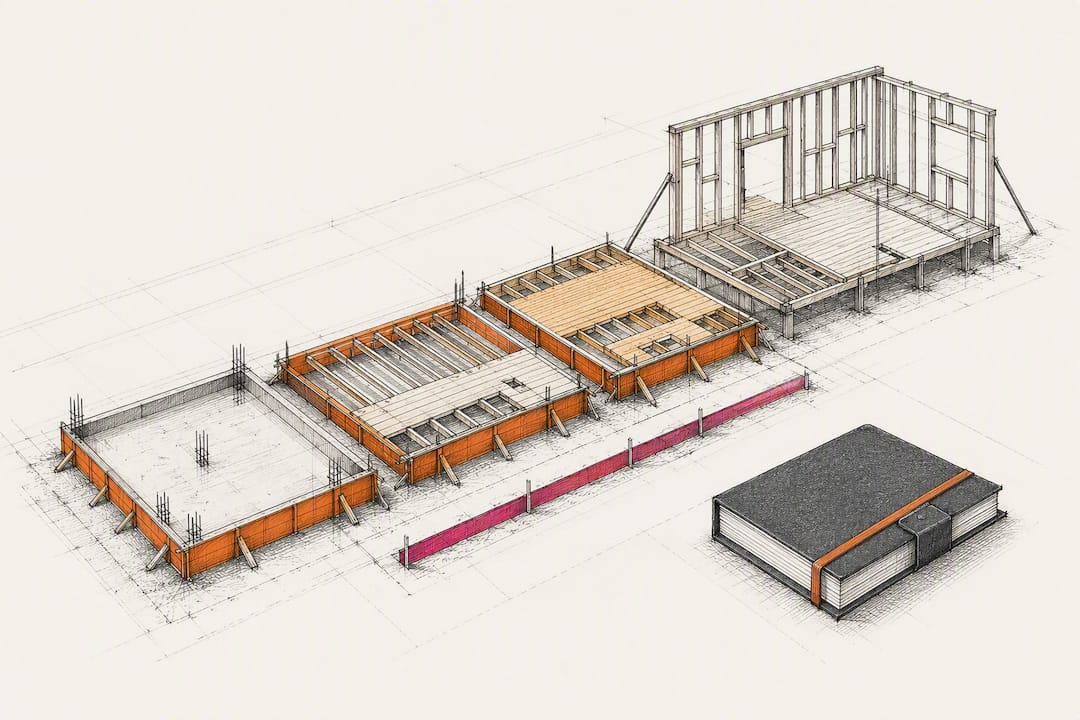
5 Step Construction Sales Forecasting to Protect Cash Flow
Use a weighted bottom-up forecast tied to cash-flow milestones, updated with monthly reforecasting. Start today by exporting your last 24 months of completed job values, your current backlog, and every active bid from your CRM or records. A construction-focused platform like High Level CRM by R. Construction Solutions centralizes those three inputs so you’re not stitching together spreadsheets from three departments.
TL;DR:
- Small to mid-sized contractors should start with bottom-up weighted pipeline forecasts and add cash-flow mapping within two months for best accuracy.
- Monthly reforecasting should include scenario testing for best, worst, and delayed-start cases, with clear triggers for switching between scenarios.
- Tracking key KPIs such as WIP movement, margin fade, backlog gross profit, and DSO each month helps prevent over-optimism and early cash flow issues.
- Construction-specific CRM tools like High Level CRM improve pipeline accuracy by combining bid tracking, lead management, and KPIs in a shared platform tailored for the trade.
- Integrating forecasting with real-time project data and assigning clear ownership to sales and project managers enhances forecast reliability and timely decision-making.
Table of Contents
- Why Sales Forecasting Matters for Construction Firms
- Forecasting Models That Work for Construction
- How to Build a Reliable Construction Sales Forecast
- KPIs, Reports, and Checks That Prove Forecast Health
- How High Level CRM Puts This Into Practice
- A Sales Leader’s Take on Getting This Right
- Put Your Forecast on Autopilot With Construction-Specific Tools
- Sources
Why Sales Forecasting Matters for Construction Firms
Construction billing rarely matches production. You pour the foundation in March, invoice net-30, and don’t see cash until May, sometimes later if retainage sits on the books until closeout. A forecast that only tracks earned revenue hides that gap. A forecast that maps billing milestones against real production timelines shows you exactly where the cash pressure builds before it forces a line-of-credit draw.
Construction Executive’s planning framework links cash, cost, backlog, and capacity together, and recommends monthly reviews tied to WIP reporting specifically because these four levers move independently. Backlog looks healthy while cash runs dry, or capacity looks fine on paper while three superintendents are double-booked in the same month.
Reliable forecasting also protects your bonding capacity, since sureties want to see disciplined revenue projections before extending larger limits. It tells you when to add a crew and when to hold. When forecasts improve, expect these outcomes within a quarter or two:
- Fewer emergency draws on your line of credit
- Bid decisions based on actual crew and equipment availability, not guesswork
- Earlier warning when a big job’s billing schedule creates a cash valley
- Better conversations with your bonding company and bank
Forecasting Models That Work for Construction
Not every model fits every contractor. Inside Advisor Pro’s breakdown of construction revenue forecasting models groups them by company size and purpose, and picking the wrong one for your scale wastes time you don’t have.
-
Bottom-up weighted pipeline. You build the forecast job by job, assigning a win probability to each bid based on project type, client history, and your own close rates. It demands discipline, since every estimator and salesperson has to update stages consistently, but it’s the most accurate model for small-to-mid firms running $2 million to $50 million in annual volume.
-
Cash-flow forecasting. This model translates revenue into actual cash timing by mapping billing milestones, retainage releases, and collection cycles month by month. It answers the question bottom-up forecasting can’t: when does the money actually land?
-
Top-down forecasting. Multi-division firms set a strategic revenue target, then distribute it across regions or business lines based on historical share. It’s fast but weak on job-level accuracy, so pair it with bottom-up data at the division level.
-
Rolling forecasts with scenario modeling. You reforecast every month rather than once a year, and you run best-case, worst-case, and delayed-start scenarios against your pipeline to see how sensitive your cash position is to slippage.
Quick decision guide: if you run fewer than 20 active jobs, start with bottom-up weighted and add cash-flow mapping in month two. If you’re managing multiple divisions or regions, layer top-down targets over bottom-up detail instead of choosing one exclusively.
How to Build a Reliable Construction Sales Forecast
Building the forecast is a five-step process, and skipping steps is exactly where most contractors’ projections fall apart.
-
Pull your historical and pipeline data. Export job value, bid date, expected start date, billing schedule, and any change orders from the past two years. If your records live across three systems, this step alone often takes longer than the rest combined, which is a strong argument for consolidating in one platform.
-
Assign weighted probabilities. Set probability rules by project type and your actual historical win rate, not a gut feeling. A repeat commercial client at the proposal stage might carry 70% odds; a cold public bid at the same stage might carry 15%.
-
Convert revenue into cash timing. Map each job’s billing milestones to specific forecast months, and account for retainage and subcontractor draw schedules. This step is where earned revenue and collected cash finally get reconciled, a distinction Construction Executive treats as central to avoiding paper profits with no liquidity behind them.
-
Set a reforecasting cadence and assign owners. Pick a day each month, assign a specific person to own the update (usually your controller or sales manager), and put a 30-minute agenda in place: review variance, update probabilities, flag risks.
-
Run scenario tests. Model best case, worst case, and a delayed-start scenario, then write down the specific trigger that moves you from one to another, like a permit delay past 45 days.
Pro Tip: Assign each reforecast owner a single metric they’re accountable for catching, like backlog gross profit or DSO drift, rather than making the whole forecast one person’s job. Shared ownership beats a single overloaded gatekeeper.
KPIs, Reports, and Checks That Prove Forecast Health
A forecast without guardrails drifts toward optimism, and optimism is expensive in this industry. Watch these numbers every month:
- WIP movement. Track how underbillings and overbillings shift month to month; a growing underbilling position often signals a collections problem before it shows up in cash.
- Margin fade. Compare estimated margin at bid against current margin on active jobs; consistent fade points to estimating errors or scope creep going unbilled.
- Backlog gross profit. Total revenue in backlog tells you less than the profit sitting inside it.
- Days sales outstanding (DSO). Rising DSO usually means retainage or change-order billing is stuck somewhere in approval.
Construction Executive’s framework recommends tying these reviews directly to your monthly WIP cycle so forecast health and financial health get checked in the same meeting, not two separate ones a week apart.
Keep the dashboard simple: one page with backlog, WIP variance, DSO, and margin fade, reviewed live in the monthly meeting rather than emailed around beforehand.
How High Level CRM Puts This Into Practice
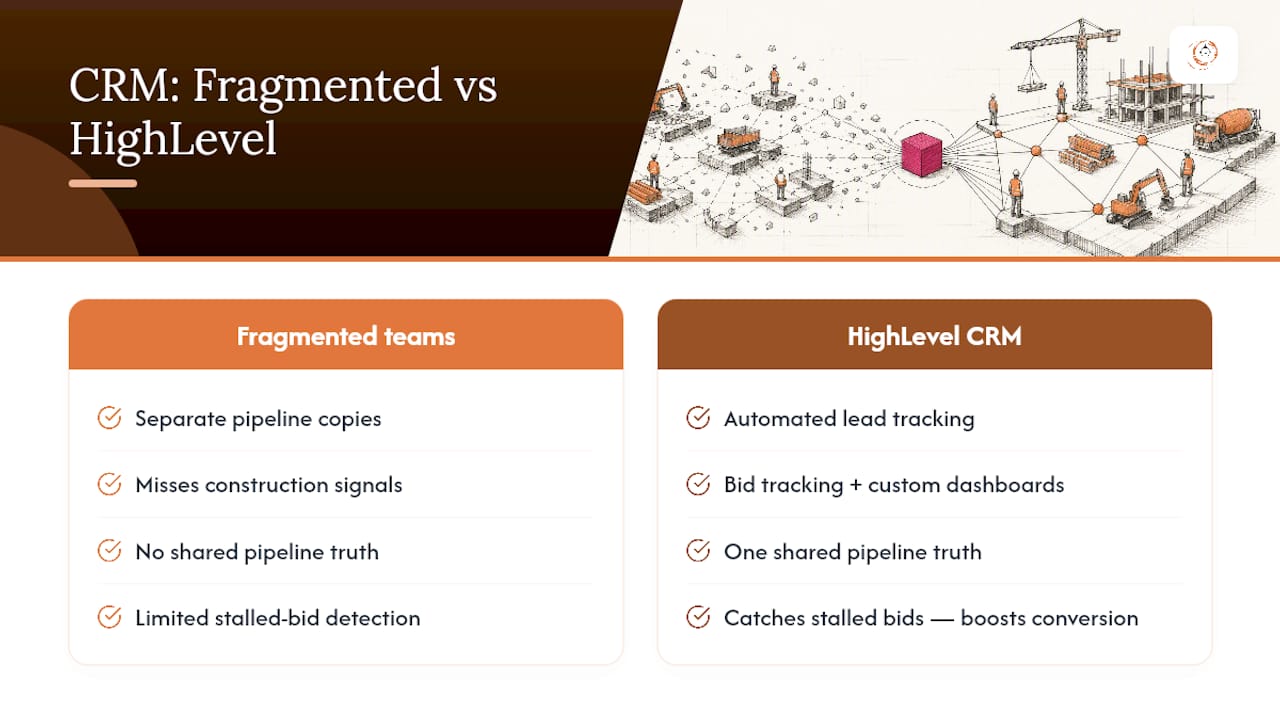
Rowena Tulacz, who writes on construction sales operations for Highlevelcrm-rconstructionsolutions, has watched the same gap repeat across contractors: sales, estimating, and project management each keep their own version of the pipeline. Generic CRM tools miss construction-specific signals like RFI velocity and change-order patterns, because they weren’t built for this trade in the first place.
High Level CRM’s automated lead tracking, bid tracking, and custom dashboards close that gap by giving estimators, PMs, and sales one shared source of pipeline truth. Contractors using the platform report notable lead conversion improvements, largely from catching stalled bids sooner. Before onboarding, map your bid stages, decide which fields sync from your estimating software, and prioritize training for whoever owns the monthly reforecast.
A Sales Leader’s Take on Getting This Right
Pull your data and run a weighted pipeline this week. That’s the whole first move, and delaying it costs you a full reforecast cycle. Over the quarter, align your WIP reporting, billing milestones, and monthly reforecast cadence into one rhythm instead of three disconnected habits. Make forecast accuracy part of every PM’s and estimator’s own performance metrics, not just the sales manager’s problem.
— Rowena
Put Your Forecast on Autopilot With Construction-Specific Tools
Highlevelcrm-rconstructionsolutions gives you one place to run the exact forecasting workflow this article just walked through, instead of rebuilding it across a spreadsheet, a separate WIP tool, and a generic CRM never built for bid stages or retainage. The Industries We Serve page breaks down setup specifics for residential contractors, commercial builders, suppliers, and consultants, since each group maps pipeline stages a little differently.
When you’re evaluating any CRM for forecasting purposes, check three things: can it integrate with your estimating software, can dashboards be customized to your KPIs (backlog gross profit, DSO, margin fade) without a developer, and does onboarding include real training rather than a login and a PDF. High Level CRM was built around all three, with a construction-specific setup rather than a retrofitted generic tool. Visit the Industries We Serve page and request a demo to see your own pipeline data mapped into a live forecast.
Sources
Your forecast is only as good as the inputs feeding it, and construction has more moving inputs than most industries.
- Financial Planning Frameworks for Construction Companies - Construction Executive
- Construction revenue forecasting models - Inside Advisor Pro
BuildingRadar’s research on construction sales forecasting tools points to early project discovery and lead scoring as a way to surface higher-value opportunities before competitors even bid, which raises the overall quality of what’s sitting in your pipeline. General CRM staging frameworks, like the deal pipeline stage templates used broadly across sales teams, offer a useful starting structure, though construction pipelines need stages built around bid dates and award notifications rather than generic sales touchpoints.
Recommended
- Construction Estimating Workflow Best Practices for 2026
- Bay Area Contractor Revenue Strategy Explained
- Types of Estimating Tools for Construction Companies
- Best CRM Benefits for Construction Businesses in 2026
Signed up, or thinking about it? We build the inside of the account — pipelines, workflows, funnels, nurture, migration. Built for construction. Contact us.
Affiliate disclosure. We’re a GoHighLevel affiliate. Sign up through our link and we may earn a commission at no cost to you, or buy direct. Build-out is billed separately, never a software markup.