

Streamline Your Commercial Construction Bid Workflow
A commercial construction bid workflow is the structured sequence of steps a contractor follows from opportunity identification through proposal submission. When that sequence runs on manual processes, it bleeds time, introduces errors, and costs you winnable work. The good news: firms that apply automation and AI to their bid management process see measurable gains fast. Dodge Construction Network 2025 data shows automated opportunity scoring reduces bids pursued by 28% while increasing win rates by 41%. That single shift, focusing your team on the right opportunities, is the foundation of every efficient bid management system worth building.
What are the essential components of a streamlined bid workflow?
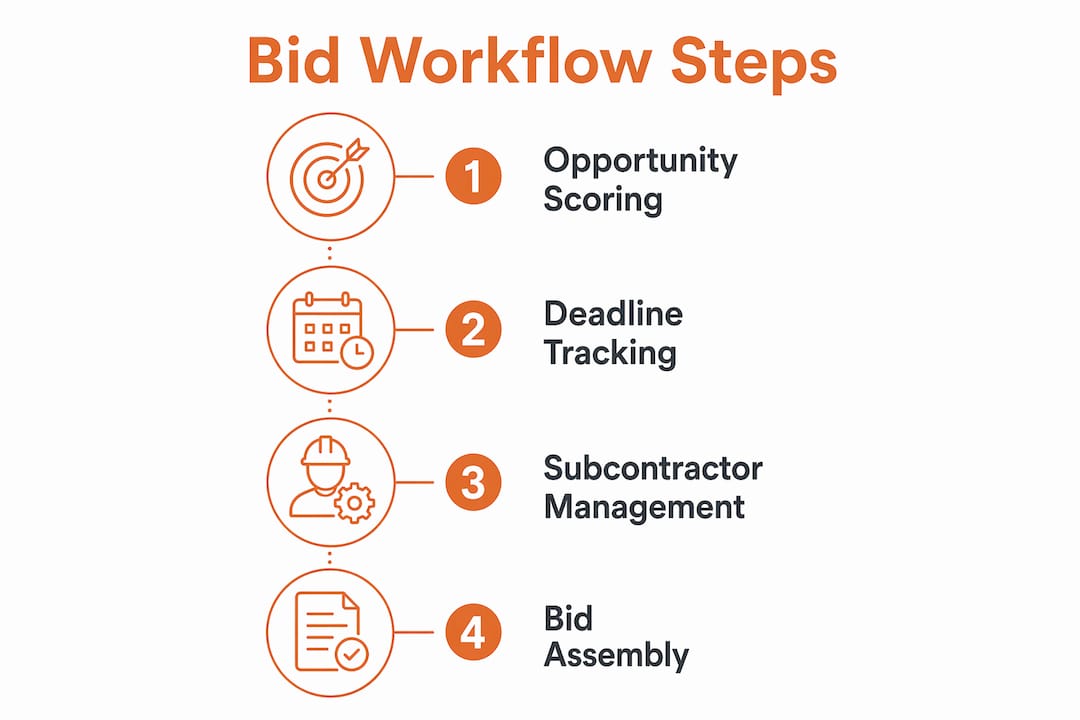
A well-built bid workflow runs on four core components: opportunity scoring, deadline tracking, subcontractor management, and automated document assembly. Each one removes a specific bottleneck that slows your team and erodes bid quality.
Opportunity scoring and go/no-go criteria are the first filter. Automated scoring evaluates each incoming opportunity against your firm’s win history, project type, geography, and bonding capacity. Without this filter, estimators spend hours pricing work your firm has little chance of winning.

Deadline tracking with cascading reminders is the second component. Centralized deadline tracking with cascading reminders reduces late bid submissions by 91%, according to an ENR 2025 survey. That figure reflects how much time and money firms lose simply by missing submission windows.
Subcontractor solicitation and qualification rounds out the pre-bid phase. A structured sub-bid database lets you send scoped invitations to pre-qualified subs, track responses, and flag coverage gaps before the bid due date. You can learn more about managing this phase through a solid sub-bid solicitation process.
Automated bid document assembly closes the loop. AGC 2025 data shows automated assembly cuts bid compilation time from 3–6 hours to 30–45 minutes and eliminates missing-document disqualifications entirely.
| Task | Manual time | Automated time |
|---|---|---|
| Opportunity scoring | 2–4 hours | 10–15 minutes |
| Deadline setup and tracking | 1–2 hours | Automatic |
| Sub solicitation and follow-up | 3–5 hours | 30–60 minutes |
| Document assembly and review | 3–6 hours | 30–45 minutes |
Pro Tip: Treat bid management as parallel milestones, not sequential steps. Launch sub-solicitation the same day you start plan review. Waiting for one phase to finish before starting the next is the most common cause of last-minute scrambles.
How does AI reduce bid preparation time and errors?
AI cuts bid preparation time by automating the most labor-intensive part of the process: reading and extracting data from large bid packages. A Q2 2026 analysis from Mirage Metrics found that AI reduces prep time from three weeks to five days on mid-size commercial bids. The same analysis found that extracting data from a 200-page package drops from 8–12 hours to 45 minutes.
The accuracy gains are equally significant. AI extracts scope and risks from bid documents with 85–95% accuracy on first pass, which reduces change orders by 25–30%. That accuracy comes from AI reading specifications, drawings, and addenda simultaneously rather than relying on a single estimator to catch every detail.
AI also generates RFIs automatically. When it identifies ambiguous specs or scope gaps, it flags them and drafts clarification requests. This turns bid prep from reactive firefighting into proactive risk management, which protects your margins before the project even starts.
Key AI benefits for your bid process:
- Automated document ingestion and scope extraction
- Risk identification and RFI draft generation
- Addenda tracking and automatic bid updates
- Pre-populated estimate line items from unit-cost libraries
- Consistency checks across all bid sections
Common pitfalls to avoid:
- Accepting AI output without estimator review on complex scopes
- Skipping addenda reconciliation after AI ingestion
- Using AI tools that do not integrate with your existing estimating platform
Pro Tip: Index your past project specifications into an AI-accessible database. This accelerates not just bidding but also future project phases, reducing downstream delays on similar work.
What workflows and tools support effective bid automation?
The technical backbone of an efficient bid process is a structured intake system connected to a unit-cost library and an approval routing workflow. Without these three elements, automation produces inconsistent outputs that estimators still have to rebuild manually.
A structured intake form captures project type, delivery method, owner, location, bid date, and scope classification the moment a new opportunity enters your system. Classification rules then route the bid to the right estimator and trigger the correct template. This single step eliminates the informal handoffs that cause scope mismatches and missed deadlines.
A unit-cost library pre-populates estimate line items based on the classified scope. Your estimator starts with a structured draft rather than a blank spreadsheet. The bid-to-proposal automation process reduces proposal turnaround from 2–5 days to 4–8 hours and cuts estimator assembly time from 3–6 hours to 30–60 minutes per bid.
Routing and approval workflows prevent proposals from leaving your firm without a second set of eyes. Automated routing sends the completed estimate to a project manager or principal for review, sets a review deadline, and escalates if no action is taken. This replaces the informal “did you check this?” email chain that delays submissions.
Automated follow-up closes the post-submission gap. Tracking when owners open proposals, when they request clarifications, and when decisions are expected keeps your team informed without manual check-ins. For more on this phase, automated lead follow-up practices apply directly to bid tracking.
| Task | Manual process | Automated process |
|---|---|---|
| Intake and classification | Email, phone, manual entry | Structured form with auto-routing |
| Estimate pre-population | Blank template | Unit-cost library auto-fill |
| Approval routing | Informal email | Automated queue with escalation |
| Proposal delivery | Manual PDF assembly | Auto-generated, branded document |
| Post-submission follow-up | Calendar reminders | Automated tracking and alerts |
How to implement a streamlined bid workflow in your firm
Implementation works best when you build the foundation before you automate anything. Three prerequisites must be in place: a current unit-cost library, standardized estimating templates, and a defined intake form. Trying to automate without these produces faster versions of your existing problems.
Follow this implementation sequence:
- Audit your current process. Map every step from opportunity receipt to submission. Identify where time is lost and where errors originate. Most firms find the intake-to-estimate handoff is the biggest failure point, especially for firms bidding more than 10–15 projects per month.
- Build your unit-cost library. Compile labor, material, and equipment costs from your last 12–24 months of completed projects. Segment by project type and region. This library is the engine that makes estimate pre-population accurate.
- Design your intake form. Capture every field your estimators need to classify and price a bid. Include project type, delivery method, owner type, estimated value range, and bid date. Keep it short enough that anyone on your team can complete it in under five minutes.
- Configure deadline tracking. Set cascading reminders at 14 days, 7 days, 3 days, and 24 hours before each bid due date. Assign ownership for each reminder so accountability is clear.
- Connect your sub-solicitation database. Load your pre-qualified subcontractor list, segmented by trade and geography. Automate invitation emails triggered by project classification.
- Activate approval routing. Define who reviews which bid types and set maximum review windows. Build escalation rules for bids that sit in queue past the deadline.
- Run a pilot on five bids. Measure time per phase, error rate, and submission compliance before rolling out firm-wide.
Pro Tip: Do not automate your milestone reminders in isolation. Connect them to your sub-solicitation triggers so that when a plan review milestone closes, sub invitations go out automatically. This parallel scheduling is what separates firms that submit on time from those that scramble.
For a detailed look at the estimating handoff, construction estimating best practices covers the intake-to-estimate transition in depth.
What measurable benefits can firms expect after improving bid workflows?
The results from full bid workflow automation are well-documented and arrive faster than most contractors expect. ENR’s 2025 Contractor Technology Survey found that firms converting to full bid automation report ROI payback within 90 days. Partial automation delivers slower returns.
Automation eliminates 65% of bid losses caused by administrative errors including missed deadlines, missing documentation, and inadequate subcontractor coverage. That figure from US Tech Automations represents a direct improvement to your win rate without changing a single line of your pricing.
Key performance improvements firms report after full implementation:
- Win rates increase by up to 41% through better opportunity selection
- Proposal turnaround drops from 2–5 days to 4–8 hours
- Late submissions fall by 91% with centralized deadline tracking
- Estimator assembly time drops from 3–6 hours to 30–60 minutes per bid
- Change orders decrease by 25–30% from more accurate scope extraction
The compounding effect matters here. Faster turnaround means your estimators can pursue more opportunities in the same time. Better opportunity scoring means you pursue the right ones. Fewer errors mean more of those bids result in awards. Integrated engineering approaches, such as those described in integrated engineering for construction, further support bid accuracy by aligning design and cost data earlier in the process.
Key Takeaways
Firms that fully automate their commercial construction bid workflow see ROI within 90 days, win rates up by 41%, and late submissions down by 91%.
| Point | Details |
|---|---|
| Automate opportunity scoring | Reduces bids pursued by 28% and increases win rates by 41% through focused effort. |
| Use cascading deadline reminders | Centralized tracking cuts late submissions by 91%, eliminating a top disqualification cause. |
| Pre-populate estimates from a unit-cost library | Cuts estimator assembly time from hours to under 60 minutes per bid. |
| Apply AI to document ingestion | Reduces 200-page package extraction from 8–12 hours to 45 minutes with 85–95% accuracy. |
| Implement fully, not partially | Full automation delivers ROI within 90 days; partial automation significantly delays payback. |
What I’ve learned from watching firms get this wrong
I’ve watched contractors invest in commercial bidding software and still miss deadlines three months later. The technology was not the problem. The intake process was. Every firm I’ve seen struggle with bid workflow automation had the same gap: no one owned the moment a bid request arrived. It sat in an inbox, got forwarded twice, and landed on an estimator’s desk four days late with half the information missing.
The firms that got it right treated the intake form as a contract. Every field was required. Every submission triggered an automatic acknowledgment and a deadline cascade. The estimator never had to ask “when is this due?” because the system told them the moment the bid entered the queue.
I also think the industry underestimates what AI actually frees up. The goal is not to replace estimators. It is to remove the non-value-add assembly tasks so your best people spend their time on judgment-intensive pricing and risk assessment. A senior estimator reviewing a pre-populated draft is ten times more valuable than that same person building a blank spreadsheet from scratch. That shift in how estimators spend their time is where the real productivity gain lives.
The firms winning more work right now are not necessarily the ones with the lowest prices. They are the ones who submit complete, accurate proposals on time, every time. That is a process problem, and it has a process solution.
— Rowena
How Highlevelcrm-rconstructionsolutions supports your bid process
Highlevelcrm-rconstructionsolutions was built with over 30 years of construction experience behind it, which means it addresses the specific workflow gaps contractors actually face, not generic CRM problems.
The platform connects opportunity monitoring, automated deadline tracking, sub-bid management, and proposal workflows in one place. Contractors using Highlevelcrm-rconstructionsolutions report lead conversion rate increases of up to 35%, driven by better follow-up and more accurate bid targeting. The system integrates with industry-specific estimating tools so your unit-cost library and approval routing work together without manual data transfers. If you are ready to reduce bid errors and submit more winning proposals, explore what Highlevelcrm-rconstructionsolutions offers contractors and see how the platform fits your current workflow.
FAQ
What does it mean to streamline a commercial construction bid workflow?
Streamlining a commercial construction bid workflow means replacing manual, disconnected steps with automated, connected processes from opportunity intake through proposal submission. The goal is faster turnaround, fewer errors, and higher win rates.
How much time can automation save on bid preparation?
AI and automation reduce bid preparation time from three weeks to five days on mid-size commercial bids, and cut document extraction from 8–12 hours to 45 minutes, according to Mirage Metrics 2026 analysis.
What is the ROI timeline for full bid workflow automation?
Firms that convert to full bid automation report ROI payback within 90 days, based on ENR’s 2025 Contractor Technology Survey. Partial automation delivers slower and less predictable returns.
How does automated opportunity scoring improve win rates?
Automated opportunity scoring filters out low-probability bids and focuses estimator time on winnable work. Dodge Construction Network 2025 data shows this approach reduces bids pursued by 28% and increases win rates by 41%.
What prerequisites do I need before automating my bid workflow?
You need a current unit-cost library, standardized estimating templates, and a defined intake form before automation delivers consistent results. Without these foundations, automated tools produce faster versions of existing errors.

