
Construction Supplier Workflow Explained for Contractors
A construction supplier workflow is the end-to-end system that manages every supplier-related activity from material demand planning through final invoice payment. In the construction industry, this process is formally called procurement management, and understanding it is the difference between protecting your project margin and watching it disappear. Poor execution at any stage, from vendor selection to goods receipt verification, directly affects profitability. Effective buyout execution after contract award can shift project margins by 2–5%. That number alone makes the construction supplier workflow explained here worth mastering.
What are the key stages in a construction supplier workflow?
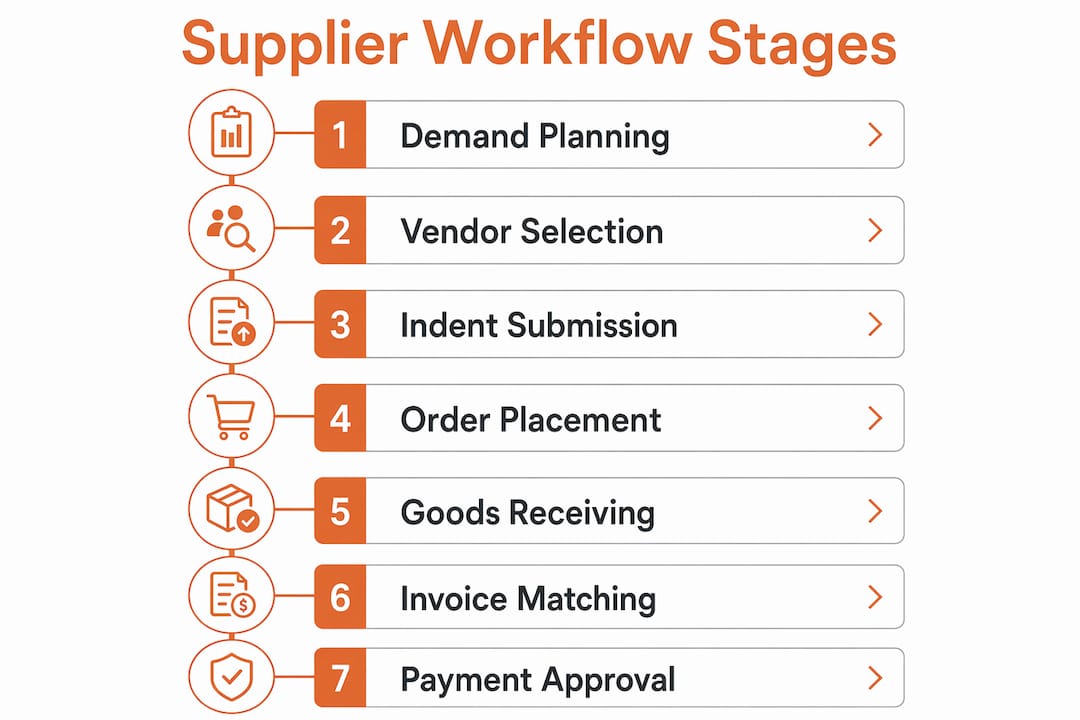
The construction supplier process follows a clear sequence. Each stage feeds the next, and skipping one creates compounding problems downstream.
-
Material planning and demand forecasting. The site team identifies what materials are needed, in what quantities, and by what dates. This stage sets the foundation for every purchase decision that follows.
-
Indent raising and approval. A material requisition, often called an indent, is submitted by the site team and routed through an approval chain. The approval captures project context: cost code, budget line, and required delivery date.
-
Purchase order creation and vendor communication. Once approved, the purchasing team issues a formal purchase order (PO) to the selected vendor. The PO locks in price, quantity, delivery terms, and payment conditions.
-
Delivery scheduling and goods receipt note verification. When materials arrive on site, the team completes a goods receipt note (GRN). The GRN must link directly to the original PO and the correct budget code. Failure to link GRN to PO and budget causes reconciliation problems at month end.
-
Invoice processing and three-way matching. The finance team matches the vendor invoice against the PO and the GRN. This three-way match confirms that what was ordered, received, and billed all align before payment is authorized. The construction industry carries an average net margin of 5–6%. A single erroneous payment can erase that margin entirely on a given job.
-
Payment authorization and close-out. Approved invoices move to payment. Closed POs feed back into project cost reports, giving project managers accurate budget visibility.
Pro Tip: Set up your indent form to require a cost code and delivery date before submission. This single step prevents the most common reconciliation errors at month end.
Each stage is a data handoff. When that data flows cleanly from one step to the next, your material inventory tracking stays accurate and your finance team spends less time chasing discrepancies.

How does effective vendor management integrate into construction supplier workflows?
Vendor management is not a separate function. It is woven into every stage of the supplier workflow for construction teams.
Vendor prequalification is the most effective risk-mitigation tool available. Prequalification screening prevents up to 80% of vendor performance issues before they reach your project site. That figure reflects a simple truth: the time you invest vetting a vendor upfront costs far less than managing a failed delivery mid-project.
A well-maintained vendor database should include:
- Compliance documents: insurance certificates, licenses, and safety certifications
- Performance history: on-time delivery rates, quality scores, and dispute records
- Financial stability indicators to flag vendors at risk of mid-project failure
- Bid response history to identify vendors who are consistently engaged
Firms should target a bid response rate of 70% or higher from their vendor pool. Any vendor bidding 30% or more above the average bid should be flagged for review. These two metrics alone give your purchasing team a fast filter for vendor reliability.
Automated alerts for insurance renewals, license expirations, and certification deadlines are not optional. Continuous, tiered supplier risk management with automated alerts is critical throughout the full contract duration. A vendor who was compliant at onboarding may lapse six months into a project without anyone noticing.
Pro Tip: Run a vendor database audit every quarter. Remove vendors with response rates below 50% and flag any with expired compliance documents. A clean database speeds up every future bid cycle.
What role does technology play in supplier workflow efficiency?
The difference between a functional supplier workflow and a high-performing one often comes down to software depth. Not all tools are equal.
| Feature | Surface-level integration | Deep EDI/API integration |
|---|---|---|
| Order confirmation | Manual email or phone call | Automatic confirmation from vendor system |
| Delivery status updates | Reactive, requires follow-up | Real-time tracking visible to all teams |
| Invoice matching | Manual comparison of PDFs | Automated three-way match against PO and GRN |
| Error rate | High, due to manual data entry | Low, data flows directly between systems |
| Team coordination | Siloed, each department works separately | Shared visibility across site, purchasing, and finance |
Surface-level integration, such as emailing PDFs, creates duplicate manual work and increases error rates. Deep integration through EDI or API connections means your vendor’s system talks directly to your purchase order software. Order confirmations arrive automatically. Delivery status updates without a phone call. Invoice data populates directly into your matching workflow.
For 2026 construction projects, platforms that connect purchase order management, GRN verification, and invoice reconciliation in a single environment give project managers real-time cost visibility. That visibility is what allows a project manager to catch a budget overrun in week three rather than week twelve.
Pro Tip: When evaluating purchase order software, ask vendors specifically whether their integration uses EDI or API connections. If the answer is “we send email notifications,” that is surface-level integration. Keep looking.
What are common pitfalls in construction supplier workflows?
Most supplier workflow failures share the same root causes. Recognizing them early saves significant cost and time.
-
Fractured communication between teams. Procurement failures result from communication silos among site, purchasing, and finance teams, not from missing documents. When the site team submits a verbal request and purchasing creates a PO without a cost code, finance cannot reconcile the invoice. The document exists. The connection does not.
-
GRNs not linked to POs or budget codes. When a delivery arrives and the GRN is created as a standalone document, month-end reconciliation becomes a manual investigation. Every unlinked GRN adds hours to your close-out process.
-
Ignoring vendor risk after onboarding. Many teams run thorough prequalification and then never check vendor compliance again. A vendor whose insurance lapses mid-project creates liability exposure that no amount of procurement documentation can fix.
-
Poor buyout execution. Poor buyout execution after contract award can erode 2–5% of project net margin before construction even starts. Rushing vendor selection to meet a project start date is one of the most expensive shortcuts in construction.
-
Choosing software for features over integration depth. A platform with a polished dashboard but shallow vendor connections still requires manual data entry at key handoff points. That manual work is where errors enter the workflow.
How can construction teams apply supplier workflow best practices?
Improving your supplier workflow does not require a full system overhaul. These steps produce measurable results when applied consistently.
-
Build structured indent and approval workflows. Every material request should capture project code, budget line, required date, and approver sign-off before it reaches purchasing. This context prevents downstream reconciliation errors.
-
Enforce three-way matching at every invoice. No invoice should reach payment without a confirmed match against the original PO and the GRN. Make this a non-negotiable step, not a spot-check.
-
Audit your vendor database quarterly. Review compliance documents, response rates, and performance scores. Remove inactive or non-compliant vendors. Add new vendors only after full prequalification.
-
Choose software with deep integration. Prioritize platforms that use EDI or API connections over those that rely on email-based updates. The efficiency gain compounds across every project.
-
Train site teams on mobile purchase request tools. When site supervisors can submit material requests and confirm deliveries from a mobile device, the data enters the system in real time. That real-time entry is what keeps your construction workflow software accurate without extra administrative work.
Key takeaways
A construction supplier workflow succeeds when every stage, from demand planning to invoice payment, is connected by accurate data, clear approvals, and continuous vendor oversight.
| Point | Details |
|---|---|
| Three-way matching is non-negotiable | Match every invoice to its PO and GRN before authorizing payment to protect project margins. |
| Prequalification prevents most vendor failures | Thorough vendor screening before onboarding prevents up to 80% of performance issues downstream. |
| GRNs must link to POs and budget codes | Unlinked GRNs cause month-end reconciliation problems that cost hours of manual investigation. |
| Deep software integration reduces errors | EDI/API-connected platforms eliminate manual data entry at critical workflow handoff points. |
| Vendor risk management must be ongoing | Automated compliance alerts throughout the contract duration prevent mid-project liability exposure. |
Why I think most teams underestimate the early stages
After working closely with construction teams for years, the pattern I see most often is this: contractors invest heavily in invoice processing and payment controls, then wonder why their margins still slip. The answer is almost always upstream.
The indent and approval stage is where most workflows quietly break down. A site supervisor calls in a verbal request. Purchasing creates a PO without a cost code. Finance receives an invoice with no matching GRN. By that point, three teams are spending hours reconstructing a paper trail that should have been built in five minutes at the start.
The other thing I have observed is that software depth matters far more than software features. I have seen teams adopt platforms with excellent dashboards that still require someone to manually email a PDF to the vendor and manually enter the confirmation. That is not integration. That is a digital filing cabinet.
The teams that protect their margins are the ones who treat procurement as a continuous data thread, not a series of disconnected transactions. They connect the GRN to the PO on the day of delivery. They run vendor audits before a project starts, not after a problem surfaces. They enforce three-way matching as a process, not a preference. That discipline is what separates a 5% margin from a 2% margin on the same job.
— Rowena
How Highlevelcrm-rconstructionsolutions supports your supplier workflow
Highlevelcrm-rconstructionsolutions is built specifically for contractors, drawing on over 30 years of construction industry experience. The platform addresses the exact workflow gaps that cost contractors margin: fragmented approvals, manual vendor tracking, and disconnected invoice reconciliation.
With automated approval routing, real-time order tracking, and centralized vendor compliance management, Highlevelcrm-rconstructionsolutions gives your purchasing, site, and finance teams a shared view of every active supplier transaction. Some users report lead conversion increases of 35% after adopting the platform. Explore the full list of CRM features and FAQs to see how the platform maps directly to your procurement workflow needs.
FAQ
What is a construction supplier workflow?
A construction supplier workflow is the end-to-end procurement process that manages material demand, vendor selection, purchase order issuance, delivery verification, and invoice payment. It is also called procurement management in formal construction project contexts.
Why does three-way matching matter in construction?
Three-way matching confirms that the vendor invoice, the purchase order, and the goods receipt note all align before payment is released. The construction industry’s average net margin of 5–6% means a single erroneous payment can eliminate profit on an entire job.
How does vendor prequalification reduce project risk?
Prequalification screening evaluates vendor compliance, financial stability, and performance history before a vendor is approved for bidding. Thorough prequalification prevents up to 80% of vendor performance issues that would otherwise surface during active construction.
What is the biggest cause of procurement failure in construction?
Fractured communication between site, purchasing, and finance teams is the primary cause of procurement failure, not missing documents. Siloed teams create data gaps that no amount of paperwork can fix after the fact.
How does software integration improve supplier workflows?
Deep integration through EDI or API connections allows vendor systems to communicate directly with your purchase order platform, automating confirmations, delivery updates, and invoice matching. This removes the manual data entry that causes most workflow errors.