
The Role of CRM in Remodeling: A 2026 Contractor Guide
Customer Relationship Management, or CRM, is the system remodeling contractors use to centralize client data, manage sales pipelines, and coordinate project workflows in one place. The role of CRM in remodeling goes far beyond storing contact information. Platforms like improveit360, Buildertrend, and HubSpot give remodelers a single source of truth for every lead, estimate, and job in progress. Businesses that invest in CRM software achieve an average ROI of $8.71 for every $1 spent. That return reflects what happens when scattered spreadsheets and sticky notes get replaced by a system built for how remodeling businesses actually operate.
How does a CRM system improve remodeling project management?
A CRM built for remodeling acts as the operating system for your entire pre-construction pipeline, connecting marketing, sales, and production without losing information at each handoff. Generic project management tools track tasks. A remodeling CRM tracks the client relationship behind every task.
The most immediate impact shows up in workflow structure. Remodeling projects follow predictable phases: initial consultation, design selection, estimate approval, permitting, construction, and final walkthrough. A CRM lets you build job templates for each project type, so your team follows the same process every time. That consistency cuts down on missed steps and rework.

Change orders are where many remodeling projects lose money and client trust. A CRM captures every change request, links it to the original contract, and flags it for approval before work continues. That paper trail protects you legally and keeps clients informed.
Crew and subcontractor coordination also improves significantly. When your production manager can see the full client history, including what was promised during the sales process, they avoid the costly errors that come from verbal handoffs. Integrated sales and production data prevents retyping errors and preserves client trust from the first call to the final punch list.
Key project management functions a remodeling CRM handles:
- Job templates for kitchens, bathrooms, decks, and additions that standardize your process
- Dependency tracking so tasks don’t start before prerequisites are complete
- Change order documentation linked directly to the client record
- Subcontractor scheduling with visibility into crew availability
- Material tracking integration to flag supply delays before they affect timelines
Pro Tip: Set up your CRM job templates before you onboard your team. Templates built around your actual project types, not generic ones, cut training time and reduce the chance of steps being skipped under pressure.
How does CRM improve client communication and lead conversion?
Remodeling has a longer sales cycle than most home services. A homeowner planning a kitchen renovation may take three to six months from first inquiry to signed contract. Without a system tracking every touchpoint, leads go cold and revenue walks out the door.
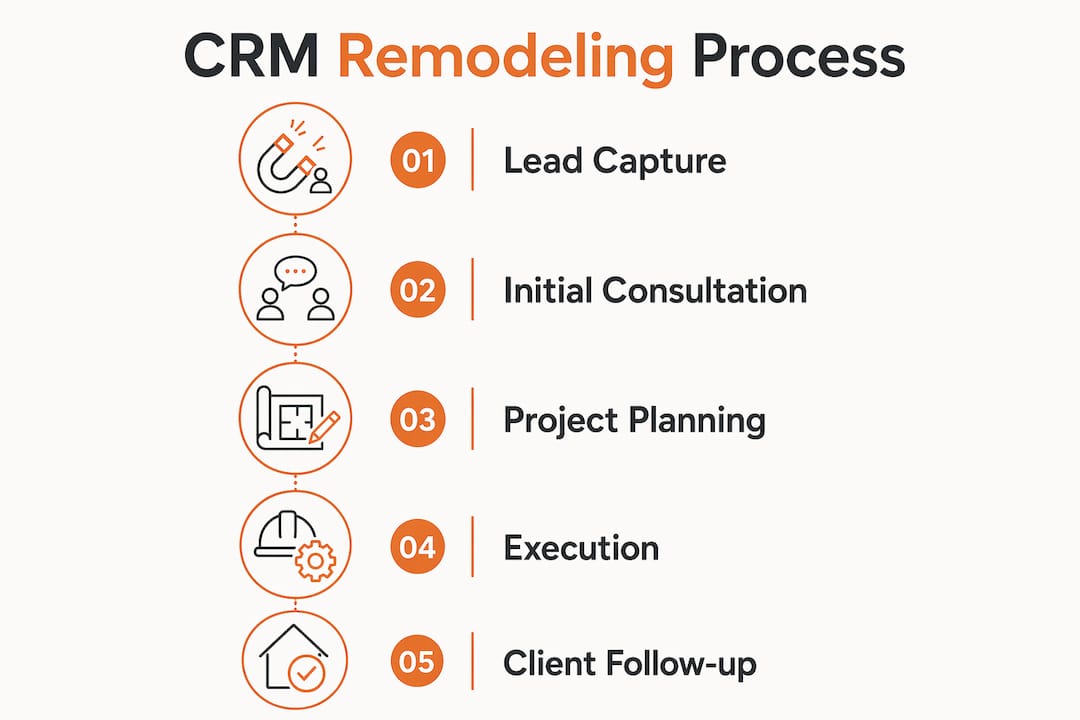
A CRM solves this by storing the full sales history for every prospect. Your sales rep can pick up a conversation weeks later and reference exactly what the client said about their budget, timeline, and design preferences. That level of continuity builds trust fast.
Automated follow-ups are one of the highest-value features in any remodeling CRM. Instead of relying on a salesperson to remember to call back, the system sends a scheduled message at the right interval. You can automate follow-up sequences for new leads, post-estimate check-ins, and project completion surveys without adding to your team’s workload.
The four ways CRM directly lifts lead conversion for remodelers:
- Lead source tracking shows which marketing channels produce your best clients, so you spend money where it works.
- Qualification scoring filters out low-budget inquiries early, saving your estimators hours each week.
- Automated reminders keep warm leads engaged during the decision period without manual effort.
- Faster estimate generation reduces the gap between inquiry and proposal. Remodeling CRM software can cut estimate creation time by 30%, which means clients get answers faster and competitors have less time to step in.
“A remodeler CRM should act as the operating system for the full pre-construction pipeline, connecting marketing to sales to production without loss of information.” — constructomarketing.com
What CRM features do remodeling contractors actually need?
Not every CRM fits a remodeling business. A platform designed for software sales or retail has a completely different data model than one built for construction. Specialized remodeling CRMs manage project types like kitchens, baths, and decks, along with budgets, timelines, selections, and photos. That specificity matters because your team should not be building workarounds just to track a tile selection or a permit date.
Core features every remodeling CRM must have
The non-negotiable features for a remodeling CRM include a visual sales pipeline, photo and plan attachments tied to the client record, budget and timeline tracking, and proposal management. Without these, you are paying for a contact database, not a business tool.
Integration with project management functions separates good remodeling CRMs from great ones. When your CRM talks to your scheduling tool, your accounting software, and your material ordering system, data flows without manual entry. That reduces errors and gives owners a real-time view of business health.
Comparing CRM platforms by remodeling business type
The best CRM depends on your sales process complexity and project size. Here is how the major platforms stack up:
| Platform | Best for | Key strength |
|---|---|---|
| improveit360 | Mid-size remodelers | Built specifically for home improvement sales cycles |
| Buildertrend | Full-service remodelers | Deep project management and client portal features |
| HubSpot | Remodelers with long sales cycles | Advanced pipeline automation and marketing tools |
| Jobber | Smaller shops needing quick quoting | Fast estimate creation and simple scheduling |
Pro Tip: Before you evaluate any platform, map your current sales process on paper. If you cannot describe your pipeline in five stages or fewer, the CRM will not fix the confusion. It will just automate it.
What happens when remodeling companies operate without a CRM?
The absence of a CRM does not just create inconvenience. It creates compounding operational failures that cost real money over time. A CRM tracks proposals, follow-ups, and project timelines in one place. Without that, decisions get made on incomplete information.
The most common pain points remodeling companies report without a CRM:
- Lost leads: Inquiries that came in during a busy week get buried in email and never followed up.
- Sales to production breakdowns: The production team starts a job without knowing what was promised during the sale, leading to client complaints and costly corrections.
- Fragmented communication: Client conversations happen across text, email, and phone with no central record. When a dispute arises, no one can reconstruct what was agreed.
- Manual proposal tracking: Estimators use spreadsheets to track which proposals are out, which have been accepted, and which need follow-up. That process breaks down at scale.
- Relationship decay: Clients who finished a project a year ago never hear from you again. Referrals and repeat business go to competitors who stayed in touch.
Each of these problems is solvable with a properly configured CRM. The cost of not solving them compounds every quarter.
How should remodeling businesses implement a CRM successfully?
Most remodelers who struggle with CRM adoption made the same mistake: they chose a platform based on features alone without assessing their operational readiness. CRM adoption is an organizational change, not just a software deployment. The technology only works if your team uses it consistently.
A practical implementation sequence for remodeling contractors:
- Audit your current process before selecting software. Document how leads come in, how estimates get created, and how jobs get handed to production. Gaps in your process will become gaps in your CRM.
- Plan your data migration carefully. Decide which existing contacts, proposals, and project records need to move into the new system and who is responsible for cleaning that data.
- Onboard your team in phases. Start with the sales team, get them using the pipeline daily, then bring in production. Trying to train everyone at once leads to low adoption across the board.
- Set up automations early. Automated lead follow-up, estimate reminders, and post-project surveys deliver immediate time savings and show your team the system’s value from day one.
- Verify the sales-to-production handoff. Before going live, confirm that every field your production team needs, including client preferences, selections, and contract details, transfers cleanly from the sales record.
Pro Tip: Assign one person as your CRM administrator for the first 90 days. That person owns data quality, answers team questions, and reports on adoption weekly. Without a dedicated owner, CRM rollouts stall.
Key Takeaways
A CRM is the single most effective tool a remodeling contractor can deploy to connect lead management, client communication, and project execution in one system.
| Point | Details |
|---|---|
| CRM delivers measurable ROI | Businesses average $8.71 returned for every $1 invested in CRM software. |
| Faster estimates close more deals | Remodeling CRMs cut estimate creation time by 30%, reducing the window for competitors to step in. |
| Specialized features matter | Remodeling CRMs track project type, budget, timeline, selections, and photos, unlike generic platforms. |
| Adoption requires a plan | Successful CRM rollout depends on data migration, phased training, and a dedicated administrator. |
| Sales-to-production handoff is critical | Full client data must transfer to the production team to prevent errors and protect client trust. |
Why I think most remodelers are still underusing their CRM
After working alongside contractors for years, the pattern I see most often is this: a remodeling company buys a CRM, enters their contacts, and then uses it as an expensive address book. The pipeline sits empty. The automations never get configured. The production team never logs in.
The problem is not the software. The problem is that most remodelers treat CRM implementation as a one-time setup rather than an ongoing practice. A CRM is only as good as the data your team puts into it and the processes you build around it. A system with half-complete records and no automations will not outperform a well-maintained spreadsheet.
What I have found actually works is starting small. Pick one workflow, typically lead follow-up, and get that running perfectly before adding complexity. Once your sales team sees that automated reminders are closing deals they would have otherwise lost, buy-in for the rest of the system comes naturally.
The remodelers who get the most from their CRM also customize it to their specific project types. A company that does primarily bathroom renovations has a different sales cycle and selection process than one focused on whole-home additions. Generic templates do not serve either business well. The investment in customization pays back quickly.
CRM is not a magic fix. It is a system that rewards discipline. The contractors who commit to it, train their teams properly, and review their pipeline data weekly are the ones who report the strongest results. That commitment is the real differentiator, not the platform.
— Rowena
How Highlevelcrm-rconstructionsolutions supports remodeling contractors
Highlevelcrm-rconstructionsolutions was built with over 30 years of construction experience behind it. That background shows up in features that generic CRMs simply do not offer: automated lead tracking designed for contractor sales cycles, custom reporting dashboards that reflect how remodeling businesses measure success, and workflow tools that connect your sales pipeline directly to production.
Contractors using Highlevelcrm-rconstructionsolutions report lead conversion increases of up to 35%, with significant reductions in project management time and errors. The platform integrates with industry-specific tools and gives your team the data they need at every stage of a project. Explore the full CRM features and FAQs to see exactly how the platform maps to your remodeling workflow, or visit the industries we serve page to see how other contractors are using it.
FAQ
What is the role of CRM in remodeling?
A CRM in remodeling centralizes client data, manages the sales pipeline, and connects sales to production in one system. It prevents lost leads, speeds up estimates, and keeps client communication consistent from first inquiry to project completion.
Which CRM is best for remodeling contractors?
The best CRM depends on your sales process complexity. HubSpot fits remodelers with long sales cycles, Jobber works well for quick quoting, and platforms like improveit360 and Buildertrend are built specifically for home improvement and full-service remodeling businesses.
How does CRM help with lead conversion in remodeling?
CRM automates follow-up sequences, tracks lead sources, and speeds up estimate generation. Remodeling CRM software can reduce estimate time by 30%, which closes the window for competitors and keeps prospects engaged.
What happens if a remodeling company does not use a CRM?
Without a CRM, leads get lost, sales-to-production handoffs break down, and client communication becomes fragmented across email, text, and phone. Those failures erode client trust and reduce repeat business and referrals over time.
How long does it take to implement a CRM for a remodeling business?
Implementation time varies by company size and data complexity, but most remodeling businesses complete a phased rollout in 30–90 days. Successful adoption requires planned data migration, team training, and a dedicated administrator for the first quarter.