
The Role of Follow-Up in Lead Conversion for Contractors
Follow-up in lead conversion is the structured, persistent engagement with prospects after initial contact that drives 80% of B2B sales to close between the 5th and 12th touchpoint. For construction sales professionals, this is not a soft skill. It is the difference between a signed contract and a competitor walking away with your project. Most reps quit too early, rely on a single channel, and send messages that add zero value. This article gives you the data, the channel mix, the message frameworks, and the automation approach to fix all three problems.
What the data says about follow-up frequency and timing
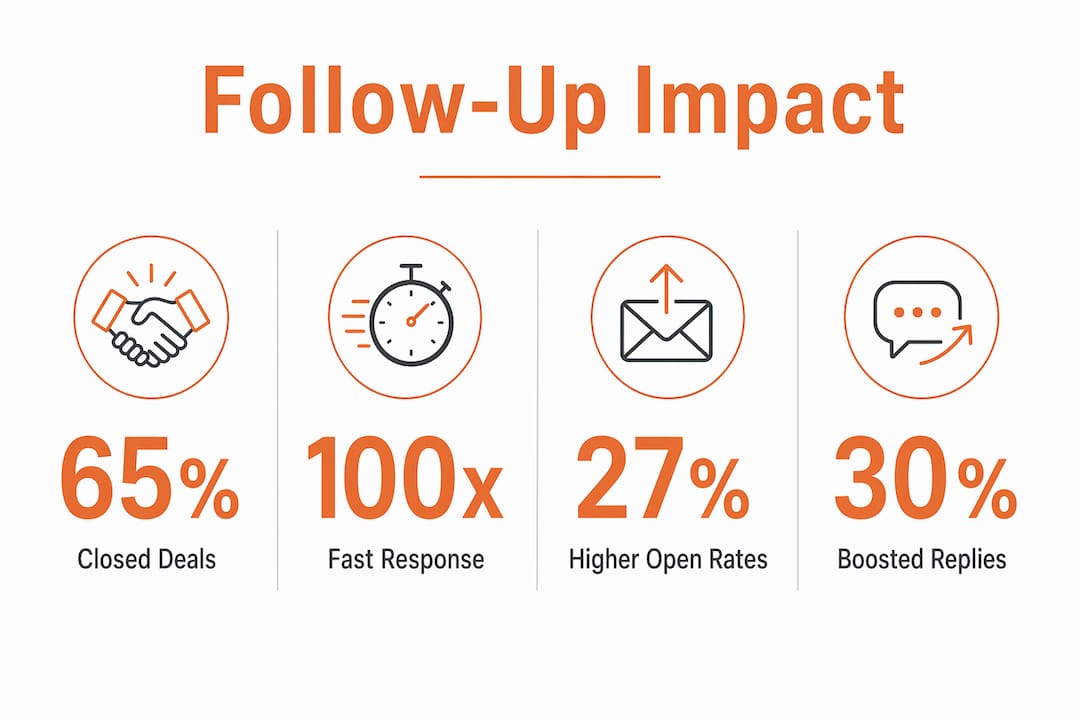
The numbers on follow-up frequency are stark and worth understanding precisely. Conversion rates by touchpoint break down as follows: touches 1 and 2 close roughly 20% of deals, touches 3 and 4 close about 15%, and touches 5 through 12 close the remaining 65%. That means the majority of your wins live in the follow-up range most reps never reach.
The reason reps stop early is rarely strategy. It is discomfort. Forty-four percent of sales professionals quit after the first or second attempt, which means they are abandoning more than half of their potential revenue before the conversation even gets competitive. In construction, where project cycles are long and decision-makers are juggling site schedules, a prospect going quiet after touch two is normal, not a rejection.
Timing matters as much as frequency. Responding to inbound leads within 5 minutes makes you 100 times more likely to qualify that prospect compared to waiting 30 minutes. That window closes fast, especially when a general contractor is getting quotes from three subcontractors simultaneously.
The spacing between touches also shapes results. Behavior-triggered follow-up sequences, which fire based on actions like opening an email or visiting your pricing page, convert 2 to 3 times better than fixed time-based drip campaigns. This matters because it means your follow-up lands when the prospect is already thinking about you, not on an arbitrary schedule.
| Touchpoint range | Estimated close rate | Key implication |
|---|---|---|
| Touches 1–2 | ~20% | Most reps stop here and leave 80% on the table |
| Touches 3–4 | ~15% | Engagement deepens; value must increase |
| Touches 5–12 | ~65% | The majority of deals close in this range |
Pro Tip: Set a calendar reminder to review your CRM pipeline weekly and flag any lead that has not received a follow-up in more than five business days. Stale leads in construction are almost always recoverable with the right message.
How multi-channel follow-up improves response rates
Single-channel follow-up is one of the most common and costly mistakes in construction sales. Multi-channel follow-up improves response rates by approximately 287% compared to email-only outreach. That is not a marginal gain. It is a structural advantage that compounds across every lead in your pipeline.

The most effective channel mix combines phone, email, LinkedIn, SMS, and short video messages. Each channel serves a different purpose and reaches prospects in different mental states. Phone calls convert 3 to 5 times more than email alone but are consistently underused because reps find them uncomfortable. SMS works well for time-sensitive follow-ups with field contacts who rarely check email during the workday. LinkedIn is effective for reaching project managers and procurement leads at larger general contractors.
Rotating channels across your sequence also avoids spam filters and prevents recipient fatigue. Sending five emails in a row to the same address increases the chance of landing in junk folders and signals low effort to the prospect. A varied sequence signals that you are organized and genuinely interested in their project.
Here is a practical channel rotation for a construction lead sequence:
- Touch 1 (Day 1): Phone call within 5 minutes of inbound inquiry
- Touch 2 (Day 2): Personalized email with a relevant project example or case study
- Touch 3 (Day 4): LinkedIn connection request with a short, specific note
- Touch 4 (Day 7): SMS or second phone call referencing the earlier conversation
- Touch 5 (Day 10): Short video message (under 90 seconds) walking through your proposal or approach
- Touch 6 (Day 14): Email with a new piece of value, such as a local project cost benchmark or material update
- Touch 7 (Day 21): Breakup email (see Section 4)
Threaded follow-up emails, which reply to the original message thread rather than starting a new one, see 27% higher open rates. This is a simple formatting change that costs nothing and improves visibility.
What makes a follow-up message worth reading
The most common follow-up email in construction sales is some version of “just checking in to see if you had a chance to review my proposal.” That message has a 1% reply rate. It adds no value, signals no preparation, and gives the prospect no reason to respond.
Every follow-up must carry something the prospect did not have before. The format of that value varies by stage and relationship, but the principle is fixed. Here are the most effective value types for construction sales follow-ups:
- Industry data: Share a relevant cost index, material price update, or local permit timeline that affects their project.
- Case study or project reference: Briefly describe a similar project you completed, including scope, timeline, and outcome.
- Tactical tip: Offer one specific recommendation based on what you know about their project, such as a phasing suggestion or a subcontractor coordination note.
- Regulatory or compliance update: Flag a code change or inspection requirement that affects their build type or region.
- Social proof: Mention a recent review, a completed project in their area, or a referral from a mutual contact.
Personalization in follow-up messages boosts response rates by over 30%, and referencing specific prospect activity or industry context increases replies by up to 88%. Personalized subject lines alone improve open rates by 30.5%. These are not small improvements. They are the difference between a sequence that generates meetings and one that generates unsubscribes.
The breakup email deserves special attention. Sent as the final touch in a sequence, it signals that you are closing the file and will not follow up again unless the prospect reaches out. Breakup emails generate 10 to 20% of remaining responses by triggering loss aversion. Prospects who were passively interested but not responding often reply when they realize the conversation is ending. The reply rate for breakup emails runs between 15 and 25%, making them the highest-performing individual message in most sequences.
Pro Tip: Keep your breakup email under five sentences. State that you are closing the file, leave the door open for future contact, and wish them well on the project. No guilt, no pressure. Polite closure converts better than a final hard push.
Building an automated follow-up process for construction sales teams
Consistent follow-up at scale is not a willpower problem. It is a systems problem. Automation combined with human personalization removes the reliance on individual reps remembering to follow up and replaces it with a process that runs regardless of how busy the job site gets.
For construction sales teams, the automation priorities are:
- Immediate response triggers: Set up automated acknowledgment messages that fire within 60 seconds of a web form submission or inbound inquiry, so the prospect knows you received their request even before a rep calls.
- Behavior-triggered sequences: Use CRM tools to detect when a prospect opens a proposal email or revisits your website, then trigger a follow-up call task or personalized message within the hour.
- On-site logging discipline: Field reps should log next steps into the CRM before leaving a job site visit. Fast on-site follow-up combined with CRM logging preserves momentum and prevents leads from going cold between site visits and office hours.
- Pipeline stage automation: When a lead moves to a new stage, such as “proposal sent” or “awaiting decision,” the CRM should automatically enroll them in the appropriate follow-up sequence without manual input.
- Reminder and escalation rules: If a lead has not been contacted in a defined window, the CRM should alert the rep or manager so nothing falls through the cracks.
The automated lead tracking approach works because it removes the cognitive load from reps who are already managing site schedules, subcontractor coordination, and client calls. When the system handles sequencing, reps can focus on the quality of each individual touchpoint rather than trying to remember who needs a call today.
Common follow-up mistakes in construction sales and how to fix them
Construction sales teams make predictable follow-up errors, and most of them are fixable with a defined process. The most damaging mistakes are:
- Stopping after one or two touches: This is the most expensive mistake. Given that 65% of deals close between touches 5 and 12, early abandonment is a direct revenue loss.
- Using only email: Email-only sequences miss prospects who are on-site, in meetings, or simply inbox-fatigued. Add phone and SMS at minimum.
- Sending identical messages: Repeating the same message with a different date signals low effort and irritates prospects. Each touch needs a new angle or piece of value.
- Ignoring timing signals: Sending a follow-up the day after a prospect just replied is too soon. Sending one six weeks after initial contact without any intermediate touches is too late. Use CRM data to calibrate spacing.
- No defined cadence: Without a written sequence, follow-up becomes inconsistent. Some leads get five touches in a week; others get none for a month. A defined cadence removes this variability.
Avoiding RFI workflow mistakes in subcontractor communication follows the same logic: unclear processes create gaps, and gaps cost contracts. The fix is the same in both cases. Write the process down, build it into your tools, and measure it.
Pro Tip: Track three metrics for every follow-up sequence: open rate, reply rate, and meeting booked rate. If open rates are low, fix your subject lines. If reply rates are low, fix your message content. If meeting rates are low, fix your call to action.
Key takeaways
Disciplined, multi-channel follow-up sequences that run through at least 5 to 12 touchpoints are the single most reliable driver of lead conversion in construction sales.
| Point | Details |
|---|---|
| Persistence through 12 touches | 65% of B2B deals close between touches 5 and 12; stopping early abandons most of your pipeline. |
| Multi-channel outreach | Mixing phone, email, LinkedIn, and SMS improves response rates by up to 287% over email alone. |
| Value in every message | “Just checking in” emails get a 1% reply rate; each touch must add a new data point, case study, or tip. |
| Automate the sequence | Behavior-triggered CRM automation removes memory reliance and keeps follow-up consistent at scale. |
| Speed on inbound leads | Responding within 5 minutes makes you 100 times more likely to qualify an inbound prospect. |
What I’ve learned about follow-up discipline in construction sales
Construction sales has a cultural bias against persistence. Reps worry about being seen as pushy, and that worry causes them to abandon leads that were genuinely interested but just busy. I have seen this pattern repeat across dozens of contractor sales teams, and the cost is always the same: a competitor who was willing to make one more call wins the contract.
The mindset shift that actually works is reframing follow-up as a service rather than a pressure tactic. When you follow up with a material cost update or a relevant project reference, you are giving the prospect something useful. You are making their decision easier. That is not intrusive. That is good sales practice.
The construction industry also has a timing dynamic that generic sales advice ignores. Decision-makers are often unreachable during peak site hours and more accessible early morning or late afternoon. Sequences that account for this rhythm outperform those that fire at standard business hours. Pair that with scheduling conflict awareness and you start reaching people when they are actually in a position to respond.
The teams I have seen convert the most leads are not the ones with the best proposals. They are the ones with the most consistent follow-up process. Automation handles the cadence. Personalization handles the content. Discipline handles the rest.
— Rowena
How Highlevelcrm-rconstructionsolutions supports your follow-up process
Highlevelcrm-rconstructionsolutions was built specifically for contractors, with over 30 years of construction industry experience behind its design. It handles the follow-up challenges described in this article directly: automated multi-channel sequences, behavior-triggered responses, on-site CRM logging, and pipeline stage automation are all built into the platform.
Contractors using Highlevelcrm-rconstructionsolutions report lead conversion rate increases of up to 35%, driven largely by consistent automated follow-up that runs even when the team is on-site. If you want to see exactly which features support your follow-up workflow, the CRM features and FAQs page covers the full capability set. You can also explore the industries we serve page to see how the platform is configured for your specific construction niche.
FAQ
How many follow-ups does it take to close a construction lead?
Research shows 65% of B2B deals close between the 5th and 12th touchpoint. Plan for a minimum of 7 to 10 follow-ups before marking a lead as lost.
What is the best timing for the first follow-up?
Responding within 5 minutes of an inbound inquiry makes you 100 times more likely to qualify the prospect. Use automated acknowledgment messages to cover this window even when reps are on-site.
What should I say in a follow-up email?
Every follow-up message must add specific value such as a project case study, material cost update, or relevant industry data. The “just checking in” approach averages a 1% reply rate and should be avoided entirely.
What is a breakup email and when should I use it?
A breakup email is the final message in a sequence, signaling that you are closing the file. It generates 10 to 20% of remaining responses by triggering loss aversion and carries the highest reply rate of any individual follow-up message.
How does CRM automation improve follow-up consistency?
CRM automation removes the reliance on individual reps remembering to follow up, replacing it with behavior-triggered sequences and pipeline stage rules that fire automatically. The benefits of automated follow-up are especially significant for construction teams managing both field and office workflows simultaneously.