Why Bay Area Builders Lose to Competition: A Contractor's Guide
Bay Area builders lose work before the first conversation happens. Buyers screen contractors out based on digital signals, perceived schedule risk, and price gaps created by unlicensed competitors, and most contractors never know it occurred. The fix starts with one action: audit your digital trust signals and automate your lead acknowledgment so you stop being eliminated before anyone picks up the phone.
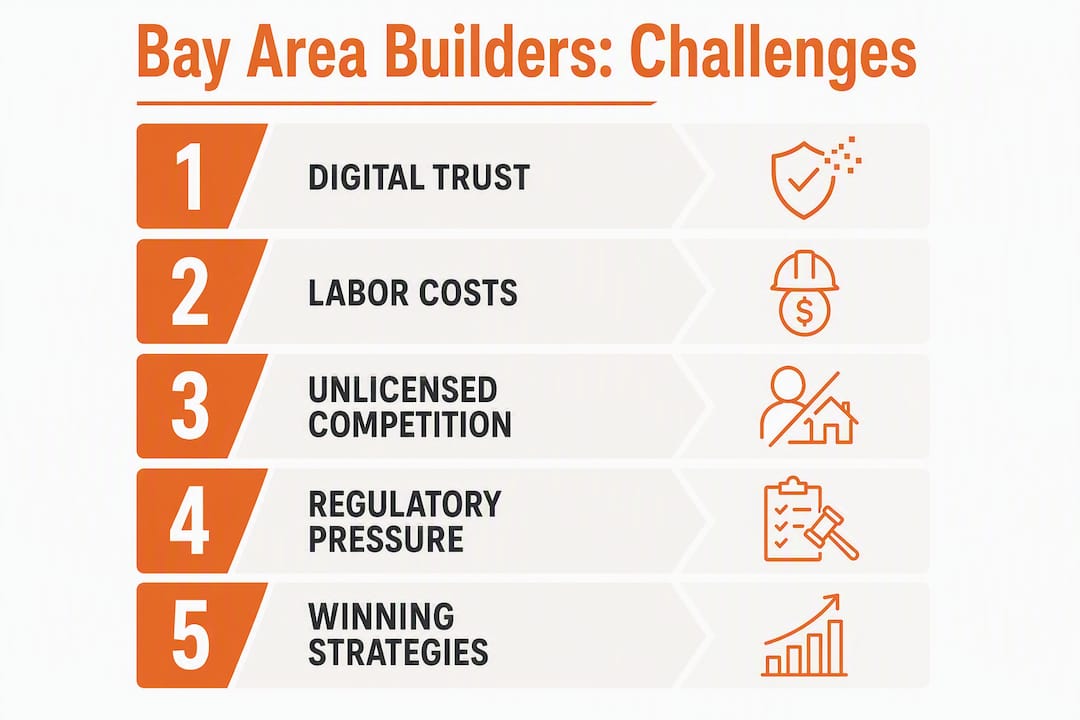
The five root causes behind most lost bids:
- Weak digital presence — no map pack visibility, stale reviews, or a slow website that fails the buyer’s silent screening
- Perceived operational risk — no preconstruction discipline, no subcontractor capacity checks, no clear project references with local permit context
- Labor cost pressure — Bay Area wage premiums price licensed contractors above informal competitors on paper, even when the real risk-adjusted cost favors the licensed firm
- Unlicensed undercutting — informal competitors offer lower bids by skipping insurance, licensing fees, and code compliance, creating a price gap buyers sometimes accept without understanding the exposure
- Slow estimating and follow-up — firms that take days to respond or submit vague bids lose to faster, more organized competitors regardless of actual capability
Table of Contents
- What does the Bay Area construction market actually look like right now?
- Why Bay Area builders lose to competition: the root causes explained
- How do modern buyers actually pick a contractor?
- What do winning Bay Area firms do differently?
- A firm that stopped losing work by changing its process
- How long do these fixes take, and what do they cost?
- Key Takeaways
- The operational cost of losing work you should have won
- How a construction-specific CRM closes the gap between losing and winning
- Authoritative sources and further reading
What does the Bay Area construction market actually look like right now?
The Bay Area market is not one market. The Bay Area market shows regional variation in construction job trends, with some areas adding jobs while others experience declines, a split driven by AI campus and hyperscale data center work concentrating in the South Bay and Peninsula. That concentration pulls skilled trades toward high-paying tech-adjacent projects, which tightens labor availability for everyone else and pushes wage rates up across the region.
“Demand is steady, but profitability is under pressure from rising wages and benefits. Contractors are building internal workforce pipelines to mitigate structural labor competition.” — AGC of California 2026 Outlook
On the regulatory side, Title 24 energy compliance and CalGreen requirements are not optional add-ons. They are baseline scope items that every compliant bid must include, which automatically increases bid complexity and cost relative to informal competitors who ignore them. San Francisco’s seismic requirements and the city’s First Source Hiring Program add further layers that require local expertise to price correctly.
New California contractor laws taking effect in 2026 increase penalties for unlicensed contracting and make informal competition less economically viable over time. That is a tailwind for licensed firms, but only if they can survive the near-term price pressure and present their compliance as a value signal rather than a cost burden.
Why Bay Area builders lose to competition: the root causes explained
Digital trust failures
Buyers run a search before they call anyone. If your Google Business Profile shows outdated hours, your website loads slowly on mobile, or your last review is from two years ago, you are eliminated before the conversation starts. This silent screening process is how most contracts are lost, and most contractors never see it happen.

Specific signals that trigger elimination: inconsistent NAP (name, address, phone) data across directories, no project photos with local permit or seismic context, and no visible response to negative reviews. A buyer comparing three contractors will default to the one whose digital presence signals competence and reliability, even if the others are technically superior.
Operational transparency failures
Buyers who get past the digital screen next evaluate whether you can actually deliver on schedule. Weak estimating, vague scope definitions, and no evidence of subcontractor capacity checks all read as schedule risk. California commercial contractors winning work now invest in estimating technology, BIM coordination, and bid management to compete on speed and accuracy rather than price alone.
Statistic callout: Winning GCs treat Title 24 and California code requirements as baseline operational capability and differentiate by removing those scopes from owner risk during preconstruction — not by pricing them as extras.
Labor and wage pressure
The South Bay wage premium is real and measurable. Trades that can earn more on a hyperscale data center project will, which means licensed contractors bidding residential or mid-market commercial work face a smaller, more expensive labor pool. That cost shows up in every bid. Buyers who do not understand the labor market see only the number, and informal competitors who pay below-market wages look attractive by comparison.
Unlicensed and informal competition
Under California Business & Professions Code 7031, an unlicensed contractor cannot legally enforce a contract or collect payment, and the owner may be able to recover all compensation paid. Buyers rarely know this. Unlicensed competitors skip licensing fees, workers’ comp, and code compliance costs, creating a bid gap that looks like savings to an uninformed buyer. SB 779’s increased penalties help, but enforcement is not instant, and the short-term undercutting dynamic remains active.
Regulatory complexity and materials cost pressure
Title 24 scope creep, permit fee increases, and rising material costs all raise the floor on compliant bids. Contractors who do not build these costs into their estimating systems accurately either lose on margin when they win or lose the bid when they price correctly. Rising material costs and longer lead times are reshaping how Bay Area projects get planned and priced in 2026, and firms without real-time cost data in their estimating workflow are consistently behind.
How do modern buyers actually pick a contractor?
The typical buyer workflow runs in this order: Google search, map pack scan, website review, portfolio check, review scan, then contact. Most buyers never reach the contact step with contractors who fail the first four. Tech-forward firms that appear in local map packs and use automated lead tracking capture more high-value projects because they pass the silent screen and respond faster.
What buyers are specifically looking for at each step:
- Map pack: proximity, star rating above 4.0, recent reviews (within 90 days)
- Website: project photos with local context (permit type, neighborhood, seismic zone), clear service area, mobile load speed under 3 seconds
- Portfolio: evidence of projects similar in scope and location to the buyer’s need
- Reviews: responses to negative reviews (shows professionalism), volume of reviews from the past 12 months
- Contact: response within hours, not days; a professional acknowledgment that confirms receipt and sets a next step
Fast wins you can implement this week: update your Google Business Profile with current hours and three recent project photos, request reviews from your last three completed clients, and set up an automated email acknowledgment for new inquiries. These three changes alone move you past the first two elimination filters.
Pro Tip: Run a 10-minute pre-call audit on your own company. Search your business name on Google, check your map pack listing, load your website on a mobile phone, and read your three most recent reviews. What you see is exactly what a buyer sees. Fix the first thing that would make you hesitate.
What do winning Bay Area firms do differently?
Firms that consistently win work in this market have made specific operational investments. Here is the prioritized sequence:
- Fix digital trust signals (Week 1–2). Update GBP, add project photos with local permit context, and respond to all reviews. This is the highest-leverage action per hour invested.
- Automate lead acknowledgment (Week 2–4). Set up an automated follow-up sequence that confirms receipt within minutes and schedules a call. Buyers who get a fast, professional response rarely keep shopping.
- Implement estimating technology (Month 1–3). Move from spreadsheet estimates to a platform that pulls current material costs and generates consistent, professional bid documents. Speed and accuracy both improve.
- Run subcontractor backlog audits before bidding (Ongoing). Firms that conduct availability and backlog audits with subcontractors before submitting bids report fewer schedule failures and higher repeat client trust. A 15-minute capacity check before each bid prevents the downstream problems that destroy client relationships.
- Automate CSLB license monitoring (Month 2–4). Embed license status checks into your subcontractor prequalification workflow. Manual checks get skipped; automated gates do not.
- Build Title 24 expertise in-house (Month 3–12). Contractors who can price and manage Title 24 compliance without subcontracting it out remove a major risk variable from their bids and present a cleaner scope to buyers.
Pro Tip: For subcontractor prequalification, add a capacity flag to your bid decision checklist: “Has this sub confirmed availability for our project window?” Firms that skip this step win bids and then lose clients when a sub is double-booked. Labor productivity tracking tools can help you monitor sub performance over time and build a reliable bench.
A firm that stopped losing work by changing its process
Consider a mid-size Bay Area commercial contractor that was consistently losing bids to competitors it knew were less experienced. The pattern: buyers were not calling back after the initial inquiry, and the firm’s win rate on competitive bids was declining despite strong references.
The changes made over 90 days: updated Google Business Profile with project photos tagged to specific neighborhoods and permit types, implemented an automated CRM follow-up sequence that acknowledged every new inquiry within 15 minutes, and added a subcontractor capacity audit step to the pre-bid checklist.
Within the first quarter, the firm’s lead-to-call conversion improved measurably. According to internal data from Highlevelcrm-rconstructionsolutions users, contractors using construction-specific CRM workflows report approximately a 35% increase in lead conversion, as do other users who close the response-time gap.
The subcontractor audit step had a secondary benefit: the firm identified two subs whose CSLB licenses had lapsed, which would have created legal exposure under California Business & Professions Code 7031 had those subs been used on a project.
How long do these fixes take, and what do they cost?
| Fix | Timeline | Effort / Cost Range | Notes |
|---|---|---|---|
| GBP update + review requests | 1–2 weeks | Low (2–4 hours staff time) | Highest ROI per hour; do this first |
| Automated lead acknowledgment | 2–4 weeks | Low to moderate (CRM setup) | Requires a CRM or email automation tool |
| Estimating technology | 1–3 months | Moderate (typical SaaS pricing) | Scales with company size; ROI improves with bid volume |
| Subcontractor backlog audits | Immediate (process change) | Low (checklist addition) | No cost; requires discipline to maintain |
| CSLB license monitoring automation | 1–2 months | Low to moderate (integration setup) | Reduces legal risk; longer payback curve |
| Title 24 in-house expertise | 6–12 months | High (training or hire) | Differentiates bids; payback over multiple projects |
Firms with limited budgets should phase investments in this order: digital trust fixes first (near-zero cost, immediate impact), then CRM automation (moderate cost, fast payback through improved conversion), then estimating tech and compliance automation together. Title 24 expertise is a longer-term investment that pays off most on projects above a certain scope threshold.
Key Takeaways
Bay Area builders lose work primarily because buyers eliminate them during silent digital screening and because structural cost pressures make unlicensed competitors appear cheaper without the risk being visible.
| Point | Details |
|---|---|
| Fix digital trust first | Update your Google Business Profile, add local project photos, and respond to reviews before anything else. |
| Automate lead follow-up | An automated acknowledgment within 15 minutes keeps buyers from moving to the next contractor on the list. |
| Audit subcontractors before bidding | A 15-minute capacity and license check before each bid prevents schedule failures and legal exposure. |
| Invest in estimating technology | Accurate, fast bids with current material costs win more work than low bids with vague scope. |
| Highlevelcrm-rconstructionsolutions | Construction-specific CRM with automated lead tracking and bid dashboards addresses the upstream visibility and follow-up failures that cause silent-screening losses. |
The operational cost of losing work you should have won
The most underestimated cost in Bay Area construction is not the lost contract itself. It is the cumulative effect of losing bids you were qualified to win because a buyer never trusted you enough to call. That pattern compounds: fewer wins mean fewer references, fewer references mean weaker digital proof, and weaker digital proof means more silent-screen eliminations. The cycle is self-reinforcing.
What the evidence shows is that the firms breaking this cycle are not necessarily the best builders in the market. They are the most organized ones. They respond faster, their bids are cleaner, their subcontractor bench is verified, and their digital presence signals competence before anyone speaks. The technical skill was never the differentiator. The operational infrastructure around the technical skill is what separates firms that grow from firms that plateau.
The contractors I see struggle most are the ones who believe their reputation should do the work that their systems are not doing. Reputation matters, but it only reaches the buyers who already know you. For everyone else, your Google Business Profile, your response time, and your bid document are your reputation.
How a construction-specific CRM closes the gap between losing and winning
The problems documented above — slow follow-up, missed leads, unverified subcontractors, inconsistent bid tracking — are exactly what a construction-specific CRM is built to address. Highlevelcrm-rconstructionsolutions was developed with over 30 years of construction industry experience and is built specifically for contractors, not adapted from a generic sales tool.
Three capabilities that directly change buyer perception and operational reliability:
- Automated lead tracking and follow-up sequences send a professional acknowledgment within minutes of a new inquiry, keeping you in the conversation while competitors are still drafting a reply. Users report approximately a 35% increase in lead conversion after implementing these workflows.
- Bid-tracking dashboards give your estimating team a single view of active bids, follow-up status, and win/loss data, so you can identify where bids are stalling and adjust.
- Subcontractor communication and status integrations reduce the manual work of license checks and capacity confirmations, embedding compliance into your workflow rather than leaving it to chance.
If you are ready to stop losing bids to slower, less organized competitors, see the full feature set and request a demo at the CRM Features & FAQs page.
Authoritative sources and further reading
- AGC of California 2026 Outlook — Labor market data, wage pressure trends, and contractor profitability outlook for California; start here for regional benchmarking.
- CalBizJournal: California Commercial Construction — Analysis of how preconstruction investment and estimating tech are reshaping competitive dynamics in California.
- Builder Outlook: Why contractors lose contracts before the first call — Detailed breakdown of the silent screening process and the digital signals buyers use to eliminate contractors early.
- Tenaya360: SEO for Contractors — Practical guide to local search visibility and map pack ranking for construction firms.
- ContractorPathway: New California Contractor Laws for 2026 — Current summary of 2026 law changes affecting licensing, penalties, and compliance requirements.
- Pegbo Blog: SB 779 and unlicensed contractor crackdown — Explains the legal risk of working with unlicensed subs and how to automate CSLB checks.
- DesCor Builders: Local contractors on labor, tariffs, and AI — Practitioner perspectives on subcontractor audits, backlog management, and current market conditions.
- The Registry SF: Northern California construction job splits — Regional labor market data showing the South Bay/Peninsula concentration and its effect on trade availability.
- ConstructionBids.ai: San Francisco construction bids guide — Overview of SF-specific compliance requirements including seismic standards and the First Source Hiring Program.
- Gidel & Kocal: 2026 Bay Area commercial construction trends — Forward-looking analysis of material costs, lead times, sustainability requirements, and labor in the Bay Area market.