
Affordable Lead Generation for Construction Businesses | High Level CRM - R. Construction Solutions
The three highest-ROI channels for affordable lead generation in a construction business are local SEO (Google Business Profile plus trade-and-city pages), structured referral programs, and phone-call attribution tied to a construction-specific CRM. Start there before spending a dollar on paid ads. Construction marketing ROI often delivers strong returns, with long-term SEO potentially providing notably higher ROI compared to many paid channels. — figures that dwarf most paid channels. Meanwhile, phone leads convert at a notably higher rate than typical web-form inquiries, yet most contractors have no idea which campaign generated the call. Fix that gap first. Your immediate first action: audit your Google Business Profile today and connect a call-tracking number so every inbound call is attributed to a source.
Key stat: Construction marketing ROI averages 280–350%, with long-term SEO reaching up to 681% — making owned channels the most cost-effective leads for contractors over time.
Table of Contents
- TL;DR: six tactics and your first step this hour
- How does local SEO give you the most affordable contractor leads?
- Why referral programs deliver the fastest short-term ROI
- Phone-call attribution: the KPI most contractors ignore
- Affordable paid advertising: when to turn it on
- Does your website actually convert the traffic you’re already getting?
- How CRM automation stops your leads from falling through the cracks
- What does each tactic cost and how long before you see leads?
- Which KPIs actually tell you if your marketing is working?
- Your 90-day plan to build affordable lead flow
- Why Highlevelcrm-rconstructionsolutions converts more construction leads
- Key Takeaways
- What contractors actually get wrong about lead generation
- See what Highlevelcrm-rconstructionsolutions can do for your pipeline
TL;DR: six tactics and your first step this hour
Six affordable tactics, ranked by impact:
- Local SEO + Google Business Profile — highest long-term ROI; free to maintain in-house
- Referral program — fastest close rates; referral marketing contributes a significant share of total leads for contractors with structured programs
- Call tracking with attribution — ties every phone lead to a campaign; prevents budget waste
- Conversion-focused landing pages — dedicated pages convert roughly 60% better than general site pages
- Targeted paid ads (after attribution is live) — Google Ads CPL and Local Services Ads costs vary widely depending on trade and market, generally ranging from lower to moderate amounts per lead
- CRM automation — closes the follow-up gap that loses most contractor leads
First step: Open Google Business Profile right now, verify your hours, add five recent project photos, and enable the call button. Takes under 30 minutes and starts generating local impressions within days.
How does local SEO give you the most affordable contractor leads?
Organic search drives roughly 52% of construction website traffic, making it the single largest traffic source available to you at near-zero marginal cost once established. Local SEO compounds: a page you optimize today keeps generating calls in year three without additional spend.
| Local SEO action | Cost | Timeline to results |
|---|---|---|
| Google Business Profile completeness | Free | 2–4 weeks |
| Service-area pages (trade + city) | Low (in-house) | 1–3 months |
| Project photo updates (weekly) | Free | Ongoing |
| Review collection system | Free | 1–2 months |
| Schema markup basics | Low (one-time) | 4–8 weeks |
| Mobile page speed fix | Low–medium | 2–4 weeks |
Measure your progress with Google Search Console (query impressions by city), calls from your Business Profile, and local map pack rankings for your top three service keywords. Firms that invest in local SEO see a 40% higher local lead conversion rate than those that skip it.
Why referral programs deliver the fastest short-term ROI
A referred prospect arrives pre-sold. They already trust you because someone they trust vouched for you, which is why referral close rates consistently outperform every paid channel. Structured referral programs can boost conversions significantly over firms without them, and companies with a strong referral program see a 25% lower customer acquisition cost than those relying on cold channels.
Getting started takes three things:
- A referral intake script — ask every client on completion day: “Do you know anyone planning a renovation or build in the next six months?”
- A tracking field in your CRM — log the referral source on every new lead record so you can measure which clients send the most business
- A small incentive — a gift card, a discount on future work, or a handwritten thank-you note; the gesture matters more than the dollar amount
Supplier and subcontractor partnerships extend the same logic. A lumber yard or electrical sub who refers you to their clients costs nothing and often delivers high-value commercial leads. Reach out with a short email, offer to reciprocate, and log the partnership in your CRM.
Measure: referral-to-estimate ratio, conversion-to-contract rate, and revenue per referral source.
Phone-call attribution: the KPI most contractors ignore
Phone leads convert at roughly 40%, yet most contractors cannot tell you which ad, page, or listing generated a given call. That blind spot causes two problems: you underinvest in channels that are actually working, and you keep paying for channels that are not.
Stat to remember: Phone leads convert at ~40% — far above typical web-form rates — making call attribution one of the highest-leverage fixes in construction marketing.
Implementation steps:
- Assign a unique tracking number to each channel (GMB, Google Ads, organic, referral landing page).
- Enable dynamic number insertion on your website so the displayed number swaps based on traffic source.
- Route all calls to a mobile sales rep with a defined response SLA — ideally under five minutes.
- Capture call source, duration, and outcome in your CRM automatically.
- Review call recordings weekly to identify objection patterns and improve your intake script.
Highlevelcrm-rconstructionsolutions integrates automated lead tracking directly with call attribution, so every inbound call is logged against its source campaign without manual data entry.
Pro Tip: Set a speed-to-lead SLA of five minutes or less for phone inquiries. Contractors who respond within five minutes are dramatically more likely to book the estimate than those who call back hours later.

Affordable paid advertising: when to turn it on
Paid ads make sense only after your call tracking is live. Without attribution, you are spending money without knowing what it returns. Once tracking is in place, two channels deliver the best cost-effective leads for contractors at entry-level budgets.
- Local Services Ads (LSAs) — appear above standard search results, carry the Google Guaranteed badge, and bill per valid lead rather than per click. CPL typically runs $15–$75, making them the most affordable paid entry point for local service contractors.
- Google Search Ads — target high-intent keywords like “[trade] contractor [city].” CPL runs $25–$150 depending on trade and market. Send clicks to a dedicated landing page, never your homepage.
Campaign setup checklist:
- Build a negative keyword list before launch (exclude “DIY,” “jobs,” “salary,” “free”).
- Create one landing page per service-city combination with a click-to-call button above the fold.
- Set a daily budget cap tied to your average job value (a $10,000 job can absorb a $150 CPL and still profit).
- Run A/B tests on headline wording for two weeks, then pause the lower-performing variant.
- Review CPL weekly; pause any keyword exceeding 1.5x your target CPL.
Construction leads range from $40 to $300 per lead depending on channel and trade. The goal is not the cheapest lead — it is the lowest cost per signed job.
Does your website actually convert the traffic you’re already getting?
The industry benchmark for website conversion is around a few percent, and dedicated landing pages convert significantly better than general site pages. Most contractor websites leave significant revenue on the table simply because the phone number is buried or the form asks for too much information.
| Conversion element | Current state check | Fix |
|---|---|---|
| Click-to-call button | Visible above fold on mobile? | Pin to top of every page |
| Lead form | More than three fields? | Cut to: name, phone, project type |
| Trust signals | Reviews visible without scrolling? | Add star rating widget near CTA |
| Mobile load speed | Over 3 seconds? | Compress images, defer scripts |
| Trade + city pages | One page per service area? | Build one page per top market |
Pro Tip: Test two versions of your primary CTA — “Get a Free Estimate” versus “Call Us Today” — for 30 days. The winner often surprises contractors who assumed one phrasing was obvious.
With mobile traffic at 58.4% of construction site visits, a slow or hard-to-navigate mobile experience is the single fastest way to lose a warm lead.
How CRM automation stops your leads from falling through the cracks
Most contractors treat lead generation as a volume problem. The real issue is the operational gap between receiving a lead and following up fast enough to win the job. A construction-specific CRM closes that gap with automation.
- Instant acknowledgment — an automated SMS fires within 60 seconds of a new inquiry, confirming receipt and setting expectations.
- Scheduling sequence — a follow-up call attempt is triggered automatically if no appointment is booked within two hours.
- Five-step email nurture — for leads that go quiet after an estimate, a pre-built sequence re-engages them over 21 days.
- Task reminders — field reps receive automatic reminders for site visits, follow-up calls, and estimate deadlines.
- Lead scoring — leads are ranked by job value, timeline, and engagement so your team focuses on the highest-potential opportunities first.
Automated follow-up for contractors materially improves speed-to-lead, which is one of the strongest predictors of whether you win the job. Users of Highlevelcrm-rconstructionsolutions report up to a 35% improvement in lead conversion after adopting the platform’s automation workflows.
What does each tactic cost and how long before you see leads?
| Tactic | Typical monthly cost | Time to first lead | Conversion quality |
|---|---|---|---|
| Google Business Profile | Free | 2–4 weeks | High |
| Local SEO (in-house) | — | 1–3 months | High |
| Referral program | — | 1–4 weeks | Very high |
| Local Services Ads | — | 1–3 days | High |
| Google Search Ads | — | 1–7 days | High |
| CRM automation | — | Immediate (follow-up) | Improves all channels |
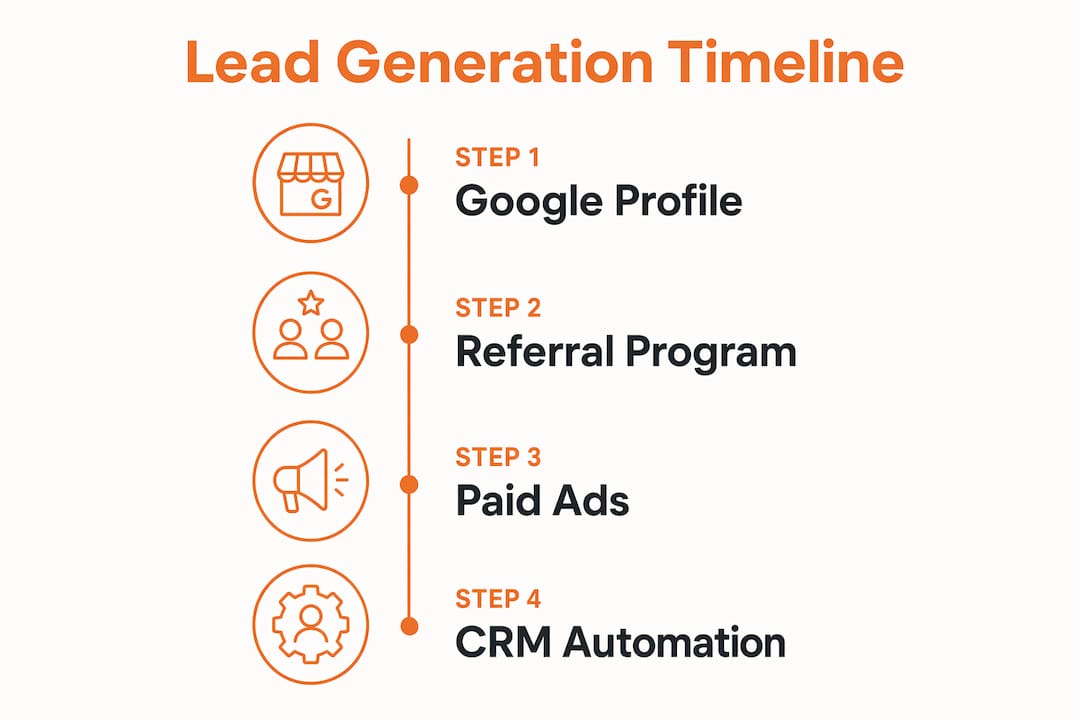
Split your budget between immediate-flow channels (LSAs, referrals) and owned channels (SEO, GMB, CRM) to lower your blended cost per lead over time. Shifting from rented leads to owned channels is the most reliable way to reduce long-term acquisition costs.
Which KPIs actually tell you if your marketing is working?
Track these six metrics and calculate them monthly:
- Cost per lead (CPL): total marketing spend ÷ total leads
- Cost per acquisition (CAC): total spend ÷ signed contracts; industry paid-channel benchmark is $95–$130
- Call-to-appointment conversion: calls received ÷ estimates scheduled
- Estimate-to-contract rate: estimates sent ÷ contracts signed
- Speed-to-lead: average minutes from inquiry to first contact
- Customer lifetime value (LTV): average contract value × average repeat engagements
Attribution window: use a 90–180 day window in your CRM for construction leads, since the sales cycle from first contact to signed contract often spans weeks or months. UTM parameters on every paid link, combined with CRM source fields, give you a complete picture of which channels drive profitable jobs — not just inquiries.
Your 90-day plan to build affordable lead flow
Weeks 1–2 (foundation)
- Audit and fully complete your Google Business Profile; add call tracking number.
- Set up a construction-specific CRM with automated SMS acknowledgment for new leads.
- Create a referral intake script and send it to your top five past clients.
Weeks 3–4 (conversion)
- Build one dedicated landing page per primary service-city combination.
- Launch a Local Services Ads campaign with a $20–$30 daily budget cap.
- Add a review request step to your project completion checklist.
Months 2–3 (growth)
- Publish two service-area SEO pages per month targeting trade + city keywords.
- Activate a five-step email nurture sequence for unconverted estimates.
- Review CPL and call attribution weekly; pause underperforming ad keywords.
- Expand referral outreach to two supplier or subcontractor partners.
Minimum tools: Google Business Profile, a call-tracking integration, a simple landing page builder, and Highlevelcrm-rconstructionsolutions for CRM and pipeline management. For teams evaluating additional field tools, the construction software guide for subs covers complementary options worth reviewing.
Why Highlevelcrm-rconstructionsolutions converts more construction leads
Highlevelcrm-rconstructionsolutions was built on over 30 years of construction industry experience, which means its workflows match how contractors actually operate — not how generic SaaS companies assume they do. The platform handles automated lead capture, dynamic call attribution, custom reporting dashboards by job type, and bid and estimate tracking in one place.
Users report up to a 35% improvement in lead conversion after adoption. That figure reflects faster response times, fewer dropped leads, and better visibility into which channels produce profitable jobs. The platform integrates with industry-specific tools and surfaces cost-per-job data that generic CRMs simply cannot generate.
Before booking a demo, have these numbers ready:
- Your average job value (residential and commercial, separately)
- Your current lead sources and monthly volume
- Your typical time from inquiry to estimate sent
Pro Tip: Ask during your demo specifically about the call attribution setup. A well-configured integration between your call tracker and CRM is the single fastest way to identify which of your current channels is already working — and which to cut.
Key Takeaways
Affordable lead generation for a construction business works best when you own your channels, attribute every phone call, and automate follow-up before scaling paid spend.
| Point | Details |
|---|---|
| Local SEO first | Google Business Profile plus city pages deliver the highest long-term ROI; construction marketing SEO can reach up to 681% ROI. |
| Referrals close fastest | Structured referral programs contribute 20–25% of total leads and reduce customer acquisition cost by 25%. |
| Phone attribution is non-optional | Phone leads convert at roughly 40%; untracked calls cause you to underinvest in your best channels. |
| Paid ads after attribution | Google Ads CPL and Local Services Ads costs vary widely depending on trade and market, generally ranging from lower to moderate amounts per lead — only profitable once tracking is live. |
| Highlevelcrm-rconstructionsolutions | Users report up to 35% lead conversion improvement after adopting its automated workflows and call attribution. |
What contractors actually get wrong about lead generation
The conventional wisdom says you need more leads. What most contractors actually need is a faster, more consistent response to the leads they already have.
A contractor receiving 40 inquiries a month and converting 10% is not a marketing problem — it is an operations problem. Speed-to-lead, follow-up consistency, and knowing which channels produce profitable jobs are the levers that move conversion rates. Paid ads can paper over that gap temporarily, but they amplify a leaky system rather than fix it.
The contractors who see the sharpest improvement in their numbers are almost always the ones who fixed their follow-up process first, then scaled their marketing spend. A CRM that automates the first 24 hours of lead handling — acknowledgment, scheduling, qualification — changes the economics of every channel you run. That is not a technology argument; it is a conversion-rate argument backed by what contractors report after making the switch.
See what Highlevelcrm-rconstructionsolutions can do for your pipeline
Contractors who book a demo with Highlevelcrm-rconstructionsolutions walk through a setup tailored to their trade, market, and current lead sources. The session covers call tracking integration, automation workflow configuration, and a review of which quick wins apply to your specific business — typically call attribution and the first automated follow-up sequence.
The platform runs on a monthly subscription following an initial setup and onboarding process. No long-term contracts are required to get started. To see which construction segments the platform serves and whether your trade qualifies, visit the industries we serve page. If you want to review features and integrations before the call, the CRM features and FAQs page covers the full list. Book your demo with your average job value and current lead sources in hand — the conversation will be more useful for it.