
Lead Nurturing for Home Builders: Your 2026 Guide
Lead nurturing for home builders is the structured, automated process of engaging prospects across the full custom homebuyer decision cycle to improve conversion rates and close more sales. Most home builders focus heavily on generating new leads but underinvest in the follow-up system that turns those leads into signed contracts. Structured nurturing can lift conversion rates from 10% to 30%. That gap represents real revenue sitting uncaptured in your pipeline. The good news is that the right system, built around your buyers’ actual timeline, closes it.
What makes lead nurturing critical for home builders?
The custom home buying decision takes 12–18 months. That timeline is not a quirk of your market. It reflects the financial weight, emotional complexity, and sheer number of decisions a buyer must make before signing. Most industries sell in days or weeks. You are selling across seasons.
Without a consistent follow-up system, leads go cold fast. Nearly 50% of leads are lost before the first appointment due to inconsistent or delayed follow-up. That is not a lead quality problem. That is a process problem.

A one-off email or a single phone call does not hold a prospect’s attention for 18 months. Automated nurture sequences do. They maintain contact at the right intervals without requiring your sales team to manually track every lead in a spreadsheet.
The content you send during this long window matters as much as the timing. Buyers in the early research phase want education, not a sales pitch. Topics like financing options, lot selection, and the custom build process keep your brand relevant while the buyer builds confidence. Buyer-centric content aligned to the decision stage consistently outperforms generic company updates.
- Automated sequences maintain contact without manual effort from your team
- Educational content builds trust during the passive research phase
- Consistent touchpoints reduce the risk of losing warm leads to a competitor
- Multi-channel communication, covering email, text, and phone, reaches buyers where they are
Pro Tip: Set up a separate nurture track for leads who have gone quiet after 60 days. A simple three-email “re-engagement” sequence asking about their timeline often reactivates prospects you assumed were lost.
How to structure an effective lead nurturing sequence
Timing is the backbone of any nurturing system. The right message at the wrong moment does nothing. Here is a proven phase structure matched to where buyers actually are in their decision.
-
First 48 hours. Respond immediately. This is the highest-intent window. A lead who fills out a contact form is actively comparing builders right now. Send a personal email, follow up with a text, and attempt a phone call. Automated follow-up within 48 hours is the industry standard for minimizing early lead loss.
-
Days 3–14. Light maintenance phase. Send two to three emails spaced several days apart. Focus on your process, your portfolio, and what makes your builds different. Avoid pressure. The goal is familiarity.
-
Days 14–30. Transition to a weekly or biweekly cadence. Introduce content about financing, lot availability, and the design process. These topics address the questions buyers are actively researching.
-
Days 30–180. Value-based touchpoints spaced 3–4 weeks apart keep you top of mind without overwhelming the prospect. Use this phase for case studies, video walkthroughs, and community updates.
-
Beyond 180 days. Monthly contact is sufficient. A short check-in email asking about their timeline keeps the relationship alive without feeling intrusive.
| Phase | Timing | Content focus |
|---|---|---|
| Immediate response | 0–48 hours | Personal outreach, intro to your process |
| Light maintenance | Days 3–14 | Portfolio, differentiators, builder story |
| Active education | Days 14–30 | Financing, lots, design options |
| Value nurturing | Days 30–180 | Case studies, video tours, community news |
| Long-term check-in | 180+ days | Timeline check-ins, market updates |
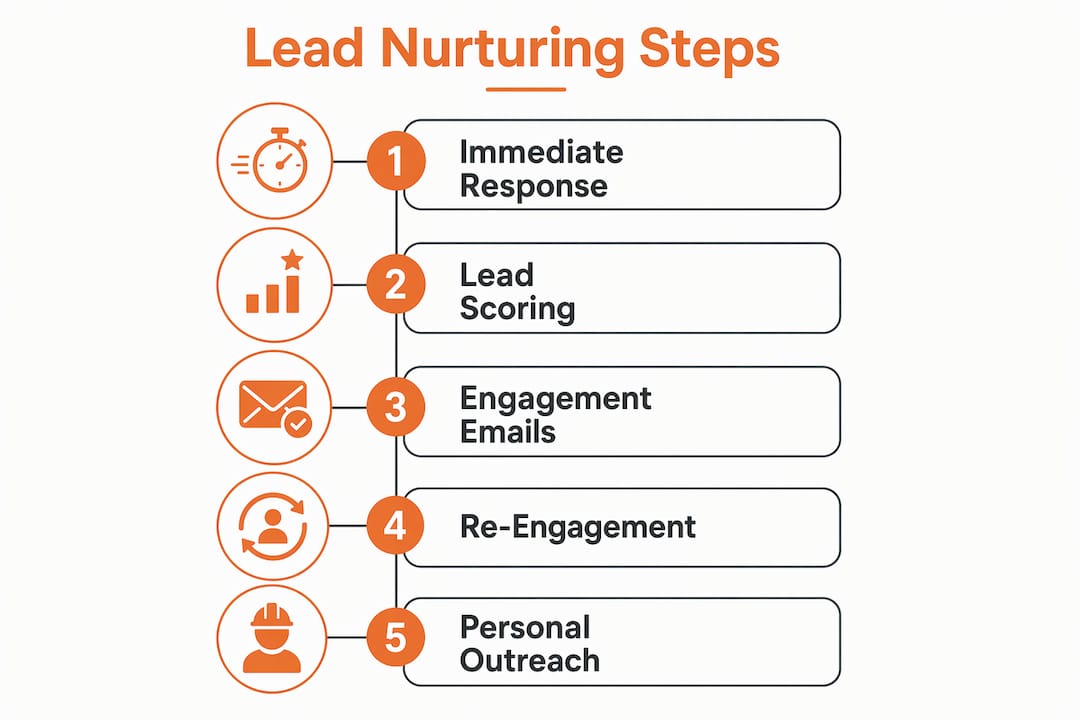
Lead scoring assigns engagement points based on email opens, link clicks, and form submissions. Leads who score above a set threshold get flagged for personal outreach from your sales team. Lower-scoring leads stay in the automated sequence. This keeps your team focused on the buyers most likely to convert.
Pro Tip: The moment a lead replies to an email or books an appointment, pause all automation immediately. Sending a generic drip email to someone you just spoke with destroys the trust you built.
What tools and technology support successful nurturing?
The right technology removes the manual burden from home builder lead management. Without it, even the best nurturing plan falls apart when your team gets busy on a project.
A unified CRM platform is the foundation. Consolidating buyer lifecycle data in one system eliminates the data silos that cause missed follow-ups and duplicate outreach. When every interaction, from the first web form to the signed contract, lives in one place, your team communicates with precision.
Key features to look for in a builder-focused CRM:
- Automated email and text sequences triggered by lead actions or time intervals
- Lead scoring to surface high-priority prospects for personal follow-up
- Multi-channel communication covering email, SMS, and phone from a single dashboard
- Pipeline visibility showing where every lead sits in the buying process
- Integration with builder-specific tools like estimating software and project management platforms
Generic CRM platforms built for retail or financial services rarely fit construction workflows. A platform built with construction experience understands that your sales cycle is not linear and that buyers often go quiet for months before re-engaging.
Sales center technology that supports the full buyer journey, from first inquiry through contract, pairs well with a CRM that tracks every touchpoint. Buyers who interact with visual tools like floor plan configurators or finish selectors generate behavioral data your CRM can use to score and segment leads. Material configurators give buyers a hands-on experience that keeps them engaged between your outreach touchpoints.
Highlevelcrm-rconstructionsolutions was built specifically for construction businesses, with automated lead tracking, custom reporting dashboards, and workflows designed around how builders actually operate. Users report lead conversion increases of 35%, which reflects what happens when the right system replaces manual follow-up.
Common challenges home builders face in lead nurturing
Most builders know they should follow up more consistently. The gap between knowing and doing comes down to three recurring problems.
Delayed or inconsistent follow-up is the most expensive mistake. Contractors drop nearly half of incoming leads simply because they cannot respond promptly while managing active projects. Automation solves this directly. A CRM that sends an immediate response the moment a lead submits a form removes the human delay entirely.
Treating email as a newsletter is the second major pitfall. Sending monthly company updates is not nurturing. Builders who miss the educational window during the passive research phase lose buyers to competitors who answered their questions first. Every email in your sequence should address a specific question a buyer at that stage is likely asking.
Disconnected tools create data gaps that cost you deals. When your lead capture form, email platform, and CRM do not talk to each other, leads fall through the cracks. A quality nurturing system drives more builder success than raw lead volume. That system only works when your data is clean and centralized.
- Automate the first response so no lead waits more than five minutes
- Segment leads by source and interest level before adding them to a sequence
- Review your sequence open rates monthly and replace low-performing emails
- Assign a team member to personally follow up with any lead that scores above your threshold
Pro Tip: Write your automated emails in first person and sign them with a real team member’s name. Buyers respond to people, not brands. A message from “Maria on our sales team” gets more replies than one from “The Builder Team.”
Key takeaways
Effective lead nurturing for home builders requires a structured, multi-phase system that combines automated touchpoints, buyer-centric content, and CRM-driven lead scoring to convert long-cycle prospects into signed contracts.
| Point | Details |
|---|---|
| Respond within 48 hours | Immediate automated follow-up prevents losing nearly half of new leads before first contact. |
| Match content to buyer phase | Send educational content early and case studies later to stay relevant across 12–18 months. |
| Use lead scoring | Assign engagement points to surface hot leads for personal outreach while automating the rest. |
| Pause automation on reply | Stop sequences the moment a lead responds to preserve trust and personalization. |
| Centralize your data | A unified CRM eliminates silos and gives your team accurate, complete buyer information. |
What I’ve learned about nurturing leads in construction
After years of working with builders and contractors, the pattern I see most often is this: a builder invests in marketing, generates solid leads, and then loses them in the follow-up gap. The leads were not bad. The system was missing.
What surprises most builders is how little automation they need to fix this. You do not need a complex 40-step sequence. You need a reliable five-step sequence that actually runs. A simple, consistent system beats an elaborate one that nobody maintains.
The other thing I have seen shift recently is who is doing the buying. Home builder clients today are more diverse in age, background, and family structure than they were a decade ago. Your nurturing content and imagery need to reflect that reality. A sequence that speaks only to one type of buyer leaves real prospects feeling unseen.
The builders who win in 2026 are not the ones with the most leads. They are the ones with the best follow-up systems and the clearest understanding of what their buyers actually need to hear at each stage of the decision. Build the system first. The conversions follow.
— Rowena
How Highlevelcrm-rconstructionsolutions supports your lead nurturing
Home builders who want to put these strategies into practice need a CRM built for how construction businesses actually work, not one adapted from a retail template.
Highlevelcrm-rconstructionsolutions brings together automated lead tracking, multi-channel follow-up sequences, lead scoring, and custom reporting dashboards in one platform designed with over 30 years of construction experience. You can see every lead’s status, trigger the right message at the right time, and flag high-priority prospects for personal outreach without managing a single spreadsheet. Explore the full CRM features and capabilities to see how each tool maps to the nurturing phases covered here. If you want to see which industries we serve, the platform is built specifically for construction businesses like yours.
FAQ
What is lead nurturing for home builders?
Lead nurturing for home builders is the process of maintaining consistent, relevant contact with prospects across the 12–18 month custom home buying decision cycle. The goal is to build trust and stay top of mind until the buyer is ready to commit.
How soon should a builder follow up with a new lead?
Follow up within 48 hours, and ideally within minutes using automated CRM sequences. Builders who delay lose nearly 50% of leads before the first appointment.
What content works best in a builder nurture sequence?
Educational content tied to the buyer’s current decision stage works best. Early-stage leads respond to financing guides and lot selection information. Later-stage leads engage more with design options, case studies, and build timelines.
How does lead scoring help home builder lead management?
Lead scoring assigns points based on email opens, clicks, and form activity. Leads above a set score get flagged for personal outreach, while lower-scoring leads stay in the automated sequence, keeping your team focused on the most promising prospects.
When should automated nurturing stop?
Automation should stop the moment a lead replies to a message or books an appointment. Continuing to send generic emails after direct contact damages trust and reduces your chances of closing the deal.