

Inventory Optimization in Construction: A Project Manager's Guide
Inventory optimization in construction is the process of positioning the right materials, in the right quantities, at the right locations to keep projects on schedule and costs under control. For project managers juggling multiple job sites, shifting timelines, and unpredictable supply chains, poor material control is one of the fastest ways to blow a budget. Carrying costs alone consume 20–30% of total inventory value annually, including capital tied up in storage, insurance, and shrinkage. That number makes a strong case for treating construction inventory management as a core discipline, not an afterthought. The industry standard methods, Economic Order Quantity (EOQ), Safety Stock (SS), and Reorder Point (ROP), give you the quantitative foundation to make that shift.
What is inventory optimization in construction projects?
Inventory optimization in construction is defined as the systematic balancing of material stock levels to minimize total cost while meeting project demand at every phase. The goal is not simply to reduce stock across the board. The right approach positions stock to prevent project delays, not just to shrink overall inventory numbers. That distinction matters enormously on a job site where a missing shipment of rebar can halt a concrete pour for days.
Construction differs from manufacturing because demand is non-repetitive. Each project has a unique bill of materials, a fixed end date, and location-specific logistics. Standard retail inventory models do not account for long lead times on structural steel or the reality that leftover specialty hardware has near-zero resale value. This is why construction inventory management requires project-specific adaptations on top of the classic quantitative methods.

The three foundational methods work as a system. EOQ calculates the order quantity that minimizes the combined cost of ordering and holding materials. Safety Stock sets a buffer to absorb supply delays or unexpected demand spikes. Reorder Point triggers a new purchase order before stock runs out, factoring in lead time. Together, they give procurement teams a data-driven framework rather than gut-feel purchasing.
What are the core inventory optimization techniques used in construction?
EOQ, Safety Stock, and Reorder Point in practice
Applying EOQ, SS, and ROP in combination produces results that no single method achieves alone. A study of structural works on a 2.5-storey boarding house project found that integrating all three methods reduced total inventory costs by over 51% across seven major structural materials. That is not a marginal improvement. It represents a fundamental shift in how procurement decisions get made.
The practical application works like this. EOQ tells you how many bags of cement to order per batch. Safety Stock tells you how many extra bags to keep on hand given your supplier’s reliability. Reorder Point tells you exactly when to place the next order so you never run dry mid-pour. Each method feeds the next, and the combined output is a procurement schedule tied to real project data.
Project-specialized techniques
Generic inventory methods assume stable, repeating demand. Construction does not offer that luxury. Switching to project-specialized techniques reduces carrying costs by 25–40% and improves schedule adherence. Two techniques stand out for construction-specific applications: rolling wave planning and material staging.
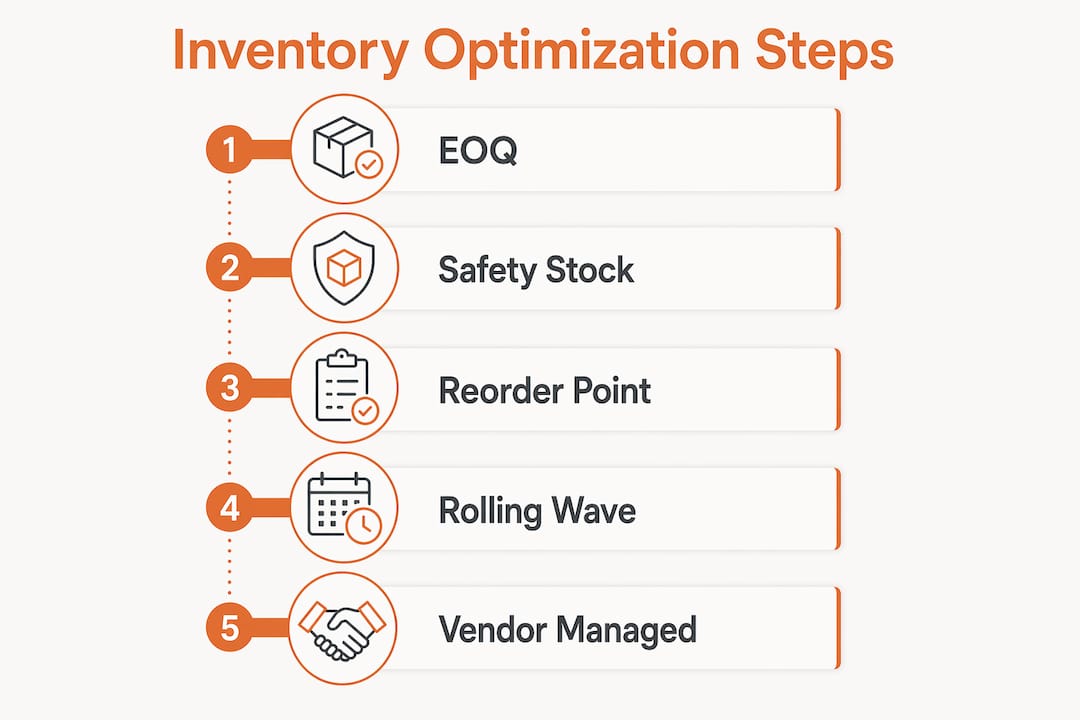
Rolling wave planning breaks a project’s material needs into near-term and long-term horizons. Near-term materials, those needed within the next two to four weeks, get week-level precision in ordering. Long-term materials, such as finishes and fixtures, get monthly forecasting updated as design details firm up. Material staging places pre-ordered stock at or near the job site in the sequence it will be used, reducing double-handling and storage time.
| Technique | Best for | Primary benefit |
|---|---|---|
| EOQ | Repetitive structural materials | Minimizes order and holding costs |
| Safety Stock | High-lead-time or critical materials | Prevents work stoppages |
| Reorder Point | All materials with known lead times | Automates replenishment timing |
| Rolling wave planning | Multi-phase projects | Aligns procurement with schedule |
| Material staging | Large job sites | Reduces handling and storage time |
Pro Tip: Combining EOQ, Safety Stock, and Reorder Point with rolling wave planning gives you both the quantitative precision and the schedule flexibility that construction projects demand. Use them together, not as standalone fixes.
How does project scheduling impact inventory optimization in construction?
Project schedules are the backbone of effective material planning. When procurement is not tied to the schedule, you get one of two outcomes: materials arrive too early and sit on site accumulating carrying costs, or they arrive too late and halt work. Both outcomes cost money. Rolling wave planning directly addresses this by synchronizing procurement with execution phases, reducing over-purchasing by 20–35%.
The connection between scheduling and inventory becomes critical during scope changes. A design revision that shifts the foundation type from spread footings to piles changes the entire structural materials list. If your procurement team is not linked to the project schedule in real time, they may continue ordering materials for the original design. Material Requirement Planning (MRP) systems solve this by recalculating material needs automatically when the schedule changes.
Here is how to align inventory with your project schedule in practice:
- Map materials to milestones. Assign every major material category to a specific project phase. Concrete and rebar tie to foundation and framing milestones. Mechanical, electrical, and plumbing materials tie to rough-in phases.
- Set lead time buffers by material type. Structural steel may carry a 12-week lead time. Drywall may carry two weeks. Build those lead times into your Reorder Points so orders go out at the right moment.
- Update forecasts bi-weekly. Construction inventory management must adapt to non-repetitive demand by using rolling forecasts updated bi-weekly to reflect evolving design details.
- Flag scope changes immediately. Any approved change order should trigger a materials review within 24 hours to catch over-ordered or newly required stock before it becomes a problem.
Fear-based over-purchasing is a real pattern in construction. Project managers who have been burned by a late delivery once tend to order extra “just in case” on every subsequent project. Precise procurement planning tied to project schedules counters this tendency by replacing anxiety-driven decisions with data-driven ones. You can also explore how estimating workflows integrate with material planning to sharpen your procurement timing further.
What technologies and systems support construction inventory control?
Digital tools have changed what is possible in construction inventory management. The shift is from spreadsheets and phone calls to integrated systems that give you real-time visibility across every job site and warehouse simultaneously.
Key technologies that deliver measurable results include:
- ERP-integrated inventory systems. Disjointed inventory tools cause duplicate purchasing and stock visibility gaps. ERP systems connect procurement, project management, and finance on a single platform, improving job costing accuracy and real-time replenishment planning.
- Multi-Echelon Inventory Optimization (MEIO) software. MEIO manages stock across multiple locations simultaneously rather than optimizing each site in isolation. MEIO software cuts total capital investment in inventory by 10–30% compared to manual, node-by-node management. For contractors running three or more active job sites, that reduction is significant.
- AI-driven demand forecasting. AI-driven forecasting analyzes sales history, service records, and site availability simultaneously to enable dynamic, real-time inventory decisions. The transition from reactive to predictive control is where the biggest efficiency gains live.
- Real-time tracking hardware. Barcode scanners, RFID tags, and mobile apps give field teams the ability to log material receipts and usage on the spot. That data feeds back into the central system, keeping stock counts accurate without manual reconciliation. You can review inventory tracking software options built specifically for construction teams.
Pro Tip: Technology alone does not fix inventory problems. Connecting field teams, warehouses, and procurement through shared systems is the cultural shift that makes the tools work. Buy-in from foremen and site supervisors is as important as the software itself.
What are the key challenges and best practices for inventory in construction?
Common challenges
Construction inventory management faces obstacles that do not exist in warehouse or retail settings. Siloed data between the field and the office leads to duplicate orders. Site-specific constraints, limited storage space, weather exposure, and theft risk, add complexity that generic inventory models ignore. Obsolete materials from design changes become sunk costs that drag down project margins.
Best practices that work
The most effective approach combines centralized visibility with distributed execution. You manage inventory data centrally so every team sees the same numbers, but you allow site-level flexibility in how materials are stored and staged.
Vendor-Managed Inventory (VMI) is one of the highest-impact practices available to construction firms. Under VMI, the supplier monitors your consumption and replenishes stock automatically. VMI reduces on-site inventory by 40–60%, improves cash flow, and shifts obsolescence risk to the supplier. It works best for consumables, fasteners, and specialty hardware with predictable usage rates. For a deeper look at how material management strategies reduce holding costs, the project manager’s guide to material management covers the topic thoroughly.
| Challenge | Solution |
|---|---|
| Siloed data across sites | ERP system with shared procurement and finance modules |
| Fear-based over-purchasing | Procurement tied to rolling wave schedule with approved buffers |
| Obsolete materials from scope changes | Bi-weekly materials review triggered by change orders |
| High carrying costs | VMI for consumables; MEIO for multi-site stock balancing |
| Duplicate orders from field teams | Centralized purchase order approval with real-time stock visibility |
Tracking performance metrics closes the loop. Monitor inventory turnover rate, carrying cost as a percentage of project value, and stockout frequency by material category. These three metrics tell you whether your system is working and where to focus improvement efforts next.
Key Takeaways
Construction inventory optimization delivers the greatest cost savings when quantitative methods, project scheduling, and integrated technology work together as a single system.
| Point | Details |
|---|---|
| Combine EOQ, SS, and ROP | Using all three methods together cuts total inventory costs by over 51% in construction projects. |
| Tie procurement to the schedule | Rolling wave planning reduces over-purchasing by 20–35% by aligning orders with project phases. |
| Use VMI for consumables | Vendor-Managed Inventory cuts on-site stock by 40–60% and shifts obsolescence risk to suppliers. |
| Integrate your systems | ERP and MEIO platforms eliminate duplicate orders and improve real-time stock visibility across sites. |
| Track three core metrics | Monitor inventory turnover, carrying cost percentage, and stockout frequency to measure and improve performance. |
What I’ve learned from watching construction firms get inventory wrong
After years of working alongside contractors and project managers, the pattern I see most often is this: firms invest in software and then wonder why nothing changes. The tool gets blamed. The real problem is almost always the same. Field supervisors are not connected to the procurement system, so they call in orders directly to suppliers. The warehouse logs a delivery. The ERP records a purchase order. Three different numbers exist for the same material, and nobody reconciles them until the project closes out and the budget is already over.
The firms that get inventory right do one thing differently. They treat the cultural integration as the primary project and the software as the support structure. That means getting foremen to log material receipts on a tablet the same day. It means procurement managers reviewing the schedule every Monday with the site superintendent, not just with the finance team. It means change orders triggering a materials review automatically, not two weeks later when someone notices the wrong product on site.
The shift from reactive to predictive inventory control is real and achievable. But it requires leadership to model the behavior first. When the project manager uses the system, the team uses the system. When the project manager emails a supplier directly and bypasses the platform, the team does the same. The technology is the easy part. The discipline is what separates firms that reduce carrying costs by 30% from those that keep overspending on materials project after project.
— Rowena
How Highlevelcrm-rconstructionsolutions supports your inventory and project management
Managing materials across multiple job sites while keeping procurement, scheduling, and finance aligned is exactly the kind of operational complexity that Highlevelcrm-rconstructionsolutions was built to address. Developed with over 30 years of construction experience, the platform gives contractors centralized visibility into workflows, automated tracking, and custom reporting dashboards that connect field activity to office decisions in real time.
Contractors using Highlevelcrm-rconstructionsolutions report lead conversion rate increases of up to 35%, and the same workflow discipline that drives those results applies directly to inventory control. When your procurement data, project schedule, and client communications live in one place, the duplicate orders and missed replenishments that drain project budgets become far less common. Explore the full CRM features and capabilities to see how integrated project management supports better material decisions from bid to closeout.
FAQ
What is inventory optimization in construction?
Inventory optimization in construction is the process of managing material stock levels to meet project demand at the lowest possible cost. It combines methods like EOQ, Safety Stock, and Reorder Point with project-specific scheduling techniques to prevent both overstock and shortages.
How does EOQ apply to construction projects?
EOQ calculates the order quantity that minimizes the combined cost of ordering and holding a specific material. In construction, it works best for structural materials with predictable usage rates, such as concrete, rebar, and lumber.
What are the benefits of inventory optimization for contractors?
The primary benefits include reduced carrying costs, fewer project delays caused by material shortages, improved cash flow, and better budget adherence. Integrating EOQ, SS, and ROP has been shown to cut total inventory costs by over 51% in construction projects.
What is Vendor-Managed Inventory and when should contractors use it?
Vendor-Managed Inventory (VMI) is an arrangement where the supplier monitors your consumption and replenishes stock automatically. It works best for consumables and fasteners with predictable usage, reducing on-site inventory by 40–60% and improving cash flow.
How do I start optimizing inventory on my construction projects?
Start by mapping your materials to project milestones and calculating lead times for each category. Then apply Reorder Points to trigger automatic purchasing, use rolling wave planning to align orders with your schedule, and connect your field teams to a centralized tracking system to eliminate duplicate orders.