
Manage Supplier Relationships with CRM Tools That Work
Supplier relationship management (SRM) is defined as the systematic process of evaluating, onboarding, monitoring, and communicating with vendors across the full procurement lifecycle. Construction project managers who manage supplier relationships with CRM tools gain a centralized system for tracking vendor performance, compliance documents, and contract milestones in one place. Generic sales CRMs were not built for this. The construction industry runs on tight timelines, layered subcontractor networks, and compliance requirements that standard platforms simply cannot handle. The right supplier management software changes that equation entirely.
Why generic CRMs fall short for managing supplier relationships
Generic CRMs are built to move leads through a sales funnel. That design works well for revenue teams but fails the moment you need to track a subcontractor’s insurance certificate, monitor a material supplier’s delivery SLA, or flag a compliance gap before an audit.
Standard CRMs lack the operational features that supplier management demands: vendor scorecards, compliance alerts, and contract administration. These are not minor omissions. They are the core tools that keep a construction project from stalling when a supplier falls short.
Construction managers who force supplier data into a generic CRM face specific failure modes:
- Vendor records exist in isolation, with no link to project contracts or SLAs
- Compliance documents get stored in email threads or shared drives, not the CRM
- There is no automated alert when a supplier’s certification expires
- Performance tracking requires manual spreadsheet work outside the system
- Audit preparation takes days instead of minutes
Visibility gaps in vendor records cause real problems during audits and active project phases. A missing insurance document or an expired license can halt work on a job site and trigger costly delays.
Pro Tip: Before evaluating any CRM for supplier use, list your top five compliance requirements. If the platform cannot automate tracking for all five, it is not the right tool for your construction operation.
The distinction matters: CRM manages customer demand while SRM ensures supply capacity and resilience. When CRM maturity outpaces SRM maturity, organizations face rising costs, missed SLAs, and client churn caused by supplier ecosystem weaknesses. Construction managers need both, working together.
What features should a CRM for suppliers include?
The most effective supplier management software for construction combines a centralized database with automated workflows and real-time performance tracking. Each feature solves a specific operational problem.
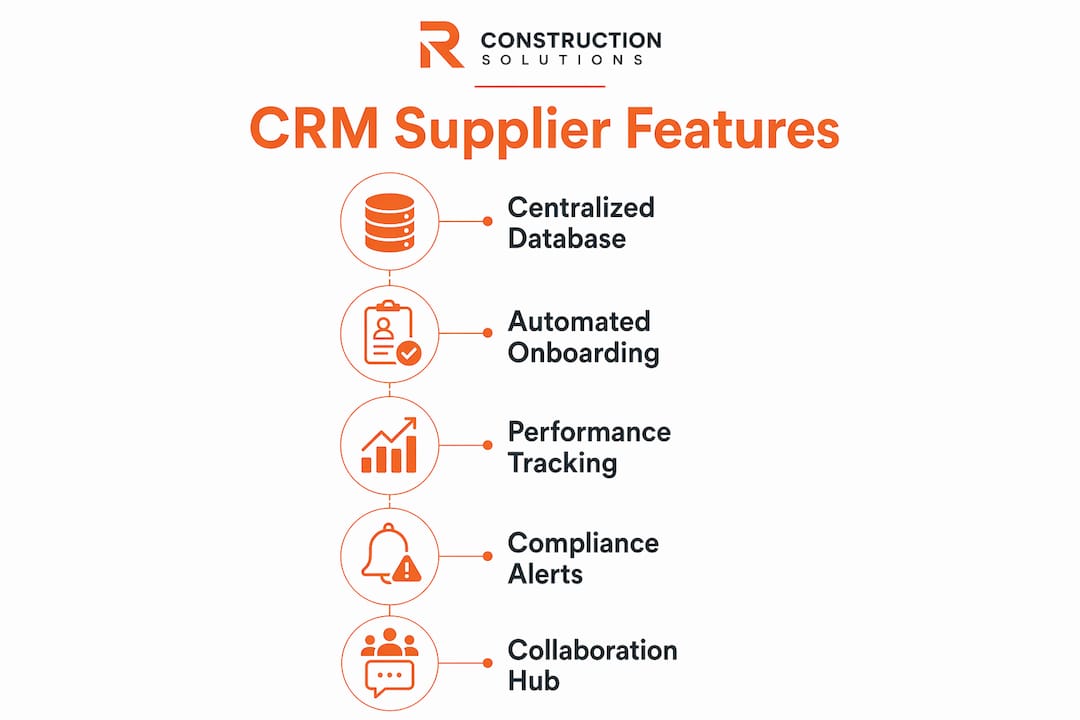
Centralized supplier database
Every supplier record should include validated master data: contact details, trade categories, license numbers, insurance certificates, and tax documentation. A single source of truth eliminates the duplicate records and outdated information that slow down procurement decisions.

Automated onboarding and qualification
Dedicated SRM platforms reduce onboarding time from weeks to days by automating workflows and providing self-service portals. For construction managers juggling multiple subcontractors across active projects, that time savings is significant. Automated onboarding checklist workflows collect documents, trigger approval steps, and notify your team when a supplier is ready to work.
Performance and compliance tracking
| Feature | What it does | Why it matters in construction |
|---|---|---|
| Vendor scorecards | Scores suppliers on delivery, quality, and responsiveness | Identifies underperforming vendors before they affect a project |
| Compliance alerts | Flags expired licenses or missing documents automatically | Prevents work stoppages caused by non-compliant subcontractors |
| Contract management | Links contracts to vendor records and tracks key dates | Reduces missed renewal deadlines and SLA violations |
| Real-time KPI tracking | Monitors supplier metrics as projects progress | Gives project managers current data, not last month’s report |
| Supplier portal | Lets vendors submit documents and updates directly | Cuts administrative back-and-forth and speeds up data collection |
Consolidating compliance and contract data reduces audit preparation time from days to seconds. That is not a minor efficiency gain. It is the difference between a smooth inspection and a project shutdown.
Pro Tip: Set up automated alerts for certificate expiration dates at 90, 60, and 30 days out. Most construction managers only catch lapses at renewal time, which is often too late to avoid a work stoppage.
Communication and collaboration hub
A CRM built for suppliers centralizes all vendor communication: emails, calls, document requests, and issue logs. Every team member sees the same history. No more searching through inboxes to find out who last spoke with a concrete supplier about a delayed shipment.
How to integrate CRM tools to manage suppliers in construction
A structured rollout prevents the most common CRM failures. Follow these steps to deploy supplier management software effectively on your construction projects.
-
Cleanse your supplier data first. Automating bad data only replicates fragmentation and inefficiency. Before migrating any vendor records, remove duplicates, validate contact information, and confirm that license and insurance data is current. This step is the most skipped and the most consequential.
-
Configure onboarding workflows. Map out every document a new supplier must submit: W-9, general liability certificate, workers’ compensation proof, trade license. Build automated collection steps into the CRM so suppliers receive requests and reminders without manual follow-up from your team.
-
Set performance KPIs for each supplier category. Material suppliers get tracked on delivery accuracy and lead time. Subcontractors get scored on schedule adherence, safety compliance, and quality. Define these metrics before go-live so the system captures meaningful data from day one.
-
Train your internal team. A CRM only works if your project managers and procurement staff use it consistently. Run role-specific training sessions. Focus on the workflows each person touches daily, not a full platform overview that overwhelms and gets forgotten.
-
Engage suppliers with self-service portals. Supplier portal adoption is the primary factor in achieving automation efficiencies and reducing administrative burden. Make the portal simple. Provide a short guide. Offer a direct contact for technical questions during the first 30 days.
-
Connect the CRM to your ERP or project management system. Bi-directional synchronization keeps supplier master data and performance metrics current across platforms. When your ERP updates a purchase order, the CRM reflects it. When a supplier updates their insurance in the portal, both systems see it.
-
Build audit readiness into the system from the start. Configure the CRM to log every document submission, approval, and communication automatically. When an auditor asks for a compliance history, you pull a report instead of assembling a paper trail.
Common challenges when using CRM tools for supplier management
The most frequent reason CRM implementations underdeliver is poor data quality at the start. Construction managers often migrate years of supplier records without cleaning them first. The result is a digital system with the same fragmentation as the spreadsheets it replaced.
A second challenge is low supplier adoption of self-service portals. Supplier resistance to portals creates manual administrative overhead and blocks automation benefits entirely. The fix is not a better portal. It is better onboarding for the suppliers themselves. A short video walkthrough and a dedicated support contact during the first month dramatically improve adoption rates.
“Supplier management is not just data storage. It is a strategic operational layer. Imbalance between CRM and SRM maturity causes rising costs and client churn.” — Ivalua, Strategic Sourcing Insights
A third challenge is treating the CRM as the complete solution when it is only part of one. CRM and SRM serve distinct but complementary roles. CRM handles customer-facing demand. SRM handles supply capacity and risk. Construction managers who rely on a CRM alone, without SRM capabilities, will hit a ceiling. The goal is a connected system where both functions share data and reinforce each other.
Avoid these additional pitfalls:
- Skipping contract management integration, which leaves renewal dates untracked
- Failing to assign a CRM administrator who owns data quality on an ongoing basis
- Using the CRM only for new suppliers and ignoring existing vendor records
- Not reviewing supplier scorecards regularly, which makes the data pointless
Key takeaways
Effective supplier relationship management in construction requires purpose-built CRM tools that connect vendor records, compliance tracking, contract management, and performance data in a single system.
| Point | Details |
|---|---|
| Generic CRMs are insufficient | Standard sales CRMs lack vendor scorecards, compliance alerts, and contract management features construction requires. |
| Data quality comes first | Cleanse and deduplicate all supplier records before migrating to any CRM or SRM platform. |
| Automate onboarding workflows | Automated document collection reduces supplier onboarding from weeks to days and cuts manual follow-up. |
| Supplier portal adoption is critical | Simple, accessible portals drive the automation efficiencies that justify the CRM investment. |
| CRM and SRM must work together | CRM manages customer demand; SRM manages supply resilience. Both are needed for full operational efficiency. |
What I’ve learned from watching CRM rollouts succeed and fail
I have watched construction firms spend months selecting a CRM, then rush the implementation and wonder why nothing changed. The technology is rarely the problem. The process around it almost always is.
The contractors who get the most from their supplier management tools share one habit: they treat supplier onboarding as a project, not an afterthought. They assign an owner, set a timeline, and hold suppliers accountable to the same standards they apply to their own teams. That discipline is what separates a CRM that collects dust from one that actually reduces project risk.
I also think the industry underestimates how much time gets lost to communication gaps with suppliers. When a project manager has to call three people to find out whether a subcontractor’s insurance is current, that is a system failure. A well-configured CRM eliminates that call entirely. The alert fires automatically. The document is in the system. The answer takes seconds.
The future of supplier management in construction points toward AI-driven risk scoring and predictive compliance alerts. Platforms are already moving in that direction. But the contractors who will benefit most are the ones who have clean data and disciplined workflows in place today. You cannot automate your way out of a data quality problem.
If you are a contractor evaluating CRM options, start with the supplier lifecycle, not the sales funnel. The right tool is the one built for how construction actually works.
— Rowena
How Highlevelcrm-rconstructionsolutions supports your supplier workflows
Highlevelcrm-rconstructionsolutions was built with over 30 years of construction industry experience behind it. That background shows up in features that generic platforms simply do not offer: automated lead and vendor tracking, custom reporting dashboards, and workflows designed around how construction projects actually run.
For construction managers focused on supplier relationship management, Highlevelcrm-rconstructionsolutions provides the automation and visibility tools that keep vendor data current, compliance documents organized, and communication centralized. Some users report lead conversion rate increases of 35% after switching from generic platforms. Explore the full CRM features and capabilities to see how the platform fits your supplier management needs. You can also review the industries served to confirm the platform aligns with your specific construction workflows.
FAQ
What is supplier relationship management in construction?
Supplier relationship management (SRM) is the process of evaluating, onboarding, monitoring, and communicating with vendors across the full procurement lifecycle. In construction, it includes compliance tracking, contract management, and performance scoring for subcontractors and material suppliers.
Why do generic CRMs fail for supplier management?
Generic CRMs are designed for sales funnels and lack features like vendor scorecards, compliance alerts, and contract administration. Construction managers need tools that link vendor records directly to project contracts, SLAs, and compliance documents.
How does automating supplier communication help construction projects?
Automated supplier communication eliminates manual follow-up on document requests, certificate renewals, and performance updates. Automated workflows replacing emails and spreadsheets provide substantial time savings and performance visibility critical for construction timelines.
What is the first step in setting up a CRM for supplier management?
Data cleansing is the first and most important step. Migrating duplicate or outdated supplier records into a new system replicates existing problems rather than solving them.
Can a CRM replace dedicated supplier relationship management software?
A CRM alone cannot fully replace dedicated SRM software. The two systems serve complementary roles: CRM manages customer demand while SRM manages supply capacity and risk. The most effective setup connects both with bi-directional data synchronization.