
Subcontractor Prequalification: Score 4 Risks, Use CAPs for Contractors
Run a standardized, project-specific prequalification program that scores four things: safety, financial health and bonding, insurance, and references. Pair it with annual renewal plus a project-specific recheck at every award. Before anyone signs a contract, verify the underlying documents yourself. Skip that step and the rest of the program is just paperwork.
TL;DR:
- Using standardized forms like ConsensusDocs 721 ensures consistent evaluation and decision-making across project teams.
- Regularly updating and verifying subcontractor documentation, including certificates and financials, prevents stale data from skewing risk assessments.
- Applying a tiered scoring system with escalation for borderline cases allows flexible management of skilled trades with imperfect scores.
- Automating alerts for document expirations and safety records helps maintain current, accurate subcontractor information at scale.
- Adopting construction-specific client management systems enhances control over multilevel prequalification processes, especially across multiple projects.
Table of Contents
- What Is Subcontractor Prequalification and Why Does It Matter?
- How Do You Run a Standardized Prequalification Process?
- What Happens When a Subcontractor Doesn’t Fully Qualify?
- How Do You Scale Prequalification Without Losing Control?
- What Documents Belong in Every Prequalification Packet?
- From Pass/Fail to Ongoing Partnership
- How High Level CRM Supports an Ongoing Prequalification Program
- Sources
What Is Subcontractor Prequalification and Why Does It Matter?
Subcontractor prequalification is the screening process a general contractor runs before handing over a scope of work: verifying that a subcontractor has the financial capacity, safety record, insurance, and experience to perform without blowing up your schedule or your balance sheet. Ask why prequalification matters and the honest answer is that it’s cheaper to say no in the bid room than to fire a failing sub mid framing package. The subcontractor evaluation process exists because past performance decays fast, and a firm that was solid two years ago might be carrying debt, understaffed, or in litigation today.
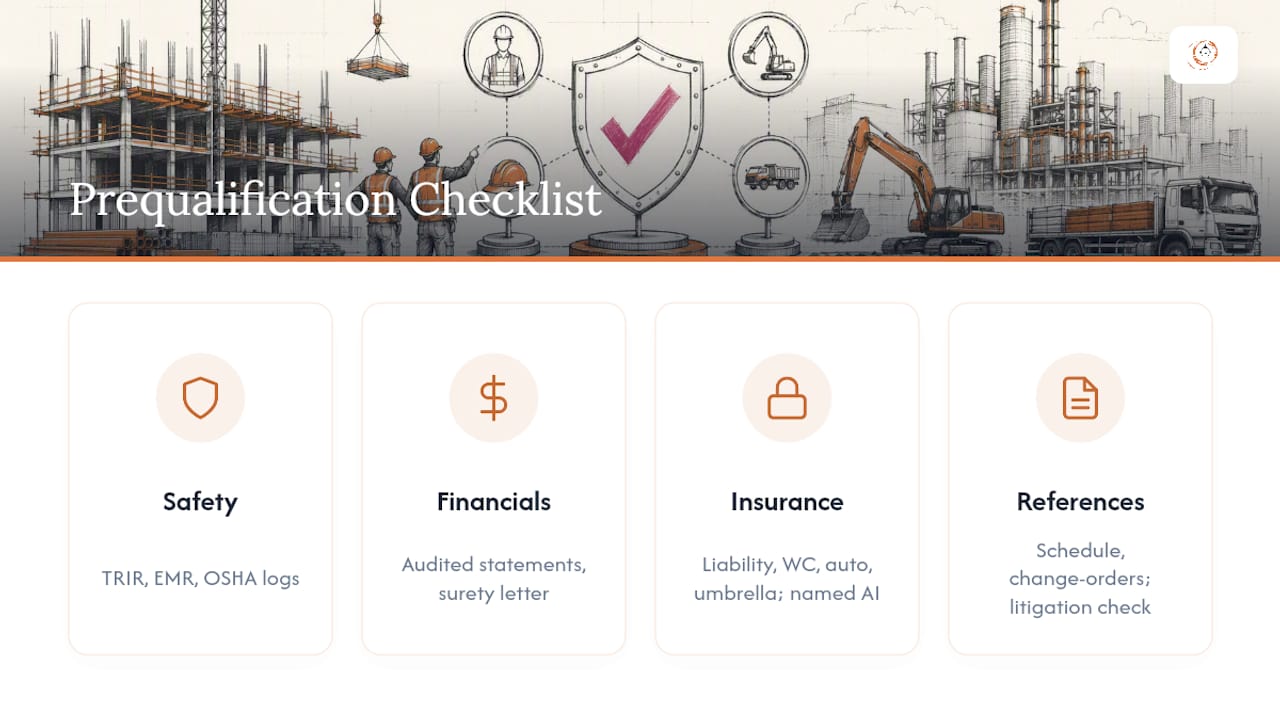
Safety. Pull the Total Recordable Incident Rate (TRIR), the Experience Modification Rate (EMR), and OSHA 300/300A logs. Don’t stop at the number. A low TRIR paired with a spike in incident severity, or a sudden EMR jump, deserves a direct question about what happened and what corrective steps followed.
Financials and bonding. Request current financial statements, ideally audited or reviewed, and watch working capital, backlog relative to bonding capacity, and liquidity trends. A surety letter confirming available bonding capacity tells you whether this subcontractor can actually carry your project’s size, not just win it.
Insurance. Confirm general liability, workers’ compensation, auto, and umbrella coverage limits match your contract requirements, check that you’re named as additional insured with correct wording, and flag any policy expiring before substantial completion.
References and litigation. Ask references about schedule performance and change order behavior, not just “would you hire them again.” Run a litigation check. According to AGC’s best practices guidance, red flags include shrinking working capital, backlog that balloons without a subcontracting plan, and a pattern of unusually low bids across multiple projects, often a sign of underpricing that ends in default.
How Do You Run a Standardized Prequalification Process?
Ad hoc prequalification, where one project manager emails a spreadsheet and another calls three references from memory, produces inconsistent decisions and exposes you legally when a rejected subcontractor asks why. Standardized forms fix that. ConsensusDocs 721 offers a widely used statement-of-qualifications template covering backlog value, bond rate, workers’ compensation history, and business certifications, and contractors using standardized forms report meaningfully more consistent evaluation decisions across teams than those relying on informal methods.
Here’s a workable operational sequence:
- Collect the standardized qualification packet at bid time, before scope is awarded.
- Score each subcontractor on a numeric rubric, weighting safety, financials, insurance, and references.
- Classify results into simple tiers, such as gold/silver/bronze, so reviewers apply consistent thresholds.
- Escalate borderline scores to a risk manager or principal rather than letting a single estimator decide.
- Verify documents again immediately before award if more than a few months have passed since qualification.
Pro Tip: Set a hard rule that any subcontractor scoring in your bottom tier automatically triggers a second reviewer, not an automatic rejection. Some of your best trade partners will land there because of thin paperwork, not thin performance.
Ownership matters as much as scoring. A risk manager or dedicated subcontractor administrator should own final approvals, with project managers handling initial intake. Leading firms increasingly treat each bid as its own underwriting event, rather than trusting a qualification from a year ago, according to BuilderOutlook’s reporting on contractor evaluation practices.
What Happens When a Subcontractor Doesn’t Fully Qualify?
A borderline score shouldn’t automatically mean exclusion. Skilled trades are scarce, and a rigid pass/fail gate walks away from subcontractors who could perform fine under the right controls.
- Joint checks with material suppliers reduce the risk of a subcontractor spending job funds elsewhere.
- Increased retainage gives you leverage if performance slips mid project.
- Milestone-based payments tie cash flow to verified progress instead of calendar dates.
- Supplier pre-purchase removes material procurement risk from a subcontractor with thin working capital.
For anything more serious, put it in writing: a Corrective Action Plan (CAP) with specific milestones, deadlines, and owner sign-off, reviewed on a set schedule rather than left to expire quietly. Flow the CAP’s monitoring requirements into the actual subcontract language so it’s enforceable, not just filed away. AGC’s guidance points to letters of credit and guarantees as additional protections for higher-risk awards, and when a subcontractor won’t accept reasonable mitigation terms, that refusal is itself useful information.
How Do You Scale Prequalification Without Losing Control?
Manual prequalification works fine for a handful of trade partners. It breaks down once you’re running multiple projects with dozens of subcontractors, because paper files decay. An EMR from eighteen months ago tells you almost nothing about next quarter’s risk.
- Standardize the data fields you collect, using something close to the ConsensusDocs 721 field set: backlog, bond rate, EMR, certifications, so every subcontractor record is comparable.
- Automate expiration alerts for certificates of insurance, bond renewals, and OSHA citation updates instead of relying on someone remembering to check.
- Centralize records in a shared database rather than folders on individual project managers’ drives, so you can spot trend lines across projects, not just a single snapshot.
- Pilot before you scale. Start with one division or region, confirm your rubric produces sane tiering, then expand.
Pro Tip: The “decaying dataset” problem is the single biggest reason prequalification programs quietly fail. A file that was accurate at bid time can be six months stale by the time work actually starts, and nobody catches it without an automated trigger.
Automated reminders for insurance expirations and safety citation changes reduce the administrative load on your risk team and close the gap between when a subcontractor’s status changes and when you find out about it, a pattern seen across construction management platforms broadly.
What Documents Belong in Every Prequalification Packet?
Keep the required document list tight enough that subcontractors actually complete it, but strict enough that nothing critical slips through.
- W-9 for tax identification, using the current IRS form.
- Certificate of insurance (COI) checked against your minimum limits and additional-insured wording.
- Financial statements, audited or reviewed, checked for working capital and liquidity trends.
- Surety letter confirming bonding capacity matches project size.
- OSHA 300/300A logs reviewed alongside TRIR and EMR figures.
- Reference list from recent, comparable projects, contacted directly.
Collect the packet at bid submission, re-verify before award, and confirm insurance is still active before the first pay application. Temporary self-certifications are acceptable for minor gaps but should carry a firm replacement deadline, not an open-ended pass.
From Pass/Fail to Ongoing Partnership
The best programs treat prequalification as underwriting, not a one-time gate. A “yes, but” decision, approving work under a CAP and tighter payment terms, keeps skilled trades in your pipeline instead of forcing an all-or-nothing call. That only works with continuous verification, because qualification data ages fast and a clean file from last year proves little about this year’s risk.
— Rowena
How High Level CRM Supports an Ongoing Prequalification Program
Spreadsheets and shared drives can run a small prequalification program. They start failing once you’re tracking insurance expirations, EMR updates, and CAP milestones across dozens of subcontractors and multiple active projects. That’s where a construction-specific system earns its keep.
A construction-specific system builds automated lead tracking, custom reporting dashboards, and subcontractor communication tools directly into a platform made for contractors, not adapted from generic sales software. Set expiration reminders for insurance and bonding documents, centralize your scoring rubric and subcontractor records in one dashboard, and stop chasing paperwork by email. If your subcontractor list has outgrown a spreadsheet, or you’re managing multiple active projects at once, it’s worth piloting a system built for this exact workflow rather than patching one together. Visit the industries we serve page to see how the platform fits contractors, suppliers, and consultants managing subcontractor relationships at scale, and get a demo call scheduled to walk through your current process.
Sources
- ConsensusDocs 721 — Statement of Qualifications
- How contractors actually evaluate, qualify, and avoid project failure before contract award in 2026 — BuilderOutlook
- AGC — Preventing subcontractor default: best practices
- IRS Form W-9
- Beyond pass/fail — FMJ / IFMA
Recommended
- Commercial Construction Software Comparison Checklist 2026
- How to Select Software for Multi-Project Contractors
- Top Bidding Sites for Contractors: 2026 Shortlist
- Construction CRM vs HubSpot: A Contractor’s Comparison Guide
Signed up, or thinking about it? We build the inside of the account — pipelines, workflows, funnels, nurture, migration. Built for construction. Contact us.
Affiliate disclosure. We’re a GoHighLevel affiliate. Sign up through our link and we may earn a commission at no cost to you, or buy direct. Build-out is billed separately, never a software markup.