
How Accurate Estimates Increase Win Rates | High Level CRM - R. Construction Solutions
Accurate estimates increase win rates because they let you price competitively without padding bids with excessive risk markups. An empirical analysis of procurement auctions confirms that firms with more accurate cost estimation procedures submit lower, more competitive bid amounts while protecting their margins. The average contractor wins roughly 25% of submitted bids, while top performers consistently reach 40–50% by combining process discipline, better tooling, and selective bidding. Highlevelcrm-rconstructionsolutions was built with over 30 years of construction experience specifically to close the workflow gaps that hold contractors back from that upper tier.
The bottom line: Contractors who treat estimating as a repeatable business process win more bids, protect more margin, and build stronger pipelines than those who treat it as a deadline scramble.
Table of Contents
- How estimate accuracy directly changes your bid outcome
- Which KPIs connect estimate accuracy to win rate and profitability
- Practical steps to improve your estimate accuracy right now
- How technology and CRM integration amplify your accuracy gains
- Key Takeaways
- The blind spot most contractors never address
- Highlevelcrm-rconstructionsolutions gives contractors the estimating edge they need to win
How estimate accuracy directly changes your bid outcome
The connection between precision and awarded contracts runs through several concrete mechanisms, not just price.
- Lower risk markups. When you know your costs with confidence, you do not need to add a large contingency buffer to protect yourself from surprises. That lower number goes on the bid form, and you become more competitive without sacrificing margin.
- Reduced winner’s curse. The winner’s curse occurs when a contractor wins a bid precisely because their estimate was too low. Procurement-auction research shows that accurate estimators avoid this trap because their numbers reflect reality. A mechanical contractor who wins a hospital renovation at a price built on a 15% labor underestimate will spend the project recovering losses, not building a client relationship.
- Credibility with owners and GCs. A well-documented, itemized estimate persuades evaluators even against a slightly lower but vague competing bid because it signals that you understand the scope. Owners read a detailed breakdown as reduced risk, not just a number.
- Speed and bid volume. Faster, accurate takeoffs let your team bid more opportunities per month. More bids at the same win rate means more awards. Better yet, speed creates room for selective bidding, where you target projects you are most likely to win at healthy margins.
- Fewer post-award disputes. Structured estimating practices reduce post-award friction, disputes, and supplier coordination problems, which protects your reputation and your referral pipeline.
Which KPIs connect estimate accuracy to win rate and profitability
Tracking the right metrics turns estimating improvement from a gut feeling into a measurable business outcome. Use this table as your baseline dashboard.
| KPI | Formula | What to watch | Frequency |
|---|---|---|---|
| Estimate-to-actual ratio (E/A) | Final cost ÷ estimated cost | Values above 1.0 signal chronic underestimation | Per project at closeout |
| Win rate | Bids won ÷ bids submitted | Segment by project type and size | Monthly |
| Change-order rate | Change-order value ÷ contract value | High rates reveal scope or pricing gaps | Per project |
| Margin at closeout | Actual gross margin % vs. bid margin % | Margin leakage exposes estimating errors | Per project |
| Bid volume | Bids submitted per month | Tracks capacity and selective bidding impact | Monthly |
Segment every KPI by project type, region, and estimator. A commercial tenant-improvement estimator and a ground-up residential estimator face different cost drivers. Pooling their numbers hides the patterns that matter.
Pro Tip: Set a monthly 30-minute review where your lead estimator compares E/A ratios on closed projects against the original bid. Two or three sessions will reveal your most consistent error categories faster than any software report.
Practical steps to improve your estimate accuracy right now
Improvement does not require a full technology overhaul on day one. Prioritize by time horizon.
- Add a written assumptions section to every proposal. Scope gaps cause change orders. A clear assumptions section reduces disputes and increases perceived credibility with evaluators. You can use faster estimate templates to make this consistent without slowing your team down.
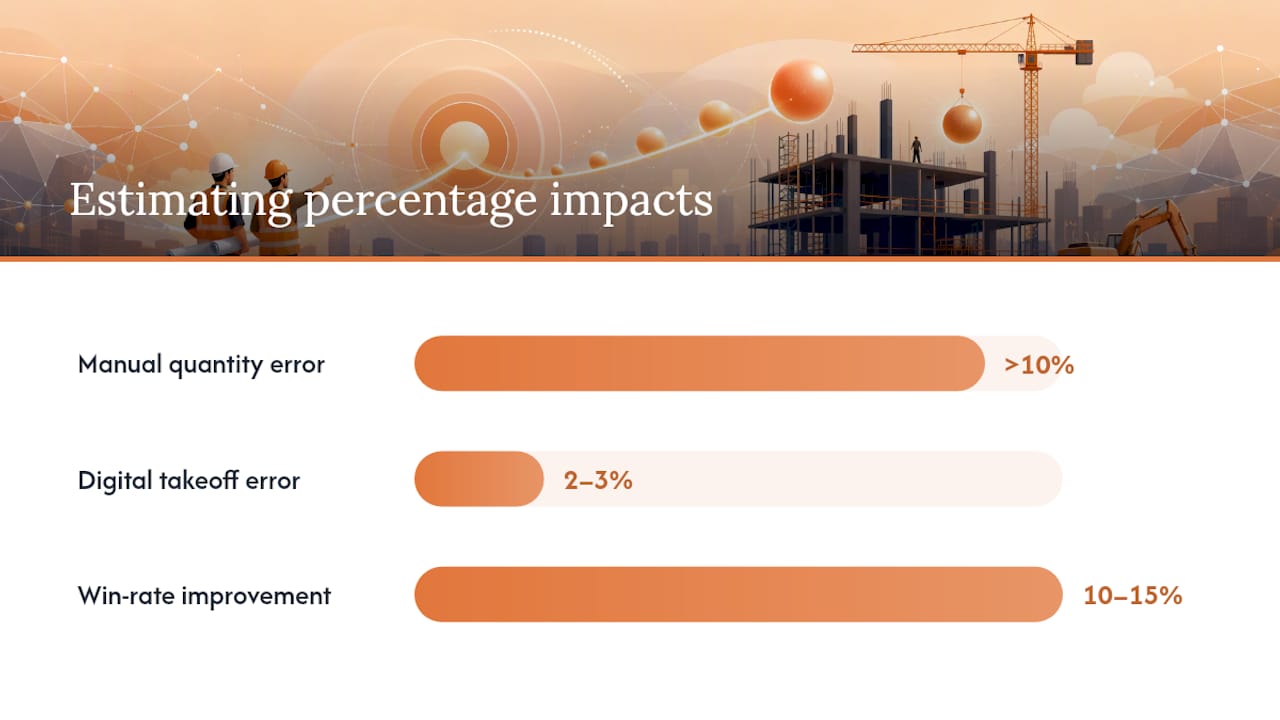
- Switch to digital takeoffs. Digital takeoff systems reduce human error and reach accuracy rates near 97–98%, compared with error rates above 10% on complex manual scopes. The investment pays back quickly on mid-size commercial projects.
Pro Tip: Two habit changes that disproportionately raise accuracy: (1) require sub bids in writing, not verbal quotes, and (2) enforce a line-item assumptions field in your bid template so every number has a documented basis.
How technology and CRM integration amplify your accuracy gains
Technology does not replace good estimating judgment. It removes the friction that prevents good judgment from being applied consistently.
| Feature | Estimating benefit |
|---|---|
| Digital takeoff integration | Reduces quantity errors; speeds production |
| Live material pricing feeds | Eliminates outdated unit costs |
| Subcontractor bid management | Enforces coverage requirements; enables bid leveling |
| Centralized historical cost database | Improves unit cost accuracy over time |
| Bid-tracking dashboard | Reveals win/loss patterns by project type |
| Automated sub follow-up | Increases sub response rates before bid deadline |
| Standardized proposal export | Consistent presentation; reduces scope ambiguity |
Highlevelcrm-rconstructionsolutions connects these features into a single workflow built for contractors. The platform centralizes historical cost data, automates subcontractor follow-ups, and tracks bids from first contact through award, so your win/loss analytics are always current. Users report up to 35% increases in lead conversion after implementing workflow and estimating integrations. For implementation, start by connecting your estimating tool via CSV export or API, then define the data fields you will capture at closeout (actual labor hours, material costs, change-order value). Three to four projects of clean data will already improve your next round of bids.
Pro Tip: Use your CRM’s bid-tracking dashboard to flag every lost bid with a reason code (price, scope, relationship, timing). After 20 bids, the pattern will tell you exactly where your estimates are costing you work.
For a deeper look at which tools integrate well with a construction CRM, the types of estimating tools for construction companies guide covers the current field.
Key Takeaways
Accurate estimates increase win rates by letting you price competitively, protect margins, and present credible proposals that owners and GCs trust over vague lower bids.
| Point | Details |
|---|---|
| Measure E/A ratio and win rate | Track estimate-to-actual variance and win rate by project type monthly to find your accuracy gaps. |
| Standardize your process first | Checklists, contingency tiers, and written assumptions sections deliver measurable gains within one project cycle. |
| Digital takeoffs cut error rates | Switching from manual to digital takeoffs can reduce quantity errors from above 10% to near 2–3% on complex scopes. |
| Feedback loop compounds over time | Contractors who standardize estimating report 10–15% win-rate improvements as historical cost data improves future bids. |
| Highlevelcrm-rconstructionsolutions closes the loop | The platform centralizes cost history, automates sub follow-ups, and tracks bid analytics so accuracy gains translate directly into awarded contracts. |
The blind spot most contractors never address
The contractors I see struggle most with estimating accuracy are not struggling because they lack talent. They are struggling because estimating lives at the bottom of the priority list until a bid deadline forces it to the top. That deadline pressure is exactly when errors happen: rushed takeoffs, verbal sub quotes, contingency added by feel rather than data.
The fix is not a better spreadsheet. It is a leadership decision to treat estimating as an operational discipline with scheduled reviews, documented standards, and a feedback loop that runs after every project closes. When your principal estimator knows that their E/A ratios will be reviewed monthly, the behavior changes. When your team knows that every lost bid gets a reason code, the patterns become visible. That visibility is what turns a one-time accuracy improvement into a compounding business advantage.
Estimating is not a back-office function. It is where your revenue is set. Treat it accordingly, and the win rate follows.
Highlevelcrm-rconstructionsolutions gives contractors the estimating edge they need to win
Winning more bids starts with knowing your numbers, and knowing your numbers requires a system that captures, organizes, and feeds that data back into every estimate you produce. Highlevelcrm-rconstructionsolutions was built with over 30 years of construction experience to do exactly that: connect your estimating tools, centralize your cost history, automate subcontractor follow-ups, and surface the bid analytics that show you where you are winning and where you are leaving work on the table. Users report up to 35% improvements in lead conversion after putting these workflows in place.
If you are ready to close the gap between your current win rate and the 40–50% that top-performing contractors achieve, see how Highlevelcrm-rconstructionsolutions supports contractors across the industry and request a demo to see the estimating and bid-tracking workflows in action.