
Why Bay Area Construction Costs Are High: What Owners Need to Know
Construction in the Bay Area is expensive because a small set of nonnegotiable costs — high skilled-labor rates, slow multi-agency permitting, mandatory seismic and energy engineering, and scarce buildable land — create a region-wide cost floor that no budget can escape. Understanding each driver helps you plan realistically instead of discovering the gap mid-project.
The four stacked drivers at a glance:
- Labor: Skilled-trade shortages and prevailing wage rules push hourly rates well above national norms, adding schedule risk on top of higher bids.
- Permitting and regulation: Multi-department reviews, CEQA exposure, and plan-check cycles add months to timelines and thousands in holding costs.
- Seismic and engineering requirements: Seismic Zone D mandates soil reports, special foundations, and shear-wall systems that simply don’t appear in most U.S. markets.
- Land scarcity and sitework: Lot prices and site preparation — grading, demolition, utility connections — can represent a larger share of total spend than the structure itself.
The sections below cover a concise cost snapshot, timeline impacts, and practical mitigation steps you can act on now.
Table of Contents
- What does a Bay Area construction project actually cost?
- Why labor is often the biggest line item on your bid
- How does Bay Area permitting add cost to your project?
- What do seismic and site engineering actually add to your budget?
- Why land scarcity drives Bay Area construction expenses so high
- How material prices and supply-chain volatility affect your bid
- What soft costs really add to your Bay Area project budget
- How delays and timeline uncertainty compound your total cost
- Practical steps to reduce your Bay Area construction cost exposure
- What should you realistically expect as a Bay Area owner or developer?
- Key Takeaways
- The cost floor is real — here is what the numbers actually tell you
- How a construction CRM cuts the coordination costs that inflate Bay Area budgets
- Useful sources for verifying Bay Area construction figures
What does a Bay Area construction project actually cost?
Getting your budget anchored to real Bay Area numbers — not national averages — is the single most important step before you break ground.
Per-square-foot ranges and how they compare nationally
National construction cost benchmarks of $150–$300 per square foot are often 50–100% below what Bay Area projects actually cost. Local new-build costs for a custom or semi-custom home routinely run $500–$1,200 per square foot, depending on lot conditions, finish level, and structural complexity. That range breaks down roughly as follows:
| Tier | Bay Area Cost (per sq ft) | Typical Profile |
|---|---|---|
| Production/tract-style | $500–$1,200 | Flat lot, standard finishes, minimal sitework |
| Mid-range custom | — | Moderate sitework, engineered foundation, good finishes |
| High-end/complex custom | $675–$1,200 | Hillside, luxury finishes, deep foundations, retaining walls |
| National average (reference) | $150–$300 | Flat lot, standard code, no seismic premium |
Bay Area projects frequently run 2–3x national averages because seismic requirements, Title 24 energy compliance, and high soft costs are not captured in national benchmarks.
Hard vs. soft cost split
Hard costs (structure, MEP, finishes) typically represent 60–75% of a Bay Area project budget. Soft costs — architecture, structural engineering, Title 24 energy calculations, permits, impact fees, insurance, and financing — consume the remaining 25–40%. Engineering and design fees alone commonly run 8–15% of hard construction costs in the Bay Area.
A worked example: 2,000 sq ft mid-range custom home
- Hard construction costs: 2,000 sq ft × $675/sq ft = $1,350,000
- Sitework (moderate lot): $100,000–$150,000
- Soft costs at 30%: $405,000–$450,000 (architecture, engineering, permits, impact fees, insurance)
- Land (Bay Area median parcel): $500,000–$1,500,000+
- Total all-in range: $2,355,000–$3,450,000+
That math explains why Bay Area housing price analysis consistently shows total project costs that shock buyers accustomed to national figures.
Why labor is often the biggest line item on your bid
Skilled-trade shortages are structural, not cyclical. Up to 92% of California construction firms report difficulty hiring qualified workers, and that pressure shows up directly in bid prices and schedule risk.

Wages, shortages, and the prevailing wage premium
California’s minimum wage reached $16.90 per hour effective January 1, 2026, but that figure is almost irrelevant to construction trades. Journeyman electricians, plumbers, and ironworkers in the Bay Area bill at $85–$150+ per hour when benefits and burden are included. On publicly funded or prevailing-wage projects, those rates are mandated by the California Department of Industrial Relations and cannot be negotiated down.
Demographic shifts and reduced immigration participation are compounding the problem. The Bay Area’s aging journeyman workforce is retiring faster than apprenticeship programs can replace it. Competition from large commercial and tech-campus projects pulls the same pool of electricians and ironworkers away from residential work, often at higher pay. When a residential contractor loses a crew to a data-center project mid-schedule, the delay costs are real: idle subcontractors, materials sitting on-site, and inspection windows missed.
Wage inflation for some residential trades has run above 9% year-over-year in recent periods, meaning a bid locked in January can look very different by the time a permit clears six months later.
What drives labor costs higher on any given project:
- Crew scarcity forces general contractors to accept higher sub bids or wait weeks for availability.
- Prevailing wage rules on publicly assisted projects add 20–40% to base labor costs.
- Overtime and weekend premiums become unavoidable when permit delays compress schedules.
- Specialty trades (waterproofing, seismic retrofitters, Title 24 commissioning agents) have the thinnest labor pools and the highest premiums.
Pro Tip: Lock your key subcontractors — framing, MEP rough-in, and concrete — before your permit issues, not after. A signed letter of intent with a mobilization date costs nothing and prevents the most common schedule-driven cost overruns.
How does Bay Area permitting add cost to your project?
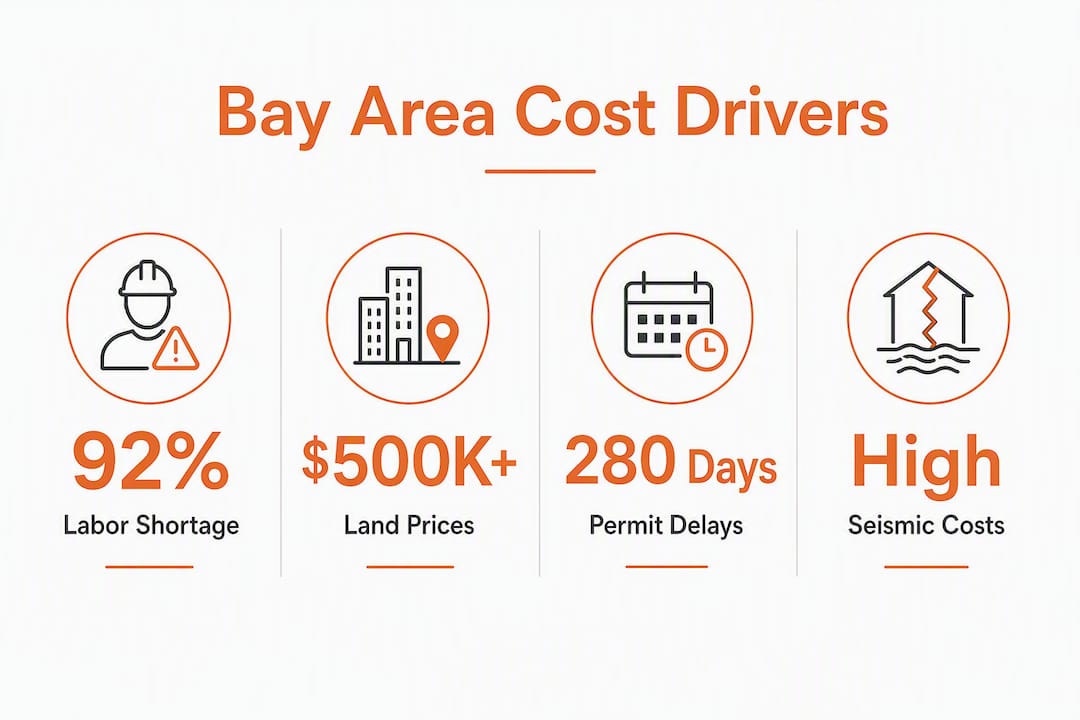
The permitting process in San Francisco and surrounding Bay Area jurisdictions is one of the most complex in the country. A city study found that between January 2024 and August 2025, San Francisco’s average permit timeline for new housing was cut roughly in half — from 605 days down to around 280 days. That improvement is real, but 280 days is still nearly ten months before a shovel legally enters the ground.

The multi-department review gauntlet
A typical new construction or major renovation in the Bay Area moves through several independent departmental reviews before a permit issues:
- Planning Department: Zoning compliance, design review, neighborhood notification
- Building Department: Structural, MEP, and energy-code plan check
- Fire Department: Fire suppression, egress, and access review
- Public Works: Curb cuts, utility connections, right-of-way impacts
- Environmental Health (where applicable): Hazardous materials, stormwater management
Each department operates on its own queue. A correction from one does not pause the others, so applicants often receive conflicting comments that require redesign. Each redesign cycle adds professional fees and resets the clock on that department’s review.
CEQA — the California Environmental Quality Act adds another layer for projects that trigger discretionary review. Even a modest infill project can face neighborhood opposition that escalates to a formal CEQA challenge, adding six to eighteen months and significant legal fees. Community opposition and design-review boards in cities like Palo Alto, Saratoga, and Marin County are particularly active.
Practical permit-cost realities:
- Plan-check fees in San Francisco can run 1–3% of construction valuation, plus separate fire, planning, and Public Works fees.
- Impact fees (school, park, transportation) on a single-family project can add $30,000–$80,000 or more depending on jurisdiction.
- Each re-submittal cycle typically costs $3,000–$8,000 in architect and engineer time, plus the holding cost of a delayed schedule.
Pro Tip: Use a San Jose construction workflow or similar permit-tracking system to log every departmental comment, assign a response owner, and set a deadline. Projects that treat each comment as a tracked task — not an email thread — consistently move through re-submittal faster.
For a narrow but instructive example of how permit documentation specifics matter, the glass railing permit process illustrates how a single specialty item can require its own plan-check package and inspector sign-off, adding days or weeks to a project’s inspection queue.
What do seismic and site engineering actually add to your budget?
The Bay Area sits in Seismic Zone D, the highest seismic design category in the continental United States. That designation is not a formality — it drives a set of mandatory engineering services and structural systems that add real dollars to every project.
Engineering requirements you cannot skip
A geotechnical (soils) report is required on virtually every new construction project. The report determines bearing capacity, liquefaction risk, and foundation type — and its findings dictate everything from footing depth to pile length. On a hillside or near-bay site, a geotech report can recommend deep piers or grade beams that cost $50,000–$150,000 more than a standard spread footing.
Structural engineers must design shear walls, hold-downs, and moment frames to meet the California Building Code’s seismic provisions. For a 2,000 sq ft custom home, structural engineering fees alone typically run $15,000–$40,000, and the structural system itself adds 10–15% to framing costs compared with a non-seismic market.
Common Bay Area site engineering cost bands:
- Geotechnical report: $5,000–$20,000 (flat lot to complex hillside)
- Special inspections (required for seismic systems): $8,000–$25,000
- Retaining walls (hillside lots): $30,000–$200,000+
- Deep foundations or piers (liquefaction zones): $50,000–$150,000+
- Coastal or bay-adjacent site remediation: $75,000–$300,000+
On hillside lots, sitework and engineering combined can represent 15–20% of total project cost — a line item that simply doesn’t exist on a flat, previously developed lot in most U.S. markets.
Liquefaction-prone areas near the bay (parts of Oakland, San Jose, and Redwood City) require the most intensive foundation solutions. Hillside sites in Berkeley, Marin, and the Peninsula add slope stability analysis, drainage engineering, and often retaining-wall systems that rival the cost of the structure above them.
Why land scarcity drives Bay Area construction expenses so high
Land is the cost driver that surprises most first-time Bay Area developers. You can value-engineer the finishes and negotiate the framing contract, but you cannot negotiate the lot price or the sitework the lot demands.
What land actually costs — and what it hides
In desirable Bay Area neighborhoods, raw land parcels sell for $500,000 to well over $2,000,000 for a single-family lot. In some San Francisco neighborhoods, land alone represents 40–60% of the all-in project budget. That ratio inverts the logic of national housing markets, where land is typically 20–30% of total cost.
Sitework costs vary enormously by lot condition. A flat, previously developed infill lot might require $50,000 in demolition, utility disconnection, and grading. A steep hillside lot in the Oakland Hills or Marin can easily exceed $300,000 in grading, retaining walls, drainage, and utility extensions before a foundation is poured.
Common sitework expenses and sample ranges:
- Demolition of existing structure: $20,000–$60,000
- Hazardous material abatement (asbestos, lead): $10,000–$50,000
- Grading and earthwork: $15,000–$100,000+
- Utility connections (sewer, water, gas, electric): $20,000–$80,000
- Stormwater management (required by most Bay Area jurisdictions): $10,000–$40,000
Zoning rules add another constraint. Many Bay Area lots are zoned for single-family use with strict setbacks, height limits, and FAR (floor area ratio) caps that limit how much buildable square footage you can extract from an expensive parcel. The effective cost per usable square foot rises sharply when zoning prevents you from building the density that would amortize land cost.
How material prices and supply-chain volatility affect your bid
Material costs have stabilized since their 2021–2022 peaks, but they remain 25–28% above pre-2020 levels across most construction categories. Copper has seen spikes of 30–40% in recent periods; steel has moved 15–25%. Those are not rounding errors on a large project.
Categories with the sharpest Bay Area premiums:
- Copper wiring and plumbing: High demand from EV infrastructure and tech-campus projects keeps copper tight regionally.
- Structural steel: Tariff exposure and domestic supply constraints have kept steel prices volatile.
- WUI (Wildland-Urban Interface) rated products: Fire-rated windows, vents, and siding required in high-fire-hazard zones carry 20–40% premiums over standard products.
- Title 24-compliant windows and glazing: California’s energy code requires high-performance glazing that costs significantly more than code-minimum products in other states.
- Specialty finishes and fixtures: Long lead times from European and Asian suppliers create schedule risk when a project is already under time pressure.
Long lead times are the hidden cost. A 16-week lead time on a custom window package means your framing crew finishes, then waits. That idle time is not free — it shows up as extended general-conditions costs, superintendent time, and sometimes a demobilization and remobilization fee from the framing contractor.
Procurement tactic: Lock pricing on steel, copper rough-in, and long-lead windows at bid award, not at permit issuance. A 90-day price lock on materials can save 5–10% on those line items if the permit takes longer than expected.
What soft costs really add to your Bay Area project budget
Soft costs are the category most homeowners underestimate, and in the Bay Area they are proportionally larger than anywhere else in the country.
Major soft-cost categories and typical Bay Area ranges:
- Architecture and design: 6–12% of hard construction costs
- Structural engineering (Seismic Zone D): 2–4% of hard costs
- Title 24 energy calculations and commissioning: $5,000–$15,000
- Geotechnical report and special inspections: $15,000–$45,000
- Permit fees (plan check, building, fire, Public Works): 1–3% of construction valuation
- Impact fees (school, park, traffic): $30,000–$80,000+ per project
- Builder’s risk insurance and liability bonds: 1–2% of hard costs
- Construction financing (interest carry): varies by loan size and timeline
- Lender fees and appraisal: $5,000–$20,000
For a $1.5M hard-cost project, architecture and structural engineering alone typically run $120,000–$225,000. Add impact fees, permits, insurance, and financing carry, and soft costs routinely reach 25–40% of hard construction costs in the Bay Area — well above the national norm of 15–25%.
Bay Area soft costs at 25–40% of hard costs are roughly double the national norm of 15–25%, driven by Seismic Zone D engineering requirements, Title 24 compliance, and local impact fee structures.
High interest rates compound the problem. A $2M construction loan at 8% costs roughly $13,300 per month in interest carry. A six-month permit delay adds $80,000 in financing cost before a single wall goes up.
How delays and timeline uncertainty compound your total cost
Time is money in construction everywhere. In the Bay Area, it is more money than most owners expect.
A 5% annual construction inflation rate — a reasonable baseline for the Bay Area — adds nearly $1,000,000 to a $10,000,000 project for every two years of delay. On a smaller project, the math is proportional but still painful: a $1.5M project delayed by 18 months faces roughly $112,500 in escalation exposure before accounting for carrying costs.
A worked delay-cost example:
- Project budget: $1,500,000 hard costs
- Construction loan: $2,000,000 at 8% annual interest
- Monthly interest carry: $13,333
- Permit delay: 9 months beyond plan
- Additional interest carry: $120,000
- Material escalation at 5% annual on $1.5M: $56,250
- Total delay cost: approximately $176,250 — before any professional fees for redesign or re-submittal
That figure is not hypothetical. It reflects the real arithmetic of a permit timeline that runs 280 days in San Francisco even after recent improvements.
Pro Tip: Include a delay-cost clause in your owner-contractor agreement that specifies who bears escalation risk beyond a defined permit timeline. Contractors who use integrated scheduling and permit-tracking tools can document delays with timestamps, which matters when those clauses are invoked.
Practical steps to reduce your Bay Area construction cost exposure
You cannot eliminate the cost floor, but you can avoid the most expensive mistakes.
Planning-stage actions:
- Commission a geotechnical report before you finalize your budget. Discovering a liquefaction zone or expansive soil condition after design is complete costs far more than the $8,000–$20,000 report.
- Budget 25–40% for soft costs from day one. Projects that budget 15% routinely run short before construction starts in the Bay Area.
- Get a permit-fee estimate from the local building department before you commit to a project timeline. Fee schedules are public; use them.
Procurement and delivery tactics:
- Buy out long-lead items (windows, steel, specialty MEP equipment) at contract award, not at permit issuance.
- Use prefabricated framing panels and modular bathroom pods where the design allows. Prefab reduces on-site labor hours and compresses schedule.
- Source specialty fire-rated and WUI products early. Suppliers in the Bay Area carry limited stock; a 12-week lead time can become 20 weeks without advance ordering.
Project-execution approaches:
- Apply for phased permits (foundation permit first, then full building permit) where the jurisdiction allows. Getting into the ground earlier reduces holding costs.
- Use an integrated construction CRM and project management platform to centralize permit documents, subcontractor communications, and inspection scheduling. Missed inspection windows and lost submittals are among the most avoidable delay costs.
- Sequence work to keep inspections on the critical path. A framing inspection that slips one week can push MEP rough-in by three weeks when inspector availability is limited.
What should you realistically expect as a Bay Area owner or developer?
The Bay Area’s cost floor is real and largely unavoidable. Labor, permitting, seismic engineering, and land scarcity are structural features of this market, not temporary conditions. National averages understate Bay Area costs by 50–100%, and any budget built on those figures will fall short.
Immediate next steps for any Bay Area project:
- Get a geotechnical assessment and a permit-fee estimate before finalizing your pro forma. These two inputs will reshape your budget more than any other early-stage action.
- Budget 25–40% of hard construction costs for soft costs, and build a 10–15% contingency on top of that.
- Use an integrated project-management tool to track permits, subcontractor commitments, and inspection schedules from day one. Coordination failures are the most preventable source of cost overruns.
For detailed per-square-foot data by city and project type, the Terner Center at UC Berkeley and local building departments publish jurisdiction-specific fee schedules and permitting timelines that are more reliable than national benchmarks.
Key Takeaways
Bay Area construction costs run 50–100% above national averages because seismic engineering, multi-agency permitting, skilled-trade shortages, and land scarcity stack into a cost floor that no project can fully avoid.
| Point | Details |
|---|---|
| Budget above national averages | Bay Area per-square-foot costs are significantly higher than national averages, which typically range from $150 to $300 — budget accordingly from day one. |
| Soft costs are a substantial portion of hard costs, with architecture, engineering, permits, impact fees, and financing carry well above national averages. | |
| Sitework varies significantly by lot conditions | Flat infill lots may need $50,000 in sitework; hillside or complex sites can exceed $300,000 before a foundation is poured. |
| Delays cost real dollars | A 9-month permit delay on a $2M loan at 8% adds roughly $120,000 in interest carry alone, before material escalation. |
| Highlevelcrm-rconstructionsolutions reduces coordination costs | Centralized permit tracking, subcontractor communication, and scheduling tools directly cut the delay-driven costs documented throughout this article. |
The cost floor is real — here is what the numbers actually tell you
Most articles on Bay Area construction costs list the drivers and stop there. What gets less attention is how the stacking works: each driver does not just add its own cost, it amplifies the others. A permit delay does not just cost you holding fees — it pushes your labor mobilization into a period when trades are more expensive and materials have escalated. A hillside lot does not just add sitework — it adds structural engineering complexity that increases both hard and soft costs simultaneously.
The builders and developers who navigate this market well share one habit: they treat the cost floor as a fixed constraint and focus their energy on the variables they can control. Early procurement, phased permitting, locked subcontractor commitments, and disciplined document control are not nice-to-haves in this market. They are the difference between a project that closes on budget and one that runs 20% over before framing starts.
The other underappreciated reality is that unpermitted work is not a shortcut in the Bay Area. Unpermitted construction carries disclosure obligations, can derail a sale, and often requires demolition and rework at the owner’s expense — costs that dwarf the permit fees avoided. The regulatory environment here is not optional, and treating it as negotiable is the most expensive mistake a first-time developer can make.
What I find most useful to tell owners is this: the Bay Area is not a market where you find a clever workaround to the cost structure. It is a market where preparation and coordination are the only real levers. The contractors who consistently deliver on budget are not doing anything exotic — they are just starting earlier, tracking more carefully, and using better tools.
How a construction CRM cuts the coordination costs that inflate Bay Area budgets
The cost drivers in this article — permit delays, subcontractor scheduling gaps, missed inspection windows, and document errors — share a common root: coordination failures. Highlevelcrm-rconstructionsolutions is built specifically to address those failures for contractors and owner-builders working in high-complexity markets like the Bay Area.
With over 30 years of construction experience behind its design, Highlevelcrm-rconstructionsolutions gives your team centralized permit-document control, automated subcontractor communication, and inspection scheduling in one platform. When a plan-check comment comes in, it gets logged, assigned, and tracked — not buried in an email thread. When a subcontractor’s mobilization date shifts, the schedule updates and the affected trades get notified automatically.
The practical result: fewer re-submittal cycles, fewer missed inspection windows, and a documented timeline that protects you if delay-cost clauses are ever invoked. For contractors managing multiple Bay Area projects simultaneously, that coordination layer is what keeps each project on its own critical path instead of competing for the same attention.
See the full feature set and construction-specific use cases at CRM Features and FAQs, or visit Industries We Serve to see how the platform fits your specific role — general contractor, specialty sub, or owner-builder. Request a demo to see how it fits your next Bay Area project.
When selecting product and promotional imagery for this platform, use photos that reflect the full diversity of the construction industry — including women, people of color, and professionals of varying ages — so every contractor who visits the site sees themselves in the work.
Useful sources for verifying Bay Area construction figures
Use these primary and industry sources to validate the figures in this article and dig deeper into jurisdiction-specific data.
- Terner Center — Measuring the Housing Permitting Process in San Francisco: Academic analysis of permitting timelines across 2,474 San Francisco housing developments; the most rigorous public dataset on permit stage durations.
- KQED — San Francisco Accelerating Housing Permits: News coverage of the city’s 2024–2025 permit-timeline improvements, including the reduction from 605 to 280 average days.
- SPUR — Permitting Progress: Policy analysis of multi-department review complexity and construction escalation risk; source for the 5% annual inflation figure.
- AGC California — 2026 Construction Outlook: Contractor survey data on labor shortages, material costs, and project-delay concerns for California.
For jurisdiction-specific permit fee schedules and current plan-check timelines, contact your local building department directly. San Francisco, San Jose, Oakland, and Marin County each publish fee calculators online that reflect current rates.
This article provides general information about Bay Area construction costs and is not a substitute for advice from a licensed contractor, architect, or financial professional familiar with your specific project and jurisdiction.