
Why Contractors Need More Than Buildertrend in 2026
Buildertrend is a genuinely strong platform for residential general contractors and custom home builders. Its Selections module is best-in-class, the client portal drives close rates, and its over 1 million users globally since 2006 confirm it earned its market position. But for a growing number of contractors, Buildertrend alone is not enough. Pricing opacity, data access restrictions, accounting sync failures, and a mobile app that field crews routinely abandon are pushing contractors to look beyond a single platform.
Here is what drives that search:
- Data ownership risk: Buildertrend has no native bulk export, meaning years of project history can be held hostage inside the platform.
- Escalating costs: Renewal hikes have been reported, and pricing is now demo-gated with no published rates.
- Accounting blind spots: Sync errors with QuickBooks cause unreliable job costing and require expensive manual corrections.
- Field adoption collapse: An overloaded UI and fragile mobile app mean crews stop using the system, leaving project data incomplete.
- Integration gaps: No native CompanyCam, Xactimate, or EagleView integration limits specialty contractors and insurance restoration firms.
- Scalability friction: More projects add complexity the platform was not designed to absorb cleanly for commercial or high-volume operations.
The contractors who thrive in 2026 are not necessarily the ones who replaced Buildertrend. They are the ones who understood what it does well, identified where it falls short for their specific operation, and built a connected software stack around those realities.
Why contractors look beyond Buildertrend: strengths and real limitations
Buildertrend’s competitive moat comes down to one feature: the Selections module. It lets homeowners pick every cabinet, fixture, paint color, and finish before trades start. For custom home builders, that is not a convenience feature. It is a sales asset. Builders who run selections through Buildertrend report significant time savings per project in coordination friction, typically saving roughly 20 hours per project and recovering $1,500 of project management time per home. On six custom builds per year, that math approaches the platform’s annual cost on the Complete tier.

The client portal, AI Client Updates (shipped june 2025), and AI Bill Pay (announced at IBS Orlando in early 2026) are real, shipped features with measurable time savings. For 5–50 person residential firms selling design-heavy work, Buildertrend earns its price.
The problems surface when contractors grow past that sweet spot.
Where Buildertrend breaks under pressure
Pricing opacity and cost escalation. After acquiring CoConstruct in 2021, Buildertrend documented 50–65% price increases in 2022, followed by continued raises through 2024. The platform now requires a custom quote call. Contractors report doubled fees after year one or year four of use, plus per-transaction fees on Buildertrend Bill Pay of approximately 2.99%. On $500,000 in annual client payments, that adds roughly $14,950 per year in fees alone.
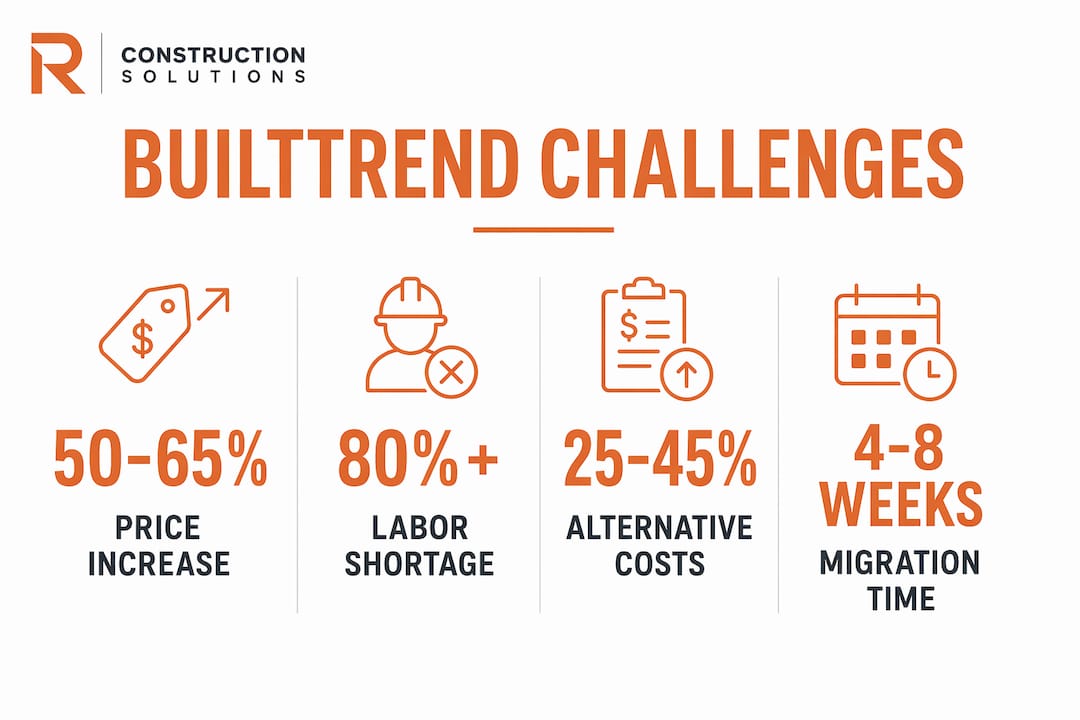
The data hostage problem. There is no native bulk export. Project documents, photos, and daily logs can generally be exported one file at a time, but financial history, client communication threads, and selections data are significantly harder to migrate. Most contractors attempting a switch end up doing a clean-start migration with archived access to the old platform, a process that typically requires 4–8 weeks of parallel operation.
Accounting sync failures. The QuickBooks integration suffers from sync errors and duplicate entries that make job costing unreliable. Office staff end up manually correcting financial data, which defeats the purpose of an integrated platform. This is not an edge case. It is a documented, recurring pattern.
Statistic callout: Rework costs average 9% of total project value, according to Construction Dive. On a $5M project, that is $450,000 disappearing because the field and the office had different versions of the same drawing or spec. Better project controls are not optional at that margin pressure.
Field adoption collapse. The platform’s UI complexity creates what contractors call the “10-click wall.” Too many steps for simple tasks means field crews stop using the app. When the field opts out, the data becomes incomplete, and the entire system loses its value as a source of truth.
Integration gaps. Buildertrend works best as a self-contained hub with QuickBooks Online as the accounting backbone. Outside that native stack, integration depth is meaningfully thinner than competitors like Procore offer in commercial construction. No native CompanyCam, no Xactimate path, no EagleView integration. Specialty contractors and insurance restoration firms hit this ceiling fast.
- Solo contractors and crews of 1–3 people find pricing prohibitive relative to what they actually use
- Specialty roofing with insurance restoration workflows has no Xactimate path inside Buildertrend
- Commercial GCs running $20M+ projects need Procore-level subcontractor coordination and AIA billing workflows
- Contractors who need transparent, published pricing before talking to sales are frustrated by the demo-gated model
80%+ of construction firms report labor shortages, according to the Associated General Contractors. That structural pressure, combined with rework costs and owner demands for digital submittals, means the firms that thrive are treating software as an operational discipline, not just a subscription.
Top Buildertrend alternatives for contractors in 2026
The right alternative depends entirely on your project type, team size, and the specific gap Buildertrend leaves in your operation. The table below maps each platform to its strongest use case across the dimensions that matter most for a real buying decision.

| Platform | Best For | Pricing and Total Cost | Ease of Adoption | Integration Capabilities | Standout Capability |
|---|---|---|---|---|---|
| Buildertrend | Residential GCs, custom home builders, remodelers | $499–$900+ per month; renewal hikes documented | Moderate; field adoption often low | QuickBooks, Gusto, Home Depot Pro Xtra; narrow third-party depth | Selections module; client portal |
| JobTread | Small to mid-size remodelers, specialty contractors | Flat-rate, transparent; base + per-user | High; clean UI, fast onboarding | Strong core integrations; G2 High Performer | Transparent pricing; all features from day one |
| Contractor Foreman | Small contractors, solo operators, specialty trades | $221 per month for 15 users | High; straightforward feature set | Covers 80%+ of Buildertrend features | Lowest cost full-featured option; 30-day free trial |
| Procore | Large GCs, $5M+ commercial projects | $10,000–$60,000+/yr; annual contracts only | Low to moderate; enterprise onboarding | Strongest in commercial; deep sub coordination | AIA billing; subcontractor compliance workflows |
| Fieldwire | Field supers, specialty contractors | Free plan (5 users); paid tiers available | High; field-first design | Plan and task sync; not a full ERP | Best-in-class field task and plan management |
| AccuLynx | Specialty roofing contractors | Tiered plans; not publicly listed | Moderate | Xactimate path; insurance restoration workflows | Industry-specific CRM and estimating |
| ConstructionOnline | Growing contractors needing financial controls | Tiered plans; not publicly listed | Moderate | Strong estimating and change order management | Financial management depth |
| Houzz Pro | Residential remodelers integrating design and sales | Tiered plans; not publicly listed | Moderate; design-oriented UI | Marketing and project tools in one platform | Integrated marketing and lead generation |
| BuildBook | Home builders prioritizing client communication | Tiered plans; not publicly listed | High; user-friendly interface | Client engagement tools | Scheduling and client communication focus |
| Buildern | General contractors seeking modern UI and reporting | Tiered plans; not publicly listed | High; modern interface | Strong collaborative features | Reporting and data accessibility |
| Corecon | Mid-market contractors needing enterprise features | Tiered plans; not publicly listed | Moderate | Strong accounting integration | Cost control and bidding depth |
| Oracle Aconex | Large, complex commercial projects | Enterprise pricing; not publicly listed | Low; enterprise implementation | Document control and risk management | Information management at enterprise scale |
| EZcontractPRO | Contractors needing contract analytics and compliance | Tiered plans; not publicly listed | Moderate | Compliance and contract tracking | Integrated compliance management |
| Corecon (Sage Construction Management) | Mid-market contractors using Sage ecosystem | Tiered plans; not publicly listed | Moderate | Deep Sage accounting integration | ERP-level cost tracking within Sage |
Pro Tip: Before evaluating any alternative, export everything you can from Buildertrend first. Financial history and selections data are the hardest to migrate. Budget 4–8 weeks for a proper transition including parallel operation, and treat that time as a real project cost.
How the leading alternatives actually differ
JobTread is the most consistently recommended alternative for remodelers switching from Buildertrend. Its flat-rate pricing model is transparent from day one, all features are included regardless of tier, and G2 named it a High Performer across construction project management, estimating, and accounting categories. JobTread ranked sixth on Deloitte’s 2025 Technology Fast 500. For contractors frustrated by Buildertrend’s pricing opacity, that transparency alone is a meaningful differentiator.
Contractor Foreman covers roughly 80% of Buildertrend’s feature set at 25–45% of the reported cost. A 15-person team on the Pro plan runs approximately $221 per month versus Buildertrend’s reported $499–$900+ per month. It also offers a 30-day free trial, something Buildertrend does not. The trade-off is a less polished client-facing portal and a lighter residential sales CRM.
Procore is not a cost-reduction move from Buildertrend. Pricing typically runs $10,000–$60,000+ per year for mid-market general contractors, and annual contracts only. The right reason to move to Procore is outgrowing Buildertrend’s capacity on commercial work, not cutting your software bill. Its unlimited-user model becomes an advantage at 80+ users, and its subcontractor coordination and AIA billing workflows have no residential equivalent.
Fieldwire is field-management first. It is not a construction ERP replacement. Field superintendents and specialty contractors who need best-in-class plan management, task tracking, and daily logs without paying for estimating and invoicing they will not use find Fieldwire a natural fit. The free plan for up to five users makes it easy to pilot.
AccuLynx fills the gap Buildertrend leaves for specialty roofing contractors. The Xactimate integration and insurance restoration workflows are purpose-built for that segment. No other platform in this comparison matches AccuLynx’s depth for roofing-specific CRM and estimating.
Oracle Aconex operates at a different scale entirely. Large, complex commercial projects requiring tight document control, risk management, and information management at the enterprise level are its domain. For most contractors reading this, it is not a realistic Buildertrend alternative. It is worth knowing it exists for the segment where Procore’s document control is still not enough.
Buildern earns attention for general contractors who want a modern interface with strong collaborative features and reporting. Its data accessibility focus addresses one of Buildertrend’s core weaknesses directly. Reviews on G2 and Capterra reflect strong user satisfaction with the reporting and collaboration tools.
Houzz Pro serves a specific niche: residential remodelers who want marketing, lead generation, and project management in one platform. If your business runs on Houzz leads and design-oriented client relationships, the integrated marketing tools justify the subscription in a way no other platform on this list can match.
For a broader look at construction CRM options beyond Buildertrend, the landscape in 2026 includes more purpose-built tools than at any prior point.
How contractors can choose the right software beyond Buildertrend
The most common mistake contractors make when evaluating software is leading with features. The right starting point is your operation’s actual failure points. Where does data get stuck? Where do field crews stop using the system? Where does your accounting team spend hours on manual corrections?
Key criteria for a real evaluation
- Business size and project type: Buildertrend is built for contractors doing 5+ projects per year with $500,000+ in annual revenue. Smaller operations should look at Contractor Foreman or JobTread. Commercial GCs above $20M should evaluate Procore.
- Integration needs: Map every tool your team currently uses. If you rely on CompanyCam, Xactimate, or EagleView, verify native integration before committing to any platform.
- Total cost of ownership: Subscription price is only part of the cost. Add onboarding time, training hours, migration effort, and any per-transaction fees. Buildertrend’s Bill Pay fee of approximately 2.99% on client payments adds up fast at volume.
- Data portability: Ask every vendor directly: can you export all project data, financial history, and client communications in a machine-readable format? If the answer is vague, treat that as a red flag.
- Scalability: A platform that works for 10 projects per year may break at 40. Test with your actual project volume, not a demo scenario.
The single-spine principle
Stack sprawl is the most common cause of failed automation rollouts. Buying Procore, Buildertrend, CompanyCam, Raken, and Fieldwire in the same year creates a data consistency problem that no individual tool can solve. The firms that outperform their peers enforce a single-spine discipline: one project management tool, one field operations tool, and one accounting platform, connected deliberately.
That does not mean using fewer tools. It means choosing tools that connect cleanly and assigning each a defined role. Your project management platform is the system of record. Your field tool feeds it daily. Your accounting platform receives job-cost data from both.
Reducing manual onboarding steps is one of the fastest ways to improve adoption. The more complex the software, the longer the retraining cycle, and the higher the risk that field crews opt out entirely. Minimizing that friction from the start is as important as the feature set itself.
Evaluating customer support and training
- Ask for references from contractors in your specific segment, not just the vendor’s showcase clients.
- Verify whether implementation support is included or billed separately. Buildertrend’s heavy reliance on onboarding consultants is a documented friction point.
- Check whether the vendor offers a free trial. Contractor Foreman’s 30-day trial and Fieldwire’s free plan let you test real workflows before committing.
- Review G2 and Capterra ratings for customer service specifically, not just overall score. Buildertrend carries a 4.7/5 customer service sub-score on Capterra across 2,483 reviews, which is a meaningful benchmark to compare against alternatives.
Migration planning
Switching software typically requires 4–8 weeks for a proper migration including data export, new platform setup, team training, and parallel operation. Never switch mid-contract if you can avoid it. The disruption cost rarely pencils out against the savings until the new platform is fully adopted. If your team is trained and using Buildertrend consistently, that adoption has real value. Factor it into the decision.
For contractors evaluating commercial construction software specifically, the criteria shift toward subcontractor coordination depth, AIA billing, and document control rather than client-facing portals and selections workflows.
What experts say about managing your contractor software stack
The construction industry has been the slowest major sector to digitize. The firms pulling ahead in 2026 are not the ones with the most software. They are the ones with the most connected software.
Industry expert Garrett Mullins identifies stack sprawl as the primary cause of lost efficiency in construction operations. His recommendation is the single-spine approach: one project management tool, one field operations tool, one accounting platform, connected deliberately rather than accumulated reactively. Firms that enforce that discipline outperform those with tool sprawl across every operational metric.
Statistic callout: 80%+ of construction firms report structural labor shortages, according to the Associated General Contractors. The pipeline of skilled trades retiring exceeds the pipeline entering. Firms are no longer competing only for projects. They are competing for the crews to run them. Software that field crews actually use is not a preference. It is a prerequisite.
Mark Caples, writing on the human cost of software adoption, emphasizes that the monetary subscription price is only part of what contractors pay. Continuous retraining and onboarding demands created by complex software suites reduce operational productivity in ways that rarely appear in a software ROI calculation. Every time a platform updates its UI or adds a feature layer, someone on your team loses productive hours relearning a workflow they had already mastered.
Operational strategists in the construction technology space stress that software value lies in data openness. A platform that holds your project history in a proprietary format and makes bulk export difficult is not a tool you own. It is a tool that owns you. The most successful firms treat their primary project management platform as a data repository and layer orchestration on top to connect field and accounting systems, keeping data flowing and avoiding vendor lock-in.
Pro Tip: When evaluating any platform, ask the vendor to walk you through a full data export of a completed project, including financial history, client communications, and all attachments. If they cannot demonstrate it in 15 minutes, budget extra weeks for your eventual migration.
The orchestration mindset accepts that no single platform does everything well. Procore is the strongest project management tool for commercial GCs. It is not the best accounting integration, the best field photo tool, or the best lien-waiver workflow. Buildertrend is the strongest residential platform for homeowner-facing workflows. It is not the best job costing tool or the best field adoption platform. Connecting specialists cleanly beats forcing one platform to do everything poorly.
For contractors exploring why construction-specific tools outperform generic solutions, the answer comes down to data flows. A generic CRM does not know what a change order is. A generic project management tool does not understand lien waivers. Purpose-built tools carry that domain logic natively, which means less configuration, fewer errors, and faster adoption by crews who recognize the workflows from day one.
You can also find useful context in this analysis of construction software alternatives for contractors evaluating options across the market.
Key Takeaways
Buildertrend is the right platform for a specific contractor profile. Outside that profile, the limitations in data access, pricing, integration depth, and field adoption create real operational and financial costs that push contractors toward better-fit alternatives or a connected multi-tool stack.
| Point | Details |
|---|---|
| Buildertrend’s core strength | The Selections module saves roughly 20 hours per project, recovering $1,500 of project management time per home for custom builders. |
| Pricing and cost risk | Renewal hikes of 50–65% are documented; per-transaction Bill Pay fees add roughly $14,950 per year on $500,000 in client payments. |
| Data portability gap | No native bulk export means migration typically requires several weeks and often results in a clean-start rather than a full data transfer. |
| Single-spine discipline | Firms that enforce one project management tool, one field operations tool, and one accounting platform outperform those with tool sprawl. |
| Highlevelcrm-rconstructionsolutions | Built with 30+ years of construction experience, it addresses the CRM and lead-tracking gaps Buildertrend leaves, with automated workflows and custom reporting tailored to contractors. |
The real cost of picking the wrong platform
Most contractors evaluate software by its feature list. That is the wrong lens. The feature list tells you what the platform can do in a demo. It does not tell you what your field crew will actually use at 6 AM on a job site, what your office manager will do when the QuickBooks sync fails for the third time this month, or what happens to five years of project history when you outgrow the platform and need to leave.
Buildertrend is a genuinely excellent platform for the contractor it was built for: a residential general contractor or custom home builder with 5–50 employees, $1M–$25M in annual revenue, and a business model where the homeowner experience drives referrals and close rates. The Selections module is not a feature. It is a competitive moat. If that description fits your operation, Buildertrend earns its price, even with the opacity and the renewal risk.
But the construction industry in 2026 is not a single segment. It is roofing contractors who need Xactimate. It is commercial GCs who need AIA billing and subcontractor compliance tracking. It is solo operators who need estimating software at $39 per month, not $9,000 per year. It is growing mid-market firms that need their project management platform, their field tool, and their accounting system to share data without a human manually reconciling them every week.
The contractors I see struggle most are not the ones who chose the wrong platform. They are the ones who chose a platform and then tried to make it do everything, long past the point where it was clearly failing them. They added workarounds. They hired someone to manage the workarounds. They paid for integrations that half-worked. They watched their field crews stop logging data because the app was too slow or too complicated. And they kept paying the annual contract because switching felt harder than staying.
Switching is hard. But staying on a platform that your team has stopped using is not a solution. It is just a more expensive version of the same problem.
The right approach is not to find the perfect platform. It is to find the right spine for your dominant project type, connect it deliberately to your field and accounting tools, and enforce that discipline across every project. That is what the firms outperforming their peers are doing in 2026.
Highlevelcrm-rconstructionsolutions fills the gap Buildertrend leaves on the CRM side
Buildertrend manages projects well. What it does not do is manage your pipeline, automate your lead follow-up, or give you a reporting dashboard that connects lead conversion to project revenue. That gap is where contractors lose money quietly, not on job costs, but on the leads that went cold because no one followed up, or the referrals that never converted because the proposal process was too slow.
Highlevelcrm-rconstructionsolutions was built with over 30 years of construction experience specifically to address that gap. It offers automated lead tracking, custom reporting dashboards tied to construction workflows, and integration with the industry-specific tools contractors already use. Users report lead conversion rate increases of up to 35% after adopting the platform, driven by automated follow-up sequences that replace the manual outreach most contractors never get around to. For mid-market contractors who have their project management covered but are losing revenue at the front end of the pipeline, it is a direct answer to a real problem. See the full range of contractor solutions Highlevelcrm-rconstructionsolutions supports across construction segments.

