
Automated Bid Follow-Up for Contractors | High Level CRM - R. Construction Solutions
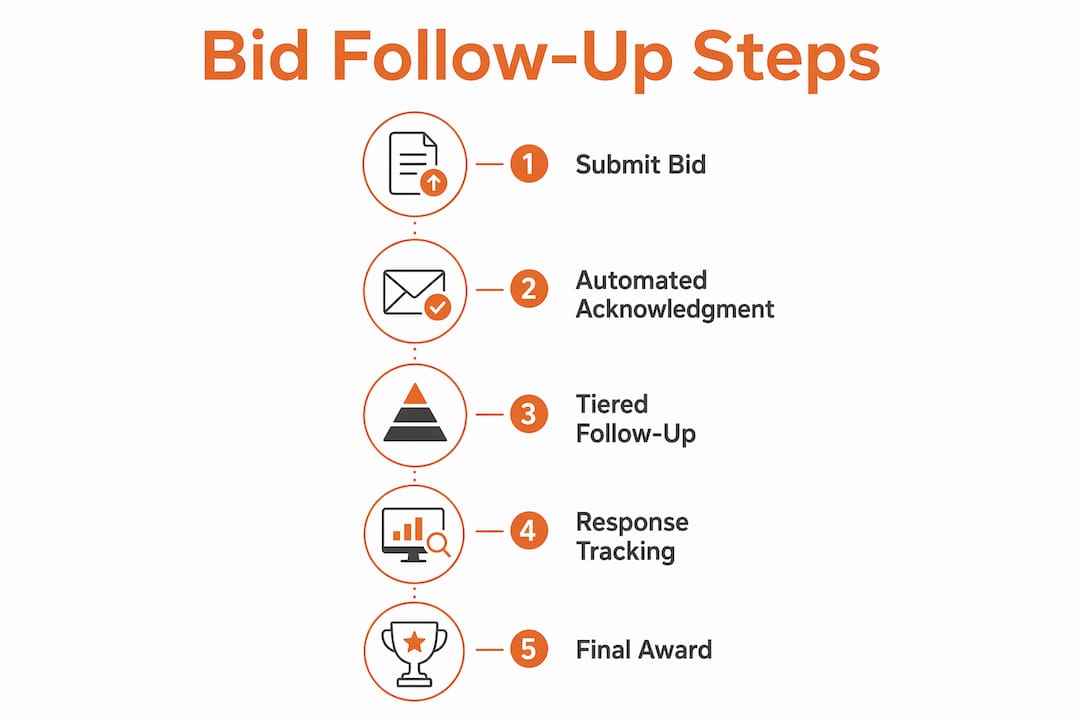
Automated bid follow-up is a CRM-driven sequence that sends professional, timed post-submission messages to GCs and owners on your behalf, so no bid goes silent after you hit send. For contractors managing dozens of active bids, the practical recommendation is simple: anchor your follow-up cadence to bid day, tier your bids by value, and let automation handle the volume while your estimators focus on the work that actually requires their judgment. Highlevelcrm-rconstructionsolutions is built on 30+ years of construction experience and designed specifically for this workflow. Users report a ~35% conversion lift after adopting construction-specific automated follow-up. The Bid/No-Bid decision sits at the center of the process, and automation enforces it before a single estimating hour gets spent.
Key facts at a glance:
- Consistent follow-up can significantly improve win rates without changing your price
- Responding promptly raises win rates substantially; delayed responses can lower win rates considerably
- Automation removes human variability across hundreds of simultaneous bids
Table of Contents
- What automated bid follow-up does and why you need it
- Core CRM features that make bid follow-up work at scale
- Practical follow-up workflows and timelines anchored to bid day
- How to measure whether your follow-up is working
- Step-by-step rollout checklist and common pitfalls
- How Highlevelcrm-rconstructionsolutions enables automated bid follow-up
- Key Takeaways
- What most contractors get wrong about follow-up automation
- See how Highlevelcrm-rconstructionsolutions fits your bid workflow
- Sources and further reading
What automated bid follow-up does and why you need it
Most contractors submit a bid and wait. Top-performing firms do the opposite: they run a structured sequence of touchpoints from submission through award, and they do it consistently across every active opportunity. That consistency is what separates a 5% win rate from a 25–30% win rate.
The core functions of an automated follow-up system are:
- Capture the bid submission and timestamp it in your CRM
- Schedule a cadence of email and SMS touchpoints anchored to bid day
- Escalate to a human when a GC replies, a deadline shifts, or a bid is marked at risk
- Log every outcome, including losses, for pricing intelligence
The business case is straightforward. Responding within 24 hours raises your win probability to roughly 41%. Most firms miss that window because no one owns the follow-up task. Automation closes that gap without adding headcount.
Contractors also lose bids for reasons that have nothing to do with price: missed RFIs, no acknowledgment of addenda, or simply going quiet after submission. Automation fixes all three by triggering alerts and pre-written responses the moment a status changes.
Pro Tip: Set up an automated acknowledgment that fires within one hour of every bid submission. It confirms receipt to the GC, signals professionalism, and costs your team zero time.
Core CRM features that make bid follow-up work at scale
Not every CRM is built for construction. The features below are what you actually need to run dependable follow-up across a full bid pipeline.
Status fields and pipeline stages:
- Submitted, Awaiting Award, Under Review, Lost, Won
- Configurable probability weights per stage for revenue forecasting
Cadence and trigger tools:
- Time-based triggers anchored to bid submission date and GC bid day
- Event-based triggers: addenda issued, schedule change, GC reply received
- Configurable intervals (24h, 48h, 72h, 2 weeks) per bid tier
Templates and messaging:
- Email and SMS templates with merge fields for project name, GC contact, and bid amount
- Approval routing so senior staff can review high-value messages before they send
Integrations to prioritize:
- Estimating platforms for automatic bid capture
- Bid boards and public bid feeds for opportunity intake
- Calendar and portal confirmations for deadline tracking
- Document storage for proposal version control
Bid/No-Bid gating: Every captured opportunity should trigger a structured checklist routed to leadership before estimating begins. This single step prevents the desperation bids that drain margins and damage your reputation with GCs.
Pro Tip: Require a completed Bid/No-Bid checklist as a mandatory field before any opportunity advances to the “Estimating” stage in your CRM. If the checklist is incomplete after 24 hours, the system should flag it for a manager.

Practical follow-up workflows and timelines anchored to bid day
Tiered follow-up is the standard among high-performing subs. The logic: your best opportunities deserve human attention; automation handles the rest.
| Tier | Bid Value | Cadence | Human Touch |
|---|---|---|---|
| Tier 1 | High value / strategic | Automated + personal calls | Yes, at every milestone |
| Tier 2 | Mid-range | Automated with personalization | At reply or 2-week mark |
| Tier 3 | Low value / volume | Basic automated status checks | Only if GC replies |
Sample cadence anchored to bid day:
- Day 0 (submission): Automated confirmation email. “We submitted our bid for [Project] this morning. We’re confident in our approach and happy to walk through our number at your convenience.”
- Day 1–2: Automated follow-up offering value engineering. “Following up on [Project]. If a VE option would help, we have one ready to share.”
- Day 3–5: Status check. “Still very interested in [Project]. Let us know if you have questions about our scope or schedule.”
- Day 10–14: Decision timeline request. “Do you have a target award date? We want to make sure we can accommodate your start date if selected.”
- 2–3 weeks: Human-reviewed message for Tier 1 bids; automated check-in for Tier 2.
Trigger rules:
- GC reply received → escalate to estimator within one hour
- Bid marked “Lost” → automatically send a debrief request asking whether price, exclusions, or schedule caused the loss
- Addendum issued → pause cadence, send acknowledgment, resume after updated bid is submitted
- Award announced → log outcome, trigger win/loss debrief workflow
Understanding how construction bids work from the GC’s perspective helps you time these messages more precisely.
How to measure whether your follow-up is working
Tracking outcomes is what separates firms that improve from firms that repeat the same mistakes. The KPIs below give you a clear picture of ROI.
Primary KPIs:
- Win rate by bid tier (Tier 1 vs. Tier 2 vs. Tier 3, tracked monthly)
- Follow-up response rate (percentage of bids that generate a GC reply)
- Time-to-first-response (hours from submission to first automated touch)
- Conversion lift (win rate before vs. after automation, measured over 90 days)
- Debrief capture rate (percentage of lost bids with a recorded debrief)
A simple funnel view in your CRM dashboard, Submission → Response → Shortlist → Award, shows you exactly where bids drop off. If you see a large drop between Response and Shortlist, your mid-cadence messages need work. If bids drop at Submission, your acknowledgment timing is the problem.
For A/B testing, run two subject line variants on your Day 3–5 email for 30 days and compare open rates. Keep the winner, test the next variable.
Highlevelcrm-rconstructionsolutions users report a ~35% conversion improvement after adopting construction-specific automated follow-up. Use that as your 90-day benchmark when you pilot.
Step-by-step rollout checklist and common pitfalls
A phased rollout reduces risk. Starting with post-bid follow-up only is a valid entry point; you can expand to full pipeline automation once the cadences are proven.
Implementation order:
- Map your bid capture sources (web forms, email, bid boards, direct calls)
- Define Bid/No-Bid rules and build the checklist in your CRM
- Build cadence templates for each tier (email + SMS)
- Connect integrations: estimating tool, bid board feed, calendar
- Pilot with 10 high-priority bids over 30 days
- Measure win rate, response rate, and debrief capture
- Iterate cadences based on results, then roll out organization-wide
Common pitfalls:
- One-size-fits-all cadences that treat a $2M opportunity the same as a $50K sub bid
- Skipping Bid/No-Bid gating and letting estimators price every inbound request
- No assigned owner for human escalations when a GC replies
- Template messages with no personalization (project name, GC contact, scope reference)
- Missing compliance steps: capture SMS/email permission and maintain audit logs for every submission confirmation
Governance: Assign one person to review lost-bid debriefs monthly. The patterns in that data, price, exclusions, schedule, directly improve your next pricing cycle.
“Triage and the Bid/No-Bid decision within 24 hours prevents wasted estimating effort and protects your firm’s reputation. A late ‘no’ is almost as damaging as a bad bid.” — Pegbo, bid invitation best practices
How Highlevelcrm-rconstructionsolutions enables automated bid follow-up
Highlevelcrm-rconstructionsolutions is built specifically for construction workflows, not adapted from a generic sales CRM. The platform maps directly to the features and cadences described above.
What the platform delivers:
- Bid/No-Bid gating with a configurable checklist that routes to leadership for approval
- Bid-day triggers and tiered cadences configurable by trade, region, and bid value
- Estimating tool integrations for automatic opportunity capture
- Email and SMS templates with construction-specific merge fields
- Outcome logging and win/loss dashboards with debrief tracking
- Custom reporting dashboards built for estimating teams, not generic sales teams
The product was developed with 30+ years of construction experience, which shows in the workflow logic. The Bid/No-Bid enforcement, the bid-day trigger structure, and the debrief automation are not bolt-on features; they reflect how estimating actually works in the field.
Users report a notable conversion lift, and onboarding includes hands-on customization of cadences to your specific trade and region. The recommended pilot approach: start with one trade or one office, run a pilot period, measure conversion lift, then expand.
Key Takeaways
Automated bid follow-up, anchored to bid day and tiered by opportunity value, is the single most practical change a contractor can make to improve win rates without changing their price.
| Point | Details |
|---|---|
| Tier your bids | Apply Tier 1 (human + automated), Tier 2 (automated + personalization), Tier 3 (basic checks) to focus effort where it counts. |
| Respond within 24 hours | Responding promptly raises win rates substantially; delayed responses can lower win rates considerably. |
| Gate with Bid/No-Bid | Require a completed Bid/No-Bid checklist before estimating begins to prevent wasted hours on poor-fit opportunities. |
| Measure conversion lift | Track win rate by tier, response rate, and debrief capture over a 90-day pilot period. |
| Start with Highlevelcrm-rconstructionsolutions | Construction-specific CRM with bid-day triggers, estimating integrations, and users reporting ~35% conversion lift. |
What most contractors get wrong about follow-up automation
The conventional wisdom says automation is about saving time. That is true, but it misses the bigger point. The real value of a structured follow-up system is that it forces discipline on decisions that most firms make emotionally: which bids to chase, how long to stay in the conversation, and when to ask for a debrief.
Firms that implement automation and then ignore the debrief data are leaving the most valuable part of the system unused. Every lost bid is a data point. Price too high on three consecutive commercial projects with the same GC? That pattern shows up in your win/loss dashboard within 60 days. Without automation logging those outcomes, you are pricing on instinct.
The other thing contractors underestimate is how much consistent follow-up changes the relationship with GC estimators. It is not about pressure. A professional check-in at Day 3 signals that you are organized and interested. That reputation compounds over time, and it shows up in invitation lists for future projects.
See how Highlevelcrm-rconstructionsolutions fits your bid workflow
Contractors who want to pilot automated bid follow-up have a clear starting point with Highlevelcrm-rconstructionsolutions. The platform comes with construction-specific cadence templates, Bid/No-Bid gating, and estimating integrations already configured for the way your team works. Onboarding includes hands-on setup and training tailored to your trade and region, so you are not building workflows from scratch.
Before your demo, ask these questions: Which estimating tools does it integrate with? How are cadences customized by bid tier? What does the onboarding timeline look like? What metrics does the dashboard track out of the box?
Run a 30-day pilot with 10 active bids, track your win rate and response rate, and compare against your baseline. The construction CRM buyer’s checklist on the Highlevelcrm-rconstructionsolutions site walks you through the full evaluation. Ready to see it in action? Book a demo and get your cadences configured for your first pilot bids.
Sources and further reading
External research:
- How to Win More Construction Bids: Strategy, Follow-Up, and Bid/No-Bid Decisions — TaskTag; covers post-bid cadence templates and bid strategy checklists
- Automating Sub Bid Follow-Up to Win More Construction Projects — Appendment; source for tiered cadence data and the 5%–to–25–30% win-rate finding
- Construction Bid Management: 7-Step Workflow — US Tech Automations; covers automated RFP intake, approval routing, and phased implementation
- How to Respond to a Bid Invitation Without Missing Anything — Pegbo; source for Bid/No-Bid triage discipline and automated debrief triggers
- Construction CRM: Boost Bid Win Rates — iRecruit; source for the 24-hour (41%) and 72-hour (12%) response-rate statistics
- BidPing — Follow-Up Best Practices — industry commentary on professional follow-up and GC relationship building
- How Home Construction Bids Work — Better Quality Builders; partner resource on bidding mechanics and digital follow-up
Internal proof points (Highlevelcrm-rconstructionsolutions):
- Real CRM Results for Construction Firms: 8 Proven Outcomes — internal case-study evidence including the ~35% conversion lift
- Automate Follow-Up for Contractor Leads: 2026 Guide — practical cadence and template guidance for contractor workflows
- Bid Management Software for Contractors: A 2026 Guide — feature overview and integration guidance

