Project Tracking for Manufacturers Explained
Project tracking for manufacturers is the systematic process of monitoring production progress, resource use, and timelines to ensure every manufacturing project meets its quality, cost, and schedule goals. This discipline goes far beyond basic task management. It integrates production planning, procurement, quality assurance, and compliance into a single operational view. Real-time data on KPIs like Overall Equipment Effectiveness (OEE), cycle time, and throughput connects daily shop floor activity to project-level outcomes. Manufacturing projects require rigorous management because minor missteps can trigger million-dollar delays across engineering, procurement, and production teams. Getting project tracking right is one of the highest-leverage decisions you can make as a manufacturer.
What is project tracking for manufacturers, and why does it differ?
Manufacturing project tracking is not a renamed version of general project management. The physical constraints of a production environment create dependencies that generic tools simply cannot model. A delayed material shipment does not just push a task back on a Gantt chart. It stalls a machine, idles a crew, and ripples through every downstream operation.
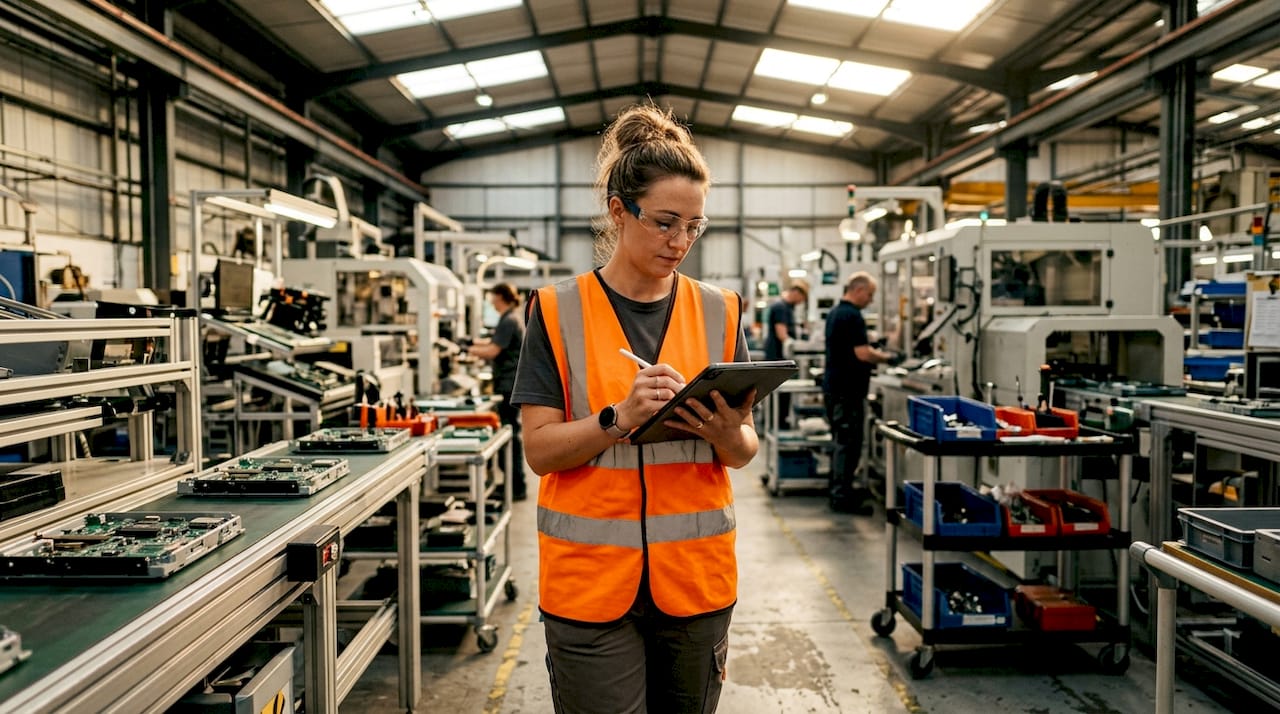
Manufacturing project management uniquely integrates quality checkpoints, inspection records, and compliance documentation directly within project workflows rather than treating them as separate functions. This hybrid approach requires specialized tools working alongside ERP systems for full resource and financial integration. A standard project management app has no concept of a bill of materials, a work order, or a machine utilization rate.
Supply chain coordination adds another layer of complexity. You are not just tracking tasks assigned to internal team members. You are tracking supplier lead times, material arrivals, and subcontractor schedules that all feed into a production sequence. One late component can invalidate an entire production run plan.
Real-time shop floor visibility is the defining requirement that separates manufacturing project tracking from office-based project management. You need to know what is happening at each workstation right now, not what was logged at the end of a shift.
- Physical constraints: Machine availability, floor space, and tooling all limit scheduling options that software must account for.
- Supply chain dependencies: Supplier delays and material shortages require automatic alerts tied to project milestones.
- Quality and compliance: Inspection records and regulatory documentation must live inside the project timeline, not in a separate system.
- Real-time visibility: Shop floor status updates must feed directly into project dashboards to reflect actual progress.
Pro Tip: If your current project tool cannot display a live production status by workstation, you are managing manufacturing projects with an office tool. That gap costs you response time when bottlenecks form.
What features should manufacturing project tracking software include?
The right project tracking software for manufacturing does several things that generic platforms cannot. The table below maps the core feature categories to their operational purpose.
| Feature category | Operational purpose |
|---|---|
| Project planning with task dependencies | Models production sequences so delays in one step automatically flag downstream tasks |
| Resource allocation (labor and machinery) | Prevents scheduling conflicts and identifies capacity gaps before they cause stoppages |
| Real-time production status tracking | Gives supervisors a live view of work-in-progress across all workstations |
| Bill of materials integration | Triggers automatic material arrival alerts and ties inventory directly to production schedules |
| Quality and compliance checkpoints | Embeds inspection steps into the project timeline so they cannot be skipped or delayed |
| Cost tracking (materials and labor) | Captures actual costs against estimates in real time to improve billing and quoting accuracy |
| Exception and bottleneck alerts | Flags cycle-time overruns and stalled work orders before minor delays cascade |
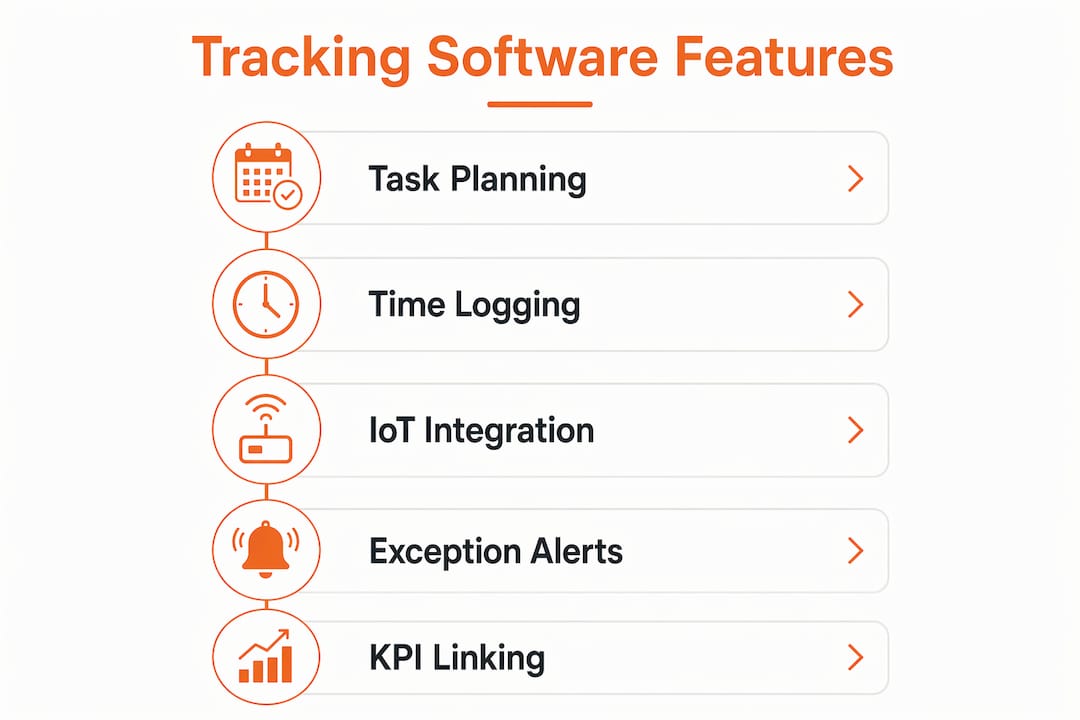
Operators logging time directly on shop floor tablets reduces manual error and automates cost tracking against original estimates. That single practice improves both billing accuracy and future quoting. It also gives project managers a real-time cost variance number rather than an end-of-month surprise.
Connecting project systems to production equipment via IoT sensors or MES integration enhances real-time visibility and enables automatic tracking of material arrival and production progress. Separating the bill of materials from the project structure limits tracking efficiency and forces manual reconciliation that creates errors.
Pro Tip: Before evaluating any software, map your bill of materials to your production stages. Software that cannot link these two structures will require manual workarounds that grow more expensive as your project volume increases.
How do operational KPIs connect to project tracking outcomes?
KPIs are the measurement layer that turns project tracking from a scheduling exercise into a performance management system. Effective manufacturing project management tracks OEE, cycle time, throughput, and cost variance alongside standard project measures to connect delivery with operational performance. This KPI tracking also identifies whether performance gaps come from technical issues or from employee adoption problems.
Each KPI serves a specific diagnostic purpose:
- OEE (Overall Equipment Effectiveness): Measures the percentage of planned production time that is truly productive. A drop in OEE during a project rollout signals equipment, process, or training issues.
- Cycle time: Tracks how long each unit takes to move through a production stage. Cycle-time overruns are the earliest warning sign of a bottleneck forming.
- Throughput: Measures units completed per time period. Declining throughput during a project phase often points to resource allocation errors.
- Cost variance: Compares actual spending to the project budget in real time. Positive variance early in a project is a signal to investigate, not celebrate.
Project milestones and operational KPIs must be linked in your tracking system. When a milestone is marked complete but OEE drops simultaneously, the milestone completion is misleading. The project may be on schedule while the floor is underperforming. Tracking both together gives you the full picture.
Manufacturers must also address change management alongside technical project management to ensure employee adoption of new processes and equipment. Adoption gaps show up in KPI data before they show up in project status reports. Watching both gives you an early warning system that purely schedule-based tracking misses entirely.
What are the best practices for project tracking in manufacturing?
Effective manufacturing workflow tracking follows a set of proven practices that balance structure with the flexibility production environments demand. Successful manufacturing projects balance structured planning with flexibility to handle real-time production bottlenecks. Purely Agile approaches do not translate well to manufacturing. Hybrid methodologies that combine Waterfall planning with Lean and Agile elements work better in practice.
-
Define your production status model first. Standardizing a production status workflow before deploying any software is critical. A clear model with states like planned, released, in progress, waiting for material, and completed reduces administrative burden and creates a single source of truth. Without this, software adoption increases complexity instead of reducing it.
-
Integrate your bill of materials into the project structure. The bill of materials must be embedded within the project plan to trigger automatic material arrival alerts and coordinate production scheduling. Treating it as a separate document forces manual reconciliation and creates gaps in your tracking data.
-
Build exception alerts before you build dashboards. Defining alerts for cycle-time overruns and stalled work orders before configuring dashboards transforms tracking from passive reporting into active control. Alerts prevent minor delays from cascading into missed delivery dates.
-
Plan for scope control from day one. Manufacturing projects expand in scope when change requests are accepted informally. A formal change control process with documented impact assessments keeps timelines and budgets intact.
-
Run cross-functional alignment meetings at fixed intervals. Engineering, procurement, production, and quality teams each hold information the others need. Weekly alignment meetings tied to project milestones surface conflicts before they become stoppages.
-
Pair technical deployment with change management. New tracking systems fail when the people using them do not understand why the process changed. Training, communication, and visible leadership support drive adoption faster than any software feature.
Pro Tip: Set up your exception alerts during the software configuration phase, not after go-live. Teams that configure alerts post-launch rarely complete the task. The first production crisis always takes priority.
You can also apply these practices to material inventory tracking within your broader project workflow to reduce waste and improve ordering accuracy.
Key Takeaways
Manufacturing project tracking succeeds when you integrate operational KPIs, a defined status model, and exception alerts into a single system before deploying any software.
| Point | Details |
|---|---|
| Define your status model first | Standardize production states across all departments before configuring any tracking software. |
| Integrate the bill of materials | Linking materials to project stages enables automatic alerts and reduces manual reconciliation errors. |
| Track KPIs alongside milestones | OEE, cycle time, and cost variance reveal performance gaps that schedule data alone will not show. |
| Build exception alerts early | Configure cycle-time and stall alerts during setup so minor delays do not cascade into missed deadlines. |
| Address adoption, not just technology | Change management drives the employee behavior that makes tracking data accurate and useful. |
What I have learned from watching manufacturers track projects the hard way
The most common mistake I see is manufacturers buying software before defining their workflows. A platform cannot fix a process that has not been designed yet. Teams end up configuring the tool around their existing confusion, and the result is a dashboard that looks impressive but reports nothing useful.
The second mistake is treating project tracking as a scheduling function owned by one department. Manufacturing project tracking works only when engineering, procurement, production, and quality all feed data into the same system. The moment one team keeps its own spreadsheet, the single source of truth is gone.
What actually works is starting with a whiteboard session that maps every production status your floor uses today. You will find inconsistencies immediately. Two supervisors will use different terms for the same state. One department will have statuses the others have never heard of. Resolving that before touching any software saves months of rework.
The manufacturers who get the most value from tracking tools are the ones who treat KPI monitoring and project milestone tracking as one discipline, not two. When a project milestone is green but OEE is falling, something is wrong. The teams that catch that signal early are the ones who finish projects on time and on budget.
— Rowena
How Highlevelcrm-rconstructionsolutions supports your project tracking needs
Highlevelcrm-rconstructionsolutions is built on over 30 years of construction and project-based industry experience, which means it addresses the operational realities that generic platforms ignore.
The platform delivers automated lead tracking, custom reporting dashboards, and workflow tools designed for project-based environments where timelines, resources, and compliance all intersect. Manufacturers and contractors using Highlevelcrm-rconstructionsolutions report lead conversion rate increases of up to 35%, driven by better visibility and faster decision-making. If you are ready to see how industry-specific tools perform against the generic alternatives, the industries we serve page shows exactly where Highlevelcrm-rconstructionsolutions fits your operation.
FAQ
What is project tracking in manufacturing?
Project tracking in manufacturing is the process of monitoring production progress, resource use, costs, and quality checkpoints against a defined project plan. It integrates operational KPIs like OEE and cycle time with standard schedule and budget measures.
How is manufacturing project tracking different from general project management?
Manufacturing project tracking accounts for physical shop floor constraints, supply chain dependencies, bill of materials integration, and embedded quality compliance steps that general project management tools do not support.
What KPIs should manufacturers track in project management?
The four most critical KPIs are OEE, cycle time, throughput, and cost variance. Tracking these alongside project milestones identifies whether performance gaps come from technical issues or from employee adoption problems.
What should manufacturers do before deploying project tracking software?
Manufacturers should define a standardized production status model across all departments before configuring any software. Without this foundation, new tools increase administrative complexity rather than reducing it.
How do exception alerts improve manufacturing project tracking?
Exception alerts for cycle-time overruns and stalled work orders turn tracking from passive reporting into active control. Configuring these alerts before go-live prevents minor production delays from cascading into missed delivery deadlines.