
What Is Production Workflow Automation: 2026 Guide
Production workflow automation is software that manages, triggers, and tracks manufacturing tasks and communications automatically without manual coordination at each step. In the industry, this is formally called manufacturing workflow orchestration, and understanding what is production workflow automation means recognizing it as the digital layer that connects people, machines, and systems across your entire production floor. According to a Gartner 2025 report, mid-size manufacturers that implement automated cross-functional workflows reduce cycle times by 27–41%. That is not a marginal gain. It is the difference between a plant that ships on time and one that bleeds money on overtime and rework.
What is production workflow automation and how does it work?
Production workflow automation is the software-driven orchestration of every task, handoff, and communication across your manufacturing process, from raw material receipt to finished goods delivery. It replaces the emails, spreadsheets, and verbal approvals that slow production down with digital triggers and automated routing.
The process works by connecting your shop-floor signals to a workflow engine. When a PLC or SCADA system detects a machine event, such as a completed batch or a quality threshold breach, the workflow engine fires the next task automatically. Manufacturing digital workflows operate at sub-second speeds driven by real-time machine data, unlike traditional business process management tools that tolerate latency of minutes or hours. That speed difference is critical. A delay of even five minutes in a high-volume line can cascade into hours of lost output.
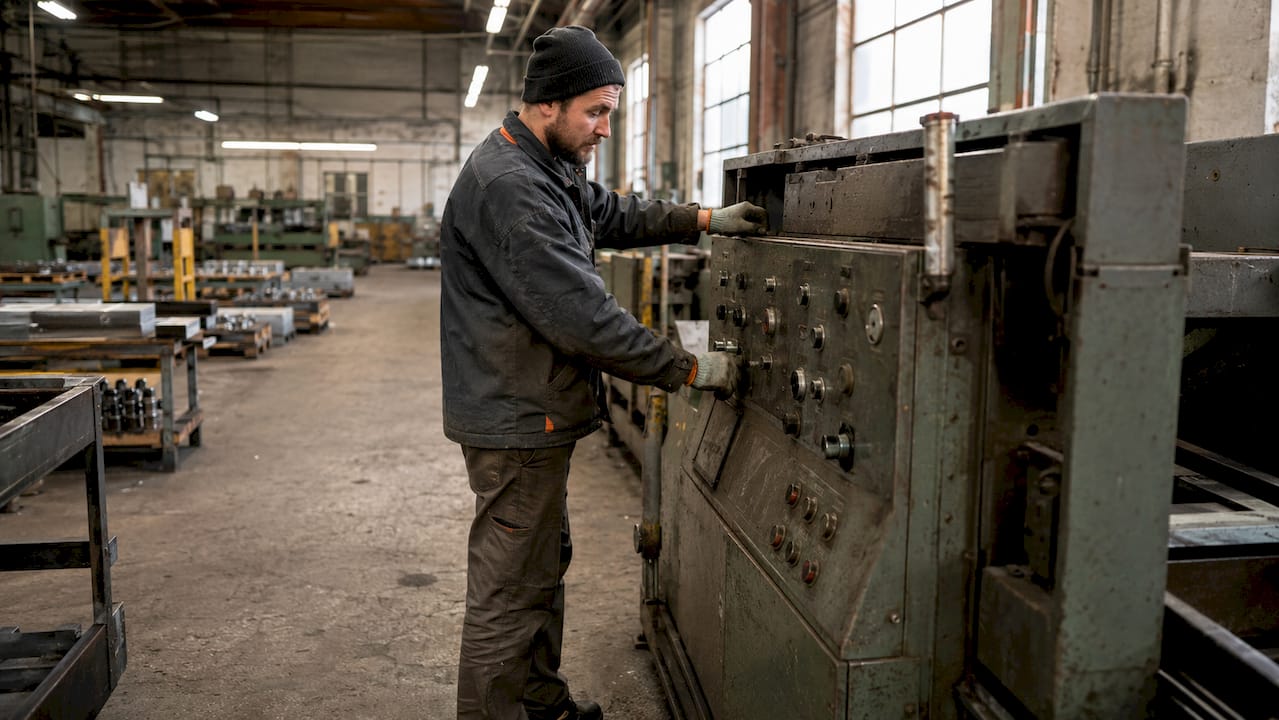
At the core of production automation explained simply: software replaces the human coordinator who used to stand between each step. A quality check fails, and the system automatically routes a nonconformance report to the quality manager, flags the scheduler, and holds the next production order. No phone calls. No missed emails. No lost paperwork.
How does production automation improve manufacturing efficiency?
The measurable impact of automation in production workflow is well documented, and the numbers are specific enough to build a business case around.
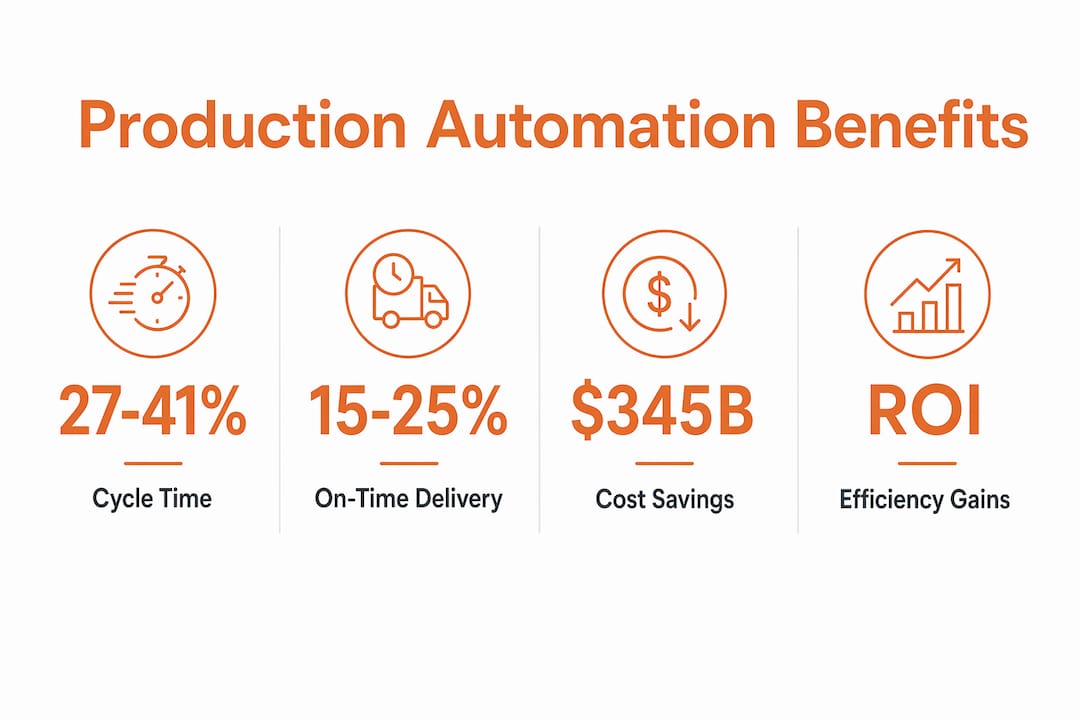
Downtime and cost reduction stand out first. U.S. manufacturers faced $345 billion in losses in 2025 due to manual inefficiencies, with unplanned downtime costing an average of $22,000 per hour. Automated workflows reduce unplanned disruptions by catching equipment signals and routing maintenance tasks before a line goes down.
Scheduling and delivery performance improve measurably as well. Automated scheduling and communication boost on-time delivery by 15–25% and reduce changeover waste by 10–20%, according to MESA International data. That improvement comes from eliminating the lag between a schedule change and the people who need to act on it.
Here is where most operations managers see the fastest wins:
- Purchase order approvals routed automatically to the right approver based on dollar threshold
- Production schedule changes pushed instantly to shift supervisors and material handlers
- Quality alerts triggered by sensor data and escalated without human intervention
- Maintenance work orders generated automatically when machine runtime thresholds are reached
- Delivery notifications sent to customers and logistics partners the moment a shipment is confirmed
Pro Tip: Prioritize the workflows with the highest downtime cost or the most manual coordination steps first. Those are your fastest ROI targets, and early wins build internal support for broader automation projects.
What technology powers production workflow automation?
Understanding how production automation works requires knowing which systems do what. Three layers matter most: ERP, MES, and the workflow automation engine itself.
| System | Primary Function | Workflow Role |
|---|---|---|
| ERP (e.g., SAP, Oracle) | Financial and transaction recording | Records outcomes; does not coordinate steps |
| MES (e.g., Siemens Opcenter, Rockwell FactoryTalk) | Production execution management | Orchestrates shop-floor tasks and tracks WIP |
| Workflow Automation Engine | Task routing and communication | Triggers, assigns, and escalates across all systems |
ERP systems manage transaction recording but do not automate coordination workflows. This is the most common and costly misconception in manufacturing. Your SAP instance knows what happened after the fact. It does not tell your maintenance crew to act before a machine fails.
The MES sits in the middle, executing production tasks and tracking work-in-progress. Effective production workflow automation connects ISA-95 levels 1 and 2, meaning PLC and SCADA systems, to Level 3 MES and Level 4 ERP through bi-directional real-time integration. That architecture is what makes event-driven manufacturing possible.
The workflow engine itself is the orchestration layer. It coordinates human and machine handoffs without replacing your ERP or MES. Think of it as the conductor that tells every instrument when to play. Visual workflow builders now allow production managers to configure these automations without heavy IT involvement, which shortens deployment timelines significantly.
MES workflow engines also provide audit trails, sign-offs, and approvals that enforce compliance, a feature that matters especially in regulated industries like pharmaceuticals, aerospace, and food processing. MES audit and approval workflows support quality management systems and reduce the documentation burden on operators.
What types of production workflows are commonly automated?
Production process automation covers a wider range of workflows than most operations managers initially expect. The entry points are straightforward. The advanced applications are where the real competitive advantage builds.
Beginner-level workflows that most plants can automate within weeks include:
- Purchase order approval routing based on spend thresholds
- Production schedule notifications pushed to supervisors and material handlers
- Quality inspection alerts triggered by sensor readings or operator inputs
- Nonconformance report routing to quality engineers and production leads
- Delivery confirmation notifications to customers and logistics teams
Automated workflows replace manual emails and paperwork across all of these use cases. The task still gets done. It just gets done faster, with a complete digital record, and without anyone having to remember to send a message.
Intermediate and advanced workflows add more intelligence to the process:
- Adaptive scheduling that automatically adjusts production orders when a machine goes offline or a material shortage is detected
- Predictive maintenance triggers that generate work orders based on vibration, temperature, or runtime data before failure occurs
- Supplier communication automation that sends purchase requests and acknowledgment confirmations without buyer intervention
- Cross-plant escalation workflows that notify regional managers when a site misses a production milestone
The key principle across all of these is that the workflow propagates changes automatically. When a schedule shifts, every downstream stakeholder receives updated information without a coordinator manually notifying each person. That is what production automation explained at its most practical looks like.
Pro Tip: Start with simple alert-based workflows before building complex multi-step automations. A basic machine downtime alert that pages the right technician immediately delivers measurable ROI and teaches your team how the system behaves before you scale.
How do you implement production workflow automation successfully?
Implementation timelines and complexity vary more than most vendors admit upfront. Beginner automations deploy in 1–4 weeks, intermediate workflows take 1–3 months, and advanced AI-driven scheduling or predictive maintenance requires 3–8 months plus additional AI model training time. Setting realistic expectations at the start prevents the frustration that kills automation projects mid-deployment.
The most common implementation failures share the same root cause: starting too complex before the data foundation is solid. Clean, consistent data from your machines and systems is not optional. If your PLC timestamps are unreliable or your MES records are incomplete, your workflow engine will trigger on bad information and erode operator trust quickly.
Workflow optimization strategies that work in practice follow this sequence:
- Audit your current manual workflows and document every handoff, approval, and communication step before automating anything
- Confirm your data infrastructure is reliable at the shop-floor level before connecting it to workflow triggers
- Select the right tooling for your plant size. A 50-person job shop needs different tools than a 500-person multi-shift facility
- Pilot one workflow end-to-end before rolling out across departments, and measure cycle time before and after
- Iterate based on operator feedback, not just management dashboards. The people running the line know where the friction actually lives
The ERP confusion point deserves a direct warning. Manufacturers commonly assume ERP can automate workflows, but ERP tracks financials and records transactions. It does not coordinate production steps. Buying a workflow automation platform alongside your ERP is not redundant spending. It is filling a gap your ERP was never designed to close.
Key takeaways
Production workflow automation delivers measurable efficiency gains only when the right technology layer handles orchestration, not when ERP is expected to do a job it was never built for.
| Point | Details |
|---|---|
| Define the right tool for the job | ERP records transactions; workflow automation engines coordinate tasks and communications across systems. |
| Cycle time gains are significant | Mid-size manufacturers reduce process cycle times by 27–41% with automated cross-functional workflows. |
| Start simple and build up | Beginner automations deploy in 1–4 weeks; advanced AI workflows require 3–8 months plus training time. |
| Real-time triggers are non-negotiable | Manufacturing workflows must operate at sub-second speeds driven by PLC and SCADA signals, not batch processing. |
| Prioritize high-cost manual steps first | Target workflows with the highest downtime cost or most manual coordination to generate early, measurable ROI. |
Why workflow automation is an operations strategy, not an IT project
I have watched operations managers hand workflow automation projects to IT departments and wait 18 months for something that should have taken 6 weeks. The technology is not the bottleneck. The organizational framing is.
When you treat production workflow automation as an IT initiative, it gets queued behind infrastructure upgrades, security patches, and software licensing negotiations. When you treat it as an operations capability, you own the timeline, the priorities, and the outcomes. That shift in ownership changes everything about how fast you move and how relevant the results are to the floor.
The ERP misconception is the single most expensive mistake I see repeatedly. A plant invests heavily in SAP or Oracle, assumes the workflow problem is solved, and then watches supervisors still texting each other about schedule changes. ERP is a record-keeping system. It tells you what happened. Workflow automation tells your team what to do next, right now, based on what is happening on the floor at this moment.
Industry 4.0 adoption does not start with AI or digital twins. It starts with getting your basic task routing and communication automated reliably. Once you have that foundation, you can layer on predictive analytics, adaptive scheduling, and machine learning. Without it, advanced tools have nothing solid to build on.
My advice to every operations manager reading this: pick one workflow that costs you real money every week, whether it is a manual quality escalation process or a scheduling communication gap, and automate it completely before touching anything else. Prove the ROI. Then use that win to fund the next project. Incremental progress compounds faster than you expect, and it builds the internal credibility you need to keep going.
— Rowena
How Highlevelcrm-rconstructionsolutions supports your workflow automation goals
If you manage production or project workflows in construction or contracting, Highlevelcrm-rconstructionsolutions brings over 30 years of construction industry experience directly into your CRM platform. It automates lead tracking, task routing, and client communications so your team spends less time coordinating and more time executing.
Highlevelcrm-rconstructionsolutions integrates with the tools contractors already use and delivers the kind of automated workflow features that reduce project management errors and improve follow-through on every job. Users report lead conversion rate increases of up to 35% after implementing automated workflows. If you are ready to see how that applies to your operation, explore the full CRM features and FAQs or visit the main site to schedule a demo with the Highlevelcrm-rconstructionsolutions team.
FAQ
What is production workflow automation in simple terms?
Production workflow automation is software that automatically routes tasks, triggers communications, and manages approvals across your manufacturing process without manual coordination at each step. It replaces emails, phone calls, and paper forms with digital triggers connected to real-time production data.
How is workflow automation different from an ERP system?
ERP systems record financial transactions and track outcomes after the fact. Workflow automation coordinates the actual steps, task handoffs, and communications that move production forward in real time. You need both, but they serve different functions.
What are the main benefits of workflow automation in production?
The core benefits include cycle time reductions of 27–41%, on-time delivery improvements of 15–25%, and significant reductions in unplanned downtime costs, which average $22,000 per hour for U.S. manufacturers. Waste from changeovers also drops by 10–20% with automated scheduling.
How long does it take to implement production workflow automation?
Beginner-level automations like alerts and basic task routing deploy in 1–4 weeks. Intermediate workflows take 1–3 months. Advanced AI-driven scheduling and predictive maintenance systems require 3–8 months plus AI model training time.
Where should an operations manager start with workflow automation?
Start with the workflow that costs the most in manual coordination time or downtime losses. Automate it completely, measure the before-and-after cycle time, and use that data to build the case for your next automation project.