
Why Manual Onboarding Wastes Time in Construction
Manual onboarding is defined as the process of bringing new hires into an organization using paper forms, email chains, and manual data entry rather than automated workflows. For construction managers, this approach is a direct drain on project timelines and budgets. Administrative time per new hire averages 10.4 hours, with total onboarding costs reaching $12,429 when lost productivity is included. That figure represents real money walking off your job site before a worker ever picks up a tool. Understanding why manual onboarding wastes time is the first step toward fixing it.
What are the specific inefficiencies in manual onboarding workflows?
Manual onboarding fails because it depends on human memory and goodwill rather than systems. When HR coordinators rely on email reminders and paper checklists, steps get missed, documents get lost, and new hires sit idle waiting for access they should have had on day one.
The most common bottlenecks in construction onboarding include:
- Paperwork duplication. New hires fill out the same personal details across multiple forms for HR, payroll, and safety compliance. Each form takes time to process separately, and errors on one require corrections across all of them.
- Multi-team coordination failures. Getting a new field supervisor set up requires HR, IT, and site management to coordinate. Without a shared system, each team waits on the other, creating a coordination tax that compounds delays across the entire process.
- Delayed equipment and system access. In construction, a new project manager who cannot access scheduling software or procurement systems on day one is effectively idle. Manual provisioning of system access takes 3–5 days on average.
- High rework rates. Manual data entry produces errors. Those errors trigger follow-up calls, corrected submissions, and repeated document requests. Each cycle burns time for both HR staff and the new hire.
- Chasing incomplete documents. Administrative tasks like chasing missing certifications, manually updating status trackers, and filing paperwork consume roughly 4.5 hours per hire on their own.
Pro Tip: Map every manual step in your current onboarding process and assign an estimated time cost to each one. Most construction managers are surprised to find that coordination and follow-up tasks account for more time than the actual paperwork.

How does manual onboarding affect project timelines and productivity?
The downstream effects of slow onboarding hit construction projects where it hurts most: schedule and workforce capacity. A new hire who spends their first week waiting for system access, safety certifications, or equipment assignments is not contributing to the project. That idle time is not a minor inconvenience. It is a direct delay to project milestones.
| Impact Area | Manual Onboarding Effect | Automated Onboarding Effect |
|---|---|---|
| System access provisioning | 3–5 days | 4 hours |
| HR admin time per hire | 6–10 hours | 1–2 hours |
| Admin task time per hire | 4.5 hours | 20 minutes |
| New hire idle time | High, often 1–3 days | Minimal |
| Compliance risk | Elevated | Significantly reduced |
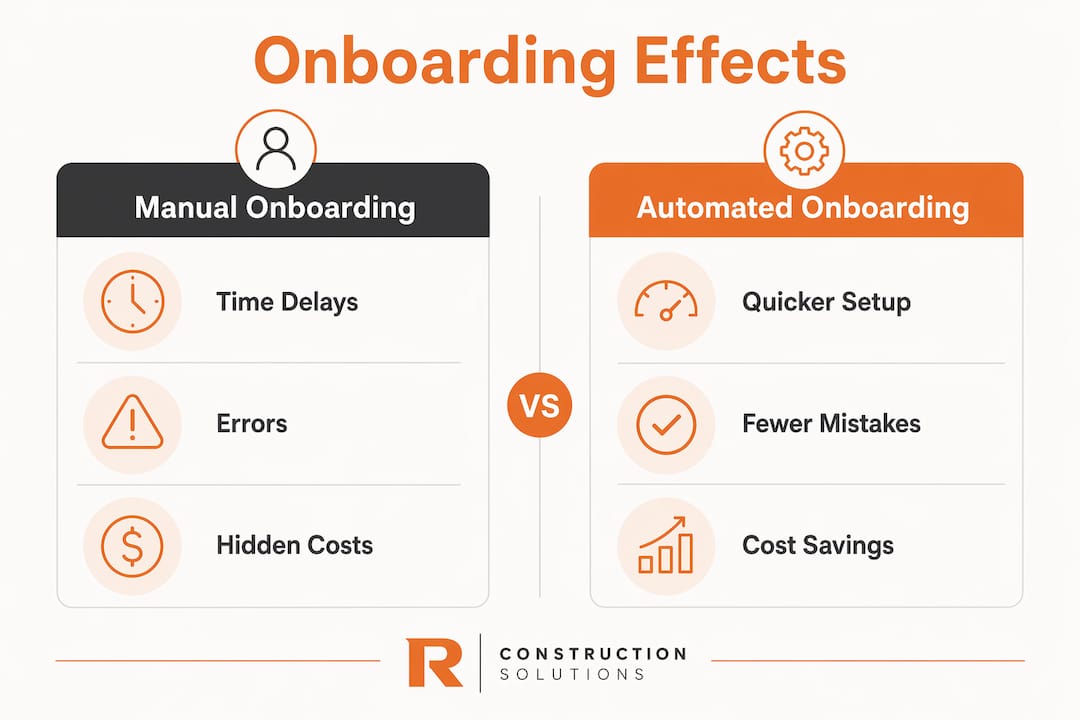
New hires who experience poor onboarding are more likely to leave within the first 90 days. Construction already faces high turnover in skilled trades, and a disorganized first week accelerates that problem. Replacing a skilled worker costs far more than fixing the onboarding process that drove them away.
Shadow IT risks emerge when new hires work around delayed access by using personal devices or unauthorized apps. In construction, where project data and client contracts live in shared systems, this creates real security vulnerabilities that often go unnoticed until an audit surfaces them. The cost of remediation far exceeds the cost of getting provisioning right the first time.
Support ticket volume also spikes when onboarding misses key provisioning steps. Each ticket pulls an IT staff member away from higher-value work, increasing context-switching costs across the organization.
Pro Tip: Track new hire idle time as a formal metric for your first 30 days of employment. If a new hire cannot perform their core job function within 48 hours of starting, your onboarding process has a measurable gap.
What hidden costs do construction companies incur from manual onboarding?
The visible cost of manual onboarding is HR staff time. The hidden costs are larger and harder to see until they accumulate into a serious budget problem.
Mid-sized construction firms with around 500 employees spend over $100,000 annually on manual onboarding labor costs alone. Benefits enrollment processing costs $89 per employee, and time management system setup runs $113.40 per employee. Multiply those figures across a full construction season of new hires and the number becomes significant.
Compliance is where manual onboarding creates its most expensive failures. Paper-based systems lack automated alerts, which means certification renewals and compliance documents get missed. Audit failures generate fines and remediation costs that dwarf the investment required to automate the process. In construction, where OSHA certifications and safety training records are legally required, a missed renewal is not just an administrative error. It is a liability.
The coordination tax compounds all of these costs. When HR, IT, and site management each maintain separate records and communicate by email, every handoff creates a delay. Those delays add up to hours of lost productivity per hire, and that lost productivity has a dollar value that rarely appears on any budget report.
Companies frequently misattribute poor performance and early turnover to bad hiring decisions when the real cause is a broken onboarding process. That misattribution leads to more spending on recruitment rather than fixing the system that is failing new hires from day one.
What best practices can eliminate time-consuming onboarding processes?
Fixing manual onboarding does not require a complete overhaul of your HR department. It requires replacing fragmented, human-dependent steps with systems that run automatically. Construction firms that have made this shift report dramatic reductions in both time and cost.
-
Automate document collection before day one. Pre-boarding workflows send new hires a digital packet of forms to complete before they arrive on site. By the time they walk in, HR already has signed documents, ID verification, and emergency contacts on file. This alone eliminates the first two hours of a typical manual onboarding session.
-
Centralize document management in one system. A single digital repository for certifications, safety training records, and employment documents eliminates the duplication problem. When every team accesses the same record, there are no conflicting versions and no lost paperwork. Construction-focused platforms that integrate with digital onboarding workflows make this practical for field-heavy operations.
-
Automate system access provisioning. IT provisioning should trigger automatically when HR marks a hire as confirmed. Automation cuts provisioning time from 3–5 days down to 4 hours. A new project manager who has system access on day one can contribute immediately rather than waiting for a ticket to be resolved.
-
Use automated checklists with accountability tracking. Automated checklists assign tasks to specific team members with deadlines and send reminders when steps are overdue. This removes the coordination tax entirely. No one needs to chase anyone because the system does it automatically. Firms that automate checklist management reduce admin time per hire from 4.5 hours to under 20 minutes.
-
Integrate onboarding with your CRM and project management tools. When your CRM captures new hire data and feeds it directly into project scheduling and payroll, you eliminate redundant data entry. Highlevelcrm-rconstructionsolutions is built specifically for construction contractors, with automated workflows that connect lead tracking, project management, and workforce coordination in one place. Contractors using construction-specific CRM tools can reduce manual onboarding steps significantly within the first hiring cycle.
The best practices for contractor onboarding consistently point to one principle: replace every human-dependent step with a system-dependent one wherever possible. Human judgment belongs in hiring decisions, not in chasing paperwork.
Key takeaways
Manual onboarding wastes time because it relies on fragmented, human-dependent tasks that create delays, errors, and hidden costs that compound across every new hire.
| Point | Details |
|---|---|
| Administrative time is measurable | Manual onboarding averages 10.4 hours of admin time per hire, costing up to $12,429 total. |
| Coordination tax is the biggest hidden cost | Cross-team delays between HR, IT, and management multiply the time lost beyond what any single task accounts for. |
| Compliance failures carry financial penalties | Missing certification deadlines due to lack of automated alerts leads to audit failures and remediation costs. |
| Automation cuts provisioning from days to hours | IT access that takes 3–5 days manually can be completed in 4 hours with automated workflows. |
| Construction-specific tools close the gap faster | Platforms built for contractors integrate onboarding with project management, eliminating redundant data entry. |
What I’ve learned from watching construction firms get onboarding wrong
I have spent years watching construction managers blame turnover on the labor market when the real problem was sitting in their HR process. A skilled electrician who spends their first three days waiting for a login and a hard hat is not going to stay. They are going to call the next contractor who has their act together.
The metric most construction managers never track is new hire idle time. They measure HR hours and recruitment costs, but they do not measure how long a new hire sits unproductive because a system access request is stuck in someone’s inbox. That idle time is the most expensive part of manual onboarding, and it is almost entirely invisible on a standard budget report.
The other thing I have seen consistently is that firms treat onboarding as an HR problem when it is actually an operations problem. Every day a new project manager cannot access your scheduling software is a day your project runs without full capacity. That has a direct cost to your timeline and your client relationships.
The construction firms that have moved to automated onboarding do not just save HR hours. They get new hires contributing faster, they reduce turnover in the first 90 days, and they stop losing compliance documents. The technology to do this exists and is not expensive relative to the cost of getting it wrong. The only thing stopping most firms is the assumption that their current process is “good enough.” It rarely is.
— Rowena
How Highlevelcrm-rconstructionsolutions addresses onboarding inefficiencies
Construction firms that eliminate manual onboarding bottlenecks need tools built for how they actually work, not generic HR software adapted for the field.
Highlevelcrm-rconstructionsolutions was developed with over 30 years of construction industry experience. Its automated workflows handle the coordination tasks that drain HR and IT teams, from document collection to system access triggers, without requiring manual follow-up. Contractors using the platform report lead conversion rate increases of 35%, and the same workflow automation that drives those results applies directly to onboarding efficiency. The CRM features include custom reporting dashboards that give managers visibility into onboarding status across every active hire. For firms ready to see how it fits their operation, the industries we serve page covers construction-specific applications in detail.
FAQ
Why does manual onboarding waste so much time?
Manual onboarding wastes time because it relies on repetitive data entry, email-based coordination, and human follow-up rather than automated systems. Administrative tasks alone average 4.5 hours per hire, and cross-team coordination delays compound that figure significantly.
What is the coordination tax in onboarding?
The coordination tax is the time lost when HR, IT, and management each manage separate onboarding steps without a shared system. Frequent context-switching and manual follow-ups between teams multiply delays beyond what any single task would cause on its own.
How does poor onboarding affect construction project timelines?
Delayed system access and incomplete setup leave new hires idle for 1–3 days, which directly reduces workforce capacity at the start of a project. Those lost days push back task completion and can affect critical milestone dates.
What is shadow IT and why does it matter in construction?
Shadow IT occurs when new hires use personal devices or unauthorized apps to work around delayed system access. In construction, this creates security vulnerabilities around project data and client contracts that often go undetected until an audit.
How much can automation reduce onboarding admin time?
Automation reduces HR onboarding time per hire from 6–10 hours down to 1–2 hours, and cuts administrative task time from 4.5 hours to approximately 20 minutes per hire.