
Why Onboarding Delays Lose Clients in Construction
Onboarding delays are the leading cause of early client loss in construction businesses, with 15–30% of churned clients citing poor onboarding as their primary reason for leaving. The financial stakes are real: avoidable onboarding friction costs service businesses $50,000–$120,000 annually. For construction firms, where project margins are already tight and client relationships take months to build, a slow start is not just an inconvenience. It is a direct threat to revenue, reputation, and long-term growth. Understanding why onboarding delays lose clients is the first step toward fixing the problem before it costs you the contract.
Why onboarding delays lose clients before work even begins
Clients sign a contract with high expectations. They want to see progress, communication, and proof that they made the right choice. When that confirmation does not arrive quickly, doubt sets in.
Research identifies a critical window called the “dead zone” in client onboarding, occurring between days 4 and 10 after contract signing. During this period, clients perceive internal busyness as silence. They do not see your team working. They see nothing. That silence reads as disorganization, not dedication.
The most damaging part is that clients rarely complain. They disengage quietly. Silent churn is the norm, not the exception. By the time a client voices frustration, they have often already decided to leave or reduce their commitment.
“Clients don’t leave because they found a better contractor. They leave because they stopped believing in the one they hired. The silence after signing is where that belief breaks down.”
The behavioral pattern is consistent across construction clients. A homeowner who hired you for a $200,000 renovation and hears nothing for eight days starts calling other contractors. A commercial property manager waiting on a project kickoff document begins questioning whether your firm can handle the scope. These are not irrational reactions. They are predictable responses to a gap in communication that your process created.
- Clients expect visible progress within the first 72 hours of signing
- Silence between days 4 and 10 triggers the highest rate of early disengagement
- Most clients who disengage during onboarding never tell you why
- Reliable contractor communication is a deciding factor for nearly half of clients considering renovation projects
Pro Tip: Send a structured “welcome and next steps” message within 24 hours of contract signing. It does not need to be long. It needs to confirm the timeline, name the point of contact, and list the first three actions your team will take.
What slow onboarding actually costs your construction firm

The financial impact of slow onboarding goes well beyond the obvious. Most construction managers think about lost contracts. The real cost is deeper and compounds over time.
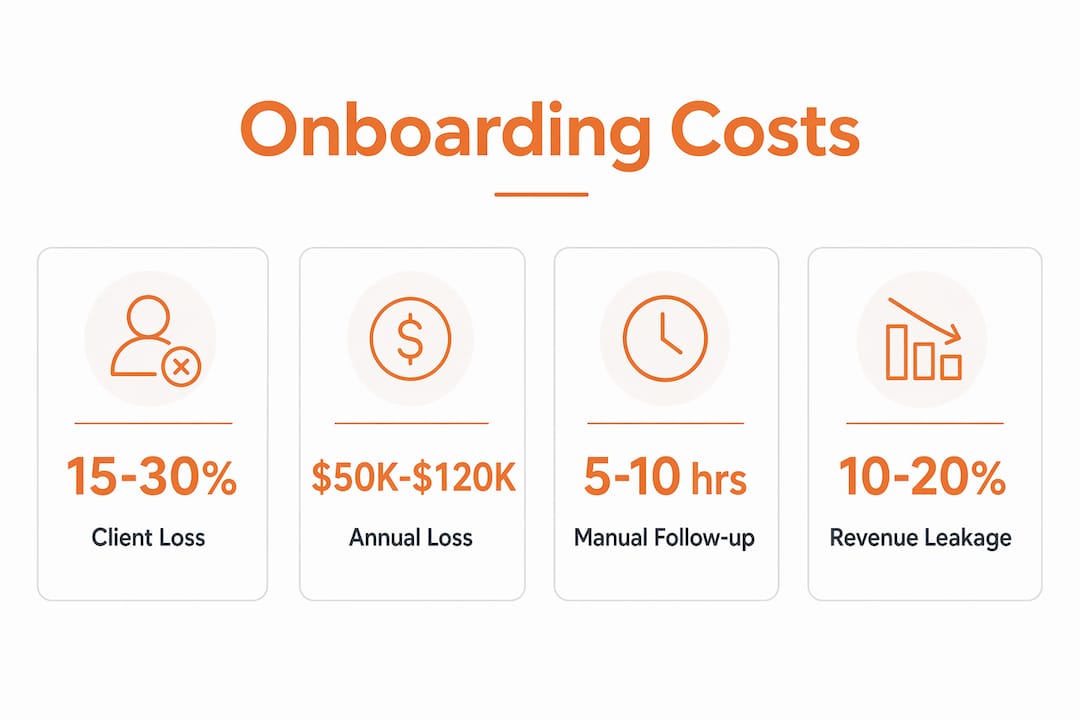
Scope creep costs 10–20% revenue leakage per project when early communication is unclear. When onboarding is rushed or disorganized, project scope is never fully defined. Clients add requests. Teams absorb extra work without billing for it. That leakage adds up fast across a portfolio of active projects.
Manual follow-up is another hidden cost. Sales and project management teams waste 5–10 hours per client on manual follow-ups during onboarding. At a fully loaded labor rate of $75 per hour, that is $375–$750 per client, before the project generates a single dollar of revenue.
| Cost Category | Impact |
|---|---|
| Scope creep from unclear onboarding | 10–20% revenue leakage per project |
| Manual follow-up labor | 5–10 hours per client wasted |
| Avoidable onboarding friction | $50,000–$120,000 annually for service firms |
| 30-day billing delay on a $5,000 retainer | $5,000 in lost revenue per client |
The cumulative effect is significant. A construction firm managing 20 active clients per year, each experiencing a 30-day onboarding delay, can lose the equivalent of one full project’s revenue in billing delays alone. That figure does not include the clients who leave before the project starts.
- Delayed billing. Every week of onboarding delay pushes your first invoice further out. Cash flow suffers before the project begins.
- Increased rework. Unclear scope from poor onboarding creates rework cycles that consume labor hours and materials.
- Higher acquisition pressure. Losing clients to poor onboarding forces you to spend more on lead generation to replace them. Acquiring new clients costs 5–25 times more than retaining existing ones.
- Staff burnout. Repeated manual tasks and client complaints during onboarding drain your team’s capacity for billable work.
What bottlenecks cause onboarding delays and hurt retention?
Most onboarding delays do not come from one big failure. They come from several small process gaps that compound into a serious problem.
Small delays cascade into much longer timelines because clients lose context and deprioritize onboarding tasks when momentum stalls. A two-day wait for a document becomes a five-day wait when the client forgets to respond. A five-day wait becomes two weeks when your team moves on to other priorities. Onboarding delays exceeding 21 days cause 31% higher first-year churn compared to onboarding completed in under 10 days.
The most common bottlenecks in construction firm onboarding include:
- Sequential information collection. Asking for documents one at a time instead of batching requests creates multiple back-and-forth cycles, each adding days to the timeline.
- Fragmented communication. When clients receive messages from three different people across email, text, and phone, they lose track of what is needed and who to contact.
- No clear onboarding owner. When everyone is responsible, no one is. Tasks fall through the gaps when ownership is undefined.
- No defined “done” criteria. Without clear milestones, onboarding bleeds into project execution. Clients do not know when they are fully onboarded, and neither does your team.
- Reactive follow-up. Waiting for clients to respond before sending the next request adds days of unnecessary delay to every step.
Pro Tip: Assign one person as the dedicated onboarding lead for every new client. That person owns all communication until the client reaches their first project milestone. This single change eliminates most handoff failures.
How to speed up onboarding and keep more clients
Faster onboarding does not mean cutting corners. It means removing the friction that slows down the process without adding value.
- Batch all information requests. Send one comprehensive intake document on day one instead of requesting items individually. This alone can cut onboarding time by 30–50% by eliminating multiple response cycles.
- Automate follow-up reminders. Set automated reminders for outstanding client tasks at 24, 48, and 72 hours. Automating follow-ups drastically reduces the time your team spends chasing responses.
- Define your “first value” milestone. Identify the specific moment when a client first sees tangible progress. For a renovation contractor, that might be the delivery of a finalized project plan. Set a target to reach that milestone within 48 hours of contract signing for straightforward projects.
- Assign a dedicated onboarding owner. One person, one client, one point of contact. This eliminates the communication fragmentation that frustrates clients most.
- Personalize by project type. Personalized onboarding based on client or project type increases 7-day retention by up to 35%. A commercial client needs different milestones and communication cadence than a residential client.
- Use a CRM to centralize client data. When all client information, documents, and communication history live in one place, your team spends less time searching and more time delivering. Setting up a CRM for your construction business is the fastest way to eliminate data fragmentation.
Pro Tip: Set a firm internal target: every new client reaches their first defined milestone within 48 hours of signing. Track this metric weekly. If you miss it more than twice in a month, your process has a bottleneck that needs fixing.
How measuring onboarding performance prevents client loss
You cannot fix what you do not measure. Construction firms that track onboarding metrics catch disengagement before it becomes churn.
Behavioral signals at day 7 predict 70–80% of eventual churn. That means you have a one-week window to identify at-risk clients and intervene. Firms that monitor these signals and act on them retain far more clients through the first 90 days.
The three metrics that matter most are:
- Time-to-first-value. How long does it take a new client to reach their first meaningful milestone? Target under 48 hours for complex construction projects.
- Activation rate. What percentage of new clients complete all onboarding steps within your target window? A low rate signals a process problem, not a client problem.
- Early churn rate. What percentage of clients disengage or cancel within the first 90 days? Accounts with strong onboarding retain 75–85% at 90 days, versus 40–55% without structured onboarding.
| Metric | What it measures | Target |
|---|---|---|
| Time-to-first-value | Speed to first client milestone | Under 48 hours |
| Activation rate | Onboarding completion percentage | 85%+ within target window |
| Early churn rate | Clients lost in first 90 days | Below 15% |
| Onboarding completion | All steps finished on schedule | 90%+ of new clients |
Measuring onboarding around activation milestones rather than calendar days aligns better with retention outcomes. A client who completes all onboarding steps in 12 days is better positioned than one who technically “finished” in 7 days but skipped key steps. Review these metrics monthly and adjust your process when any metric falls below target.
Key Takeaways
Onboarding delays lose clients because they erode trust, delay value delivery, and compound into churn before construction work ever begins.
| Point | Details |
|---|---|
| The dead zone is days 4–10 | Silence after contract signing triggers silent churn; send visible progress updates immediately. |
| Delays compound fast | Onboarding beyond 21 days causes 31% higher first-year churn versus sub-10-day onboarding. |
| Financial cost is measurable | Avoidable onboarding friction costs service firms $50,000–$120,000 annually in lost revenue and wasted labor. |
| Assign one onboarding owner | Clear ownership eliminates handoff failures and keeps client communication consistent. |
| Measure time-to-first-value | Tracking this single metric weekly reveals bottlenecks before they become client losses. |
What I’ve learned about onboarding that most contractors miss
After years of watching construction businesses struggle with client retention, the pattern is always the same. Contractors focus on winning the contract and then assume the client will stay patient while the team gets organized. That assumption is wrong, and it costs real money.
The most overlooked factor is not speed. It is perceived progress. Clients do not need everything done immediately. They need to see that something is happening. A simple email confirming the project timeline and naming their point of contact does more for retention than a week of behind-the-scenes preparation the client never sees.
The second thing most contractors miss is that onboarding ownership is not a process problem. It is a leadership decision. When I see firms where onboarding consistently fails, there is almost never a documented process gap. There is a gap in accountability. Nobody owns the client relationship in those first critical days, so nobody protects it.
Treating onboarding as a growth lever rather than an administrative checklist changes everything. The firms that grow fastest in construction are not the ones with the best crews. They are the ones whose clients feel confident from day one and refer others because of it.
— Rowena
How Highlevelcrm-rconstructionsolutions helps construction firms onboard faster
Construction firms that reduce onboarding delays retain more clients and generate revenue faster. Highlevelcrm-rconstructionsolutions is built specifically for contractors, with over 30 years of construction experience behind its design.
The platform automates client follow-ups, centralizes project communication, and tracks onboarding milestones so nothing falls through the gaps. Users report lead conversion rate increases of 35% after implementing automated workflows. The CRM features built for construction include custom reporting dashboards that show exactly where each client stands in the onboarding process. You can also explore how the platform serves construction teams across residential, commercial, and specialty contracting. Faster onboarding starts with the right system behind your team.
FAQ
Why do onboarding delays cause clients to leave?
Clients interpret slow onboarding as a sign that your firm is disorganized or unresponsive. Silent churn is the most common result, with clients disengaging quietly rather than voicing complaints.
How long should construction client onboarding take?
Onboarding completed in under 10 days produces significantly better retention than onboarding that extends beyond 21 days. The target for reaching a client’s first milestone is under 48 hours for most project types.
What is the financial cost of poor onboarding for contractors?
Avoidable onboarding friction costs service businesses $50,000–$120,000 annually. A single 30-day billing delay on a $5,000 retainer equals $5,000 in lost revenue per client.
What metrics should I track to improve client retention during onboarding?
Track time-to-first-value, activation rate, and early churn rate. Behavioral signals at day 7 predict 70–80% of eventual churn, giving you a window to intervene before a client decides to leave.
How does a CRM reduce onboarding delays for construction firms?
A construction-specific CRM centralizes client data, automates follow-up reminders, and assigns clear task ownership. These three functions eliminate the most common bottlenecks that extend onboarding timelines and increase early churn risk.