
CRM in Manufacturing Workflows: A 2026 Operations Guide
Customer relationship management (CRM) in manufacturing is defined as an integrated platform that connects sales, production, and service teams through a single, real-time view of customer orders, inventory, and production data. The role of CRM in manufacturing workflows goes far beyond contact management. When connected to an ERP system, a CRM becomes the operational nerve center that links commercial demand to production capacity. 86% of manufacturing firms that implement CRM successfully report a 21–30% sales increase and 42% better forecast accuracy. Those numbers reflect what happens when customer data stops living in spreadsheets and starts driving decisions on the shop floor.
How does CRM improve manufacturing sales and quoting workflows?
Manufacturing sales cycles are not linear. A single deal moves through request for quotation (RFQ), engineering review, procurement approval, and order placement before a purchase order ever gets signed. Generic CRMs fail in this environment because they lack native support for multi-stakeholder sales stages and cannot surface live ERP data during quoting.

A manufacturing-focused CRM solves this by embedding Configure, Price, Quote (CPQ) logic directly into the sales workflow. Sales engineers can pull real-time inventory levels and production lead times from the ERP without switching systems. That means a quote reflects actual capacity, not a best guess from last week’s spreadsheet.
The downstream effect is significant. Fewer errors in quotes translate to fewer order revisions, shorter approval cycles, and faster conversion from RFQ to confirmed order. Production managers also benefit because orders that enter the system with accurate specs require less rework before they hit the floor.
Key CRM capabilities that support manufacturing sales workflows include:
- RFQ tracking: Each quote is logged with version history, stakeholder approvals, and linked engineering notes.
- CPQ integration: Pricing rules and product configurations are enforced automatically, reducing manual errors.
- Live ERP data access: Inventory availability and lead times appear inside the CRM quote screen without a separate lookup.
- Multi-stakeholder visibility: Sales, engineering, and procurement teams see the same deal status in real time.
- Automated follow-up: Reminders trigger at each stage transition so no RFQ goes cold by accident.
Pro Tip: Map your current RFQ-to-order cycle on paper before configuring your CRM. Every handoff point where data gets re-entered manually is a place where automation will save time and cut errors.
Why does CRM-ERP integration matter for operational workflows?
The gap between a CRM and an ERP is where revenue disappears. Disconnects between CRM and ERP cause 20–30% revenue loss due to operational inefficiencies. That figure covers missed shipment windows, duplicate data entry, and orders that stall because sales and production are working from different numbers.
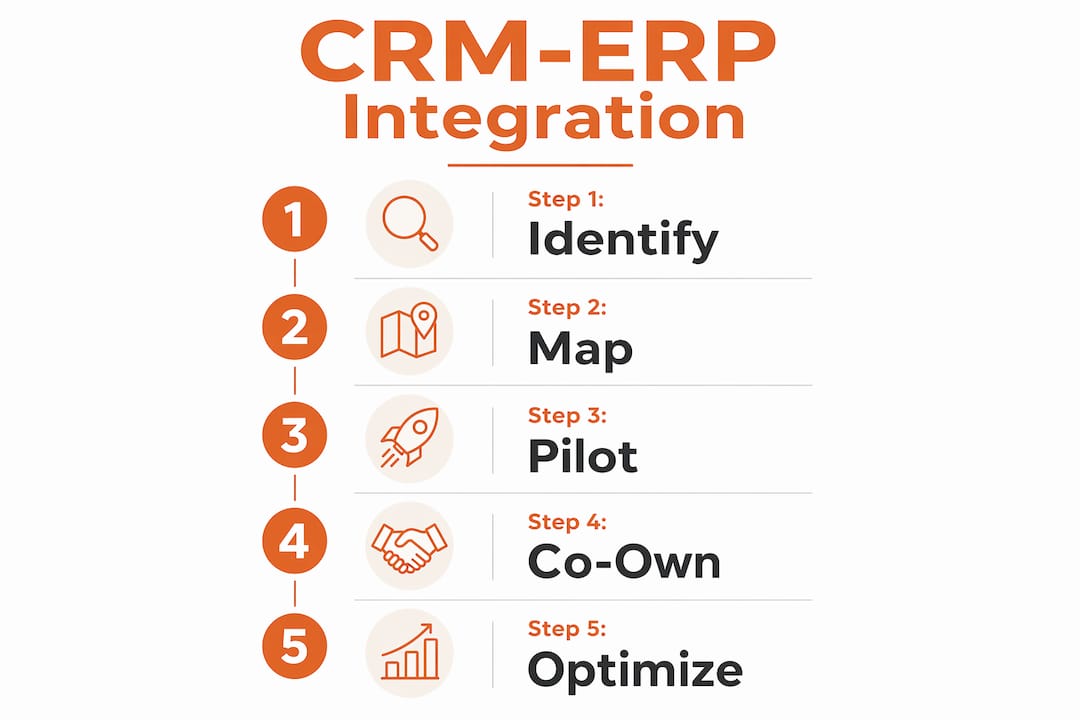
The fix is not to merge the two systems. ERP should remain the source of truth for inventory, pricing, and production schedules. The CRM surfaces that data contextually, so a sales rep or service agent sees what they need without navigating ERP screens built for accountants and planners.
The integration points that deliver the most value are:
- Order status sync: CRM displays live order progress pulled from ERP so customer-facing teams answer status questions without calling the warehouse.
- Inventory visibility: Available stock and committed quantities appear in the CRM quote and service screens.
- Pricing and discount rules: ERP-governed pricing flows into CRM quotes automatically, preventing unauthorized discounts.
- Production capacity: Open capacity windows from the ERP appear in the CRM pipeline view, letting sales teams set realistic delivery commitments.
- Procurement data: Purchase order status for raw materials is visible to production planners working inside the CRM dashboard.
A phased implementation approach reduces the risk of a failed rollout. A recommended 3-month roadmap structures the work as follows:
| Month | Focus | Goal |
|---|---|---|
| Month 1 | Pilot on high-visibility processes | Prove value, build user confidence |
| Month 2 | Integrate ERP data feeds | Create a single source of truth |
| Month 3 | Enable intelligent automation | Reduce manual tasks and exceptions |
Pro Tip: Assign one person from IT and one from operations as co-owners of the integration. Technical accuracy and workflow fit both matter. Neither team can succeed without the other.
For manufacturers exploring how construction software workflows handle similar integration challenges, the parallels in subcontractor data management are instructive.
How CRM transforms manufacturing operational intelligence and customer service
CRM’s value in manufacturing extends well past the sales team. Operational CRM acts as operational memory, integrating customer knowledge with production workflows to deliver higher returns than a sales-only deployment ever could. That means the system carries context: what a customer ordered last quarter, what their tolerance for late delivery is, and what service issues are currently open.
Production planners gain a concrete advantage when CRM deal pipeline data syncs with ERP capacity. Integrated CRM and ERP enable planners to schedule capacity and pre-order components based on confirmed and forecasted deals, eliminating the bottlenecks that come from reacting to orders after they arrive. A planner who can see a $2M deal at 80% probability closing in six weeks can reserve machine time and order long-lead materials now, not after the purchase order lands.
Service teams see an equally direct benefit. Warranty, install base, and order information consolidated in a single CRM account view reduce the system hopping that slows resolution times and frustrates customers. A service agent who can see the full account history, open cases, and relevant warranty terms in one screen resolves issues faster and retains customers more effectively.
“Value realization comes from integrating customer knowledge into operational workflows, not from technology alone. The manufacturers who treat CRM as an operational tool, not a sales reporting layer, are the ones who see measurable gains in forecast accuracy and customer retention.”
Automation compounds these gains. AI-assisted case routing directs warranty claims to the right technician based on product type and region. Automated alerts notify account managers when a high-value customer’s order is delayed. These are not futuristic features. They are available today in manufacturing-grade CRM platforms and they free your team to focus on decisions that require human judgment.
Best practices for implementing CRM in manufacturing environments
70% of manufacturing CRM projects fail due to poor fit with complex sales cycles and operational realities. That failure rate is not a technology problem. It is a planning and adoption problem.
The most common mistake is treating CRM as a sales reporting tool rather than an operational one. Manufacturers who treat CRM as a reporting burden see low adoption and poor data quality within six months. The system becomes shelfware because the people who need it most, service agents and production coordinators, were never included in the design.
Avoid these pitfalls and follow these practices instead:
- Start with a pilot: Focus the first pilot on warranty claims or order exceptions. These processes have clear inputs, outputs, and measurable resolution times, making it easy to demonstrate early wins.
- Do not duplicate ERP functions: CRM should surface ERP data, not replicate it. Rebuilding inventory management inside CRM creates two versions of the truth and guarantees errors.
- Choose a manufacturing-tailored platform: A generic CRM built for software sales will not support RFQ workflows, multi-stakeholder approvals, or ERP data feeds without expensive customization.
- Include service teams from day one: After-sales service is where customer retention is won or lost. If service agents are not part of the CRM design process, the system will not serve their needs.
- Plan for change management: Training is not enough. Assign workflow champions in each department who can answer questions and reinforce adoption in the first 90 days.
Understanding common RFI workflow mistakes in related industries also highlights how poor process design, not technology, is usually the root cause of CRM adoption failures.
Pro Tip: Measure adoption by workflow completion rates, not login counts. A team that logs in daily but skips the quoting steps has not adopted the system. Track the process, not the presence.
Key Takeaways
CRM in manufacturing delivers measurable results only when it connects sales, production, and service teams through live ERP data and manufacturing-specific workflows.
| Point | Details |
|---|---|
| CRM-ERP integration is non-negotiable | Disconnected systems cause 20–30% revenue loss; integration creates one reliable data source. |
| Start with a focused pilot | Warranty claims and order exceptions deliver fast, measurable wins that build adoption momentum. |
| ERP stays the system of record | CRM surfaces ERP data contextually; it never replaces inventory or production management functions. |
| Service teams need CRM too | Unified account views reduce resolution time and improve customer retention after the sale. |
| Generic CRMs underperform | Manufacturing sales cycles require RFQ support, CPQ logic, and live ERP data that off-the-shelf tools lack. |
What I have learned from watching CRM projects succeed and fail in manufacturing
I have watched manufacturers spend six figures on CRM platforms and see almost no return, not because the software was bad, but because the implementation ignored how the floor actually works. The sales team got a new tool. The production planners and service agents got nothing. Within a year, the CRM held stale data and the team had gone back to email chains and spreadsheets.
The projects that worked shared one trait: they started small and proved value fast. A warranty claim pilot that cut average resolution time from 11 days to 4 days is not glamorous. But it gets the service manager’s attention, and it gets the production coordinator curious about what else the system can do. That curiosity is how adoption spreads without a mandate from the top.
The other thing I have seen consistently is that CRM-ERP synergy is not a technical problem. It is a political one. Sales does not want production seeing their pipeline. Production does not trust sales forecasts. IT does not want to maintain another integration. Getting those three groups aligned on a shared data model is harder than any API configuration. The manufacturers who invest in that alignment, usually through a cross-functional steering group, are the ones who see the CRM ROI that the research promises.
My honest recommendation: do not buy a CRM until you have mapped every handoff point in your order-to-delivery cycle. The map will show you exactly where data gets lost, duplicated, or delayed. That map is your implementation plan.
— Rowena
How Highlevelcrm-rconstructionsolutions supports manufacturing workflow integration
Highlevelcrm-rconstructionsolutions was built with over 30 years of operational experience, and that depth shows in how it handles the workflows that matter most to production-focused teams. It connects quoting, order tracking, and service case management in a single platform designed for industries where a missed handoff costs real money.
If you are evaluating CRM platforms for your manufacturing operation, the CRM features and FAQs page covers the specific capabilities that support ERP integration, automated lead tracking, and custom reporting dashboards. You can also review the industries we serve page to see how the platform applies to production and operations environments. Highlevelcrm-rconstructionsolutions gives your team the operational visibility to move faster and make fewer errors, without replacing the ERP systems you already rely on.
FAQ
What is the role of CRM in manufacturing workflows?
CRM in manufacturing connects sales, production, and service teams through a shared view of customer orders, inventory, and production data. It acts as the operational layer that translates commercial demand into production action.
How does CRM integration with ERP improve manufacturing efficiency?
CRM-ERP integration eliminates duplicate data entry and gives sales and service teams live access to inventory, pricing, and order status. Disconnected systems cause 20–30% revenue loss, which integration directly prevents.
Why do so many manufacturing CRM implementations fail?
70% of manufacturing CRM projects fail because generic platforms cannot support complex sales cycles involving RFQ, engineering review, and multi-stakeholder approvals. Poor adoption planning compounds the problem.
What manufacturing workflows benefit most from CRM automation?
Warranty claim management, order exception handling, and RFQ follow-up deliver the fastest measurable returns from CRM automation. These processes have clear inputs and outputs that make performance easy to track.
How long does it take to implement CRM in a manufacturing environment?
A phased 3-month implementation roadmap covers pilot deployment in month one, ERP data integration in month two, and intelligent automation in month three. Larger organizations with complex ERP environments may require additional time for data mapping and testing.