30 Day Sales to Operations Handoff for Contractors: No Day 1 Rework
The sales-to-operations handoff is the documented transfer of scope, schedule, permits, contacts, and deliverables from sales and estimating to the operations and field teams who actually build the job. The single most important control is a named operations owner who runs a standardized checklist inside one shared project hub. Skip that step, and you get an information vacuum. Digitize the checklist and the evidence behind it, and you close that gap before it costs you a change order or a lost client.
TL;DR:
- A designated operations owner must review and approve all checklist items before mobilization to prevent delays and disputes.
- Starting handoff preparations 90 days before mobilization is recommended for complex projects, with the last 30 days focusing on finalizing documents and training.
- Clear, structured documentation in searchable formats is essential, including CAD files, asset lists, warranties, and commissioning logs, to facilitate system use.
- A project hub with templates, automated reminders, and version control ensures consistent communication and reduces errors from scattered information.
- Final acceptance requires signed documentation listing outstanding issues, with a 30-day post-mobilization monitoring period to catch early issues and confirm project readiness.
Table of Contents
- What Belongs on the Sales-to-Operations Handoff Checklist?
- Who Owns the Handoff, and Who Has to Sign Off?
- When Should Handoff Prep Start: The 90/30/30 Window
- What Data Format Does Operations Actually Need?
- How Do You Keep Communication From Breaking Down?
- What Should the Kickoff Meeting Actually Cover?
- How Do You Formally Close Out the Handoff?
- Why the 30-Day Rule Beats Good Intentions
- How High Level CRM Keeps Your Handoff Consistent Every Time
- Sources
- FAQ
What Belongs on the Sales-to-Operations Handoff Checklist?
Operations shouldn’t have to hunt for anything on Day 1. Every deliverable needs a home, a format, and a deadline tied to mobilization, not a vague “as soon as possible.”
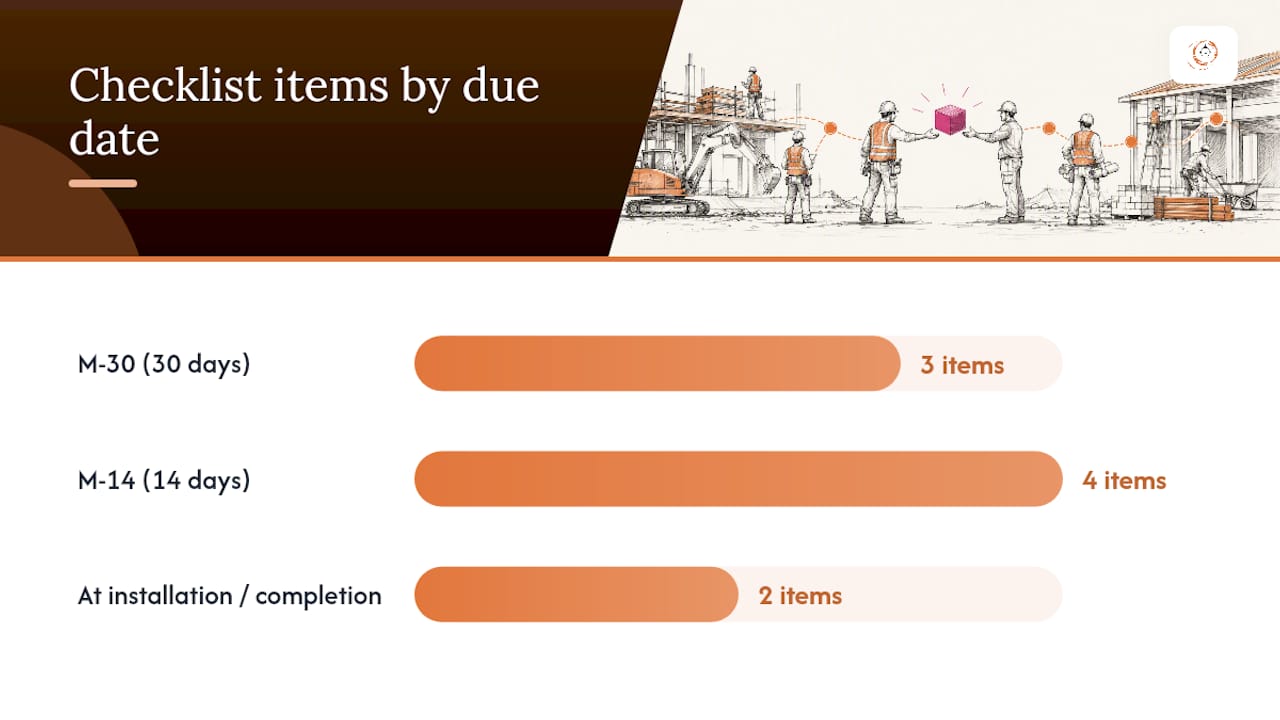
Group the checklist by category, and assign each group an owner and a due date measured in days before or after mobilization (noted as M for mobilization day):
- Contract and scope: signed contract, scope narrative, and change order log — PDF, due M-30
- Permits and certificates: permit numbers, inspection schedules, insurance certificates — PDF with expiration dates flagged, due M-14
- As-built drawings: current markups from estimating, even if preliminary — CAD or PDF, due M-14
- Commissioning reports: equipment startup logs and test results — PDF, due at substantial completion
- O&M manuals: manufacturer documentation bundled by system — PDF, due M-14
- Warranties: vendor and subcontractor warranty terms with start dates — spreadsheet, due M-14
- Punch list with owners: open items assigned to a name, not a trade — shared list, updated weekly
- Material and supplier lists: ordered items, lead times, delivery contacts — spreadsheet, due M-30
- Subcontractor contacts: scope, phone, email, site super name — shared contact sheet, due M-30
- Equipment serials: model and serial numbers tied to location — spreadsheet, due at installation
Evidence capture matters as much as the checklist itself. Photograph installed equipment before it gets covered up. Store signed PDFs, not scanned faxes buried in someone’s inbox. Timestamp commissioning records the day they’re generated, and keep everything in one central hub rather than scattered across email threads. A structured handover that gives operations complete documentation and training also improves your odds of repeat business from that owner.
Pro Tip: Assign the punch list owner by name, not by trade. “Electrical subcontractor” gets ignored. “Mike Torres, due Friday” gets done.
Who Owns the Handoff, and Who Has to Sign Off?
Ambiguity kills handoffs faster than missing paperwork. Someone has to own acceptance, and that person needs to be named in writing before the job starts, not after something goes wrong.
The operations acceptance owner, typically a project manager or operations manager, is the person who confirms every checklist item is complete and usable before the crew mobilizes. That role isn’t ceremonial. It’s the person who can say no if documentation is missing.
A workable sign-off sequence looks like this:
- Estimator or salesperson delivers the signed contract, scope, and preliminary schedule to the assigned PM.
- The superintendent reviews site logistics, access, and safety requirements against the scope.
- The commissioning agent confirms equipment specs and testing protocols are documented.
- Subcontractor leads confirm scope and pricing match what was sold.
- The owner or facilities representative acknowledges receipt of the handoff package.
Dated, countersigned documents aren’t a formality. Missing or disorganized handover documentation is one of the most common drivers of construction disputes, and a signature with a date attached is what actually establishes when liability shifted from one party to another.
When Should Handoff Prep Start: The 90/30/30 Window
Complex or greenfield projects need more runway than a typical remodel. Start handover prep 90 days before mobilization on anything with multiple systems, long-lead equipment, or heavy permitting. Simpler jobs can compress that window, but the last 30 days before mobilization should always be treated as its own phase, not a scramble at the tail end of estimating.
Here’s how the phases typically break out:
- Days 90 to 31: documentation gathering, CMMS setup, permit filing, and subcontractor pre-qualification.
- Days 30 to 1: final scope confirmation, kickoff meeting, punch list template setup, and site access arrangements.
- Day 0 to 30 post-mobilization: active monitoring, early issue escalation, and formal acceptance sign-off.
Greenfield projects that assemble roughly 56 deliverables across seven domains, documentation, CMMS transfer, warranty activation, training, punch list, and operations readiness, often need the full 90 days to hit Day 1 readiness.
Treating the first weeks after signing as real, deliverable-driven work rather than administrative overhead is the core discipline behind the 30-day handoff rule.
What Data Format Does Operations Actually Need?
A checklist is only useful if the data inside it can be searched, filtered, and loaded into whatever system operations already runs. Handing over a folder of scanned PDFs technically satisfies “documentation delivered,” but it doesn’t satisfy “operations can use this.”
Structure deliverables like this:
- As-built drawings: CAD native files plus a flattened PDF for field reference
- Serialized equipment lists: spreadsheet with asset ID, location code, manufacturer, model, and serial number
- Warranty registry: spreadsheet with start and end dates, coverage terms, and the vendor contact
- Commissioning logs: PDF with timestamps and technician sign-off
For CMMS transfer specifically, operations needs the asset hierarchy (parent systems and child components), preventive maintenance schedules, spare-parts lists with SKU numbers and min/max stock levels, and vendor contacts for every serviced piece of equipment. That level of detail is what turns a CMMS from an empty database into a working tool on day one.
Naming conventions matter more than people expect. Use a consistent format like [Project]-[System]-[DocType]-[Version] so nobody’s guessing which file is current. Give operations edit access, not just view access, from the start.
Pro Tip: If your estimating team still hands off data in read-only PDFs, you’re forcing operations to retype information that already existed. That’s where errors creep in.
How Do You Keep Communication From Breaking Down?
Most handoff failures aren’t caused by missing information. They’re caused by information that exists somewhere, in an email, a text, a spreadsheet on someone’s desktop, but never makes it into the place operations actually looks.
The fix is a single project hub where every submission has a required template, a deadline, and an automated reminder attached. When subcontractors and suppliers know exactly what format to submit in, quality goes up on its own.
A few practices that actually hold up on real jobs:
- Require a standard submission template for every subcontractor deliverable, not a free-form email.
- Set automated reminders at 7 and 2 days before each deadline.
- Validate submissions against the template before marking a checklist item complete.
- Log every document version so nobody works off a superseded drawing.
Standardized templates embedded at the procurement stage noticeably reduce ambiguity and rework when subcontractors and suppliers submit handover data. A construction-specific CRM platform like High Level CRM applies that same logic to the sales-to-operations transition: it keeps lead and job data attached to the same record from first contact through project closeout, so estimators, PMs, and superintendents are working from one continuous file instead of three disconnected systems. Firms setting this up for the first time often start with a CRM implementation playbook to sequence the rollout properly.
What Should the Kickoff Meeting Actually Cover?
The kickoff meeting is where handoff information becomes binding decisions, not a status update. Keep it to 30 to 60 minutes with the estimator, PM, superintendent, commissioning agent (if applicable), and subcontractor leads in the room.
Run through this decision checklist:
- Confirm scope clarifications and resolve any discrepancies between the sold scope and the estimate.
- Identify critical path items and long-lead materials that need immediate ordering.
- Assign first-week mobilization tasks by name.
- Confirm site access, safety requirements, and subcontractor site contacts.
Capture everything in a short meeting memo listing each action, its owner, and its deadline. Distribute it within 24 hours. A design-build firm’s preconstruction-to-delivery coordination shows how tightly this handoff needs to run when multiple trades mobilize on the same timeline.
How Do You Formally Close Out the Handoff?
Final acceptance isn’t a handshake and a set of keys. It’s a signed document listing any outstanding exceptions, the resolution date for each one, signatures from both the operations owner and the sales or estimating lead, and a clear Go or No-Go statement on whether the project is ready to proceed.
After sign-off, run a 30-day monitoring window with checks at day 7, day 15, and day 30. Build in an escalation path so early issues, a missing permit, a punch list item that resurfaces, get flagged to the operations owner immediately rather than discovered at the next scheduled meeting.
- Archive all closeout evidence (signed forms, commissioning logs, photos) in the same central hub used during handoff.
- Keep records retrievable for at least the length of your longest warranty term.
A countersigned final acceptance form is what actually establishes a legal handover. A walkthrough and a set of keys, without that signed paper, doesn’t reliably transfer liability.
Why the 30-Day Rule Beats Good Intentions
Most firms know handoff matters. Few fund it. Treating the first 30 days as an owned, budgeted phase, with one owner, one hub, one checklist, cuts delays and disputes and makes repeat business more likely, not less. That discipline is cheaper than the alternative.
— Rowena
How High Level CRM Keeps Your Handoff Consistent Every Time
Highlevelcrm-rconstructionsolutions built High Level CRM specifically to close the gap this article describes: the moment a signed job leaves estimating and someone in operations has to reconstruct the story from scratch. Because the platform keeps lead data, scope notes, and communication history attached to one job record from first contact onward, your PMs and superintendents inherit continuity instead of a cold start.
The CRM platform includes automated lead tracking, workflow templates built around construction handoff steps, custom reporting dashboards, and integrations with estimating tools contractors already use. Onboarding and training are typically included as part of the setup. If your current process still runs through email chains and spreadsheets, see how a construction-focused CRM handles the transition, or start with a CRM migration consultation to map your existing jobs into a system operations can actually use.
Sources
Build your own handoff playbook around a few authoritative references rather than starting from a blank page. Autodesk’s construction handover best practices cover the documentation and training case for a structured process. ENR’s 30-day handoff rule is the clearest short explanation of why the post-contract window needs named ownership. FieldPie’s handover workflow breakdown is useful if disputes are a recurring problem on your jobs. For greenfield or multi-system projects, iFactory’s 90-day greenfield checklist is worth the full read. Zutec’s analysis of digital handover challenges is the strongest case for moving off spreadsheets entirely.
- Construction handover best practices
- My 30-day handoff rule for construction success
- Construction Handover Process: Workflow & Documents
- Greenfield Project Handover Checklist: Construction to Operations
- Rethinking handover: the biggest challenges in construction handover
FAQ
What Is a Sales-to-Operations Handoff in Construction?
It’s the structured transfer of scope, schedule, permits, subcontractor contacts, and project documents from sales and estimating to the operations and field teams who will run the job.
How Long Should the Handoff Process Take?
Simple jobs can move through handoff in about 30 days, while complex or greenfield projects often need a 90-day window to assemble documentation, CMMS data, and training.
Who Should Own the Handoff Checklist?
An operations acceptance owner, usually a project manager or operations manager, should own the checklist and have authority to delay mobilization if deliverables are incomplete.
What Documents Cause the Most Handoff Disputes?
Missing or unsigned certificates, warranties, and permits are among the most common triggers, since disorganized documentation leaves liability boundaries unclear.
Can a CRM Actually Fix Handoff Problems?
A construction-specific CRM like High Level CRM keeps job data attached to one continuous record instead of scattered emails, which reduces the information gaps that cause handoff delays and errors.
Recommended
- Reduce Manual Onboarding Steps at Your Construction Firm
- Why Contractors Need Construction-Specific Tools
- Construction CRM Implementation: A Practical Rollout Playbook
- Commercial Construction Software Comparison Checklist 2026
Signed up, or thinking about it? We build the inside of the account — pipelines, workflows, funnels, nurture, migration. Built for construction. Contact us.
Affiliate disclosure. We’re a GoHighLevel affiliate. Sign up through our link and we may earn a commission at no cost to you, or buy direct. Build-out is billed separately, never a software markup.