

Bid Pipeline Management: The Framework That Cuts Lost Bids
Bid pipeline management is the discipline of tracking every active bid through defined stages, from first identification to project mobilization, so estimators and leaders always know where opportunities stand and what they’re worth. The single most effective change a contractor can make is combining a staged pipeline with a weekly review and a formal go/no-go score. Firms using dedicated bid systems instead of spreadsheets win 1.8 to 2.3 times more projects than those relying on email and shared drives, and the average lost bid burns $8,400 to $22,000 in estimating labor. High Level CRM was built on more than 30 years of construction operations experience, which is why this framework reflects how bid desks actually run, not how software vendors wish they ran.
- Stage every bid: identified, estimating, submitted, shortlisted, awarded, mobilized
- Score go/no-go with a weighted matrix, not gut feel
- Review the pipeline every week, not once a month
Quick fact: Bid teams lose 43% of their working time to administrative coordination rather than estimating or strategy, according to the 2026 State of Bid Management report.
Key Takeaways
Bid pipeline management works when stage discipline, weekly review, and weighted go/no-go scoring operate together rather than as separate initiatives.
| Point | Details |
|---|---|
| Use seven pipeline stages | Separate verbally awarded from contract executed to avoid overstating forecasted revenue. |
| Score every bid | Build an 8 to 12 factor go/no-go matrix and enforce a minimum threshold before estimating starts. |
| Run weekly reviews | Catch stalled bids and missed deadlines before they become lost opportunities. |
| Track KPIs beyond win rate | Monitor cycle time, bid quality score, and estimating hours per dollar awarded. |
| Pilot a construction CRM | High Level CRM offers pre-built pipeline stages and deadline automation for a 60-day trial with measurable KPIs. |
Table of Contents
- What Are the Stages of a Construction Bid Pipeline?
- What Belongs in a Bid Log and Which Metrics Matter?
- How Do You Build a Go/No-Go Process That Actually Works?
- Which Tools and Automations Actually Reduce Coordination Work?
- How a Construction CRM Puts This Framework Into Practice
- Where Does Bid Pipeline Management Fit With Sales and Project Delivery?
- How Should Contractors Prioritize Bids for Limited Estimating Capacity?
- What Causes Bid Pipelines to Break Down, and How Do You Fix It?
- Which KPIs Reveal Bid Pipeline Health Beyond Win Rate?
- How Do You Keep Every Team Informed During the Bid Process?
- Author Perspective: Protect Estimating Capacity First
- A CRM Built Around How Construction Bids Actually Move
- Sources
What Are the Stages of a Construction Bid Pipeline?
A construction bid pipeline needs more granularity than a typical sales funnel because the award process is binary and preconstruction work is expensive to redo. Most CRMs ship with generic three or four stage deal pipelines. That doesn’t match how a contractor actually moves a project from lead to mobilization, and it hides where opportunities stall.
A seven-stage model works better for most general contractors and specialty trades:
- Identified — a project has surfaced through a bid board, plan room, or relationship, but no decision has been made to pursue it.
- Estimating — the go/no-go decision is yes, and an estimator is actively building the number.
- Submitted — the proposal is in the owner or GC’s hands.
- Shortlisted — you’ve made the short list or been invited to interview or negotiate.
- Verbally awarded — you have a commitment but no signed contract, a stage many pipelines skip and shouldn’t.
- Contract executed — paperwork is signed and the job is real for forecasting purposes.
- Mobilized — the project has transitioned to operations and left the bid pipeline entirely.
Separating “verbally awarded” from “contract executed” matters because verbal commitments fall through often enough that treating them as guaranteed revenue distorts your forecast.
Each stage needs a minimum data set attached to the record, captured at entry rather than reconstructed later:
- Project name and location
- Owner or general contractor and the primary contact
- Bid due date and time
- Estimated contract value
- Bid type (hard bid, negotiated, design-build, CM at risk)
- Assigned estimator and estimated hours required
- Current stage and days in that stage
That last field matters more than most contractors realize. A bid sitting in “estimating” for three weeks past your normal turnaround is a warning sign, not a data point to ignore.
Once you have consistent fields, you can weight your pipeline value instead of just summing raw bid amounts. Multiply each open bid’s value by your historical win rate for that bid type, client relationship, and project size band, and you get a pipeline-weighted forecast that leadership can actually plan cash flow and staffing against, rather than a gross number that overstates what’s really coming.
What Belongs in a Bid Log and Which Metrics Matter?
A bid log is the operational backbone underneath the pipeline stages, and it needs to hold more than a project name and a due date to be useful. MeltPlan’s guidance on GC bid tracking makes the point directly: smaller firms can survive on a well-disciplined spreadsheet, but the discipline is the hard part, and larger firms need integrated tools to keep the data trustworthy at all.
The minimum fields, beyond the pipeline data already captured, include:
- Bid/no-go decision and reason — even declined opportunities teach you something about your pipeline’s shape.
- Delivery method — hard bid, design-build, or negotiated, since these have wildly different win rates.
- Estimating hours logged — the true cost of pursuing the bid, win or lose.
- Outcome and loss reason — awarded, lost to competitor, project canceled, client delayed.
- Competitor bid price, when available — even partial visibility sharpens future pricing.
From that log, four metrics turn a static record into a decision tool. Win rate by segment breaks performance out by project type, size band, and delivery method rather than one blended number that hides where you’re actually strong. Bid-to-build ratio tells you how many proposals it takes to fill one production slot, which drives staffing decisions directly. Estimating ROI divides the value of awarded work by total estimating hours spent across won and lost bids, exposing whether your team is chasing too many long-shot opportunities. Bid-to-award lead time flags segments where decisions drag, usually meaning your qualification criteria need tightening.
Run a weekly tactical review of open bids and near-term deadlines with the estimating team, and a monthly forecast review with leadership that rolls the pipeline-weighted value into revenue planning. The cadence split matters. Weekly is about catching things before they slip, monthly is about resourcing decisions that take longer to execute.
How Do You Build a Go/No-Go Process That Actually Works?
Most contractors either bid everything that crosses their desk or rely on a principal’s instinct. Both approaches leave money on the table, either in wasted estimating hours or in walking away from work you were well positioned to win.
- Build a weighted scoring matrix with 8 to 12 factors. Include relationship strength with the owner or GC, project size relative to your typical backlog, delivery method fit, bonding capacity impact, competitive field size, schedule feasibility, and profit margin history on similar work. Weight relationship and margin history heavier than novelty factors like “interesting project type.”
- Set a minimum score threshold below which estimating won’t start without a principal’s override, logged as an exception.
- Build a reverse timeline from the due date. Work backward: subcontractor pricing due five to seven business days out, addenda review two days out, final numbers assembled the day before, and internal review scheduled the morning of submission. Escalate automatically if any milestone is missed by more than 24 hours.
- Standardize subcontractor solicitation with a consistent scope breakdown and a document library that flags expiring insurance certificates and licenses before they become a submission-day scramble.
- Run a post-bid debrief on every outcome, win or loss, capturing the loss reason, competitor pricing if known, and whether the go/no-go score predicted the result. Feed that back into your scoring weights quarterly.
Pro Tip: Track how often your go/no-go score and your actual outcome disagree. If low-scoring bids keep winning, your weights are wrong, not your gut.
The debrief step gets skipped constantly because bid season doesn’t leave room for retrospectives. Skipping it is exactly why the same pricing mistakes repeat project after project.
Which Tools and Automations Actually Reduce Coordination Work?
The tool categories that matter for bid pipeline management are bid board aggregators, construction-specific CRMs, estimating software, document and version control systems, and workflow automation platforms. The problem isn’t a shortage of tools. A typical tender already involves 21 documents, 139 messages, and 8.6 different tools moving between people who don’t share a single source of truth.
The integration pattern that removes the most friction runs bid board monitoring into a CRM opportunity record, which triggers an estimating tool assignment, links to a document library, and kicks off a deadline workflow automatically. Get that chain right and coordination overhead drops because information stops being retyped at every handoff.
Automation delivers the most value when scoring and assignment are built directly into the bid lifecycle, so decisions happen in hours rather than the days a manual process usually takes.
Four automation patterns produce measurable results:
- Auto-scoring new opportunities against your go/no-go matrix the moment they enter the CRM.
- Addenda alerts that notify the assigned estimator and update the deadline cascade the instant a bid board posts a revision.
- Auto-assigning estimators by workload and specialty instead of an email chain asking who’s free.
- Post-submission follow-up sequences that prompt outreach at set intervals instead of relying on someone remembering to check in.
Before buying anything, check whether a toolset’s data model actually matches the object structure you need (accounts, opportunities, projects) and whether it accounts for your team’s real estimating capacity, not just deal count. A commercial construction software comparison checklist is worth running through before you commit budget to any platform.
How a Construction CRM Puts This Framework Into Practice
High Level CRM was built by people with over 30 years in construction, which shows up in details generic CRMs miss: the seven-stage pipeline comes pre-built, deadline cascades are templated around real bid timelines, and follow-up sequences trigger automatically after submission instead of relying on a sticky note.
A typical pilot runs 60 days and tracks three numbers: change in win rate by segment, estimating hours saved per bid, and on-time submission rate. Contractors adopting automated lead tracking and bid workflows commonly see conversion improvements in the range of 35% once the pipeline data model and scoring are configured correctly, though results vary by segment and starting discipline.
- Pre-built seven-stage pipeline matched to construction award cycles
- Deadline cascade templates that escalate automatically
- Automated post-submission follow-up sequences
| Pilot metric | What to watch |
|---|---|
| Win rate by segment | Compare 60-day performance against your trailing 12-month baseline |
| Estimating hours saved | Track hours logged per bid before and after automation |
| On-time submission rate | Measure how often deadline cascades prevent late submissions |
Where Does Bid Pipeline Management Fit With Sales and Project Delivery?
A bid pipeline that lives in isolation from your broader sales and project management workflow creates a hard seam at the exact moment a project needs the smoothest handoff: the day it’s awarded. Business development identifies the opportunity, estimating prices it, and operations eventually builds it, but if those three functions use disconnected tools, critical context gets lost in the transition.
The fix is treating “mobilized” as a shared checkpoint rather than an end point. When a bid moves to contract executed, the CRM record should carry forward the estimator’s assumptions, the subcontractor commitments, the client contact history, and the original scope clarifications into whatever system runs project delivery. Project managers inheriting a job without that history end up re-asking questions the estimating team already answered weeks earlier, which damages client confidence right when it matters most.
This also means your BD pipeline and your project backlog need to speak the same language around forecasting. If estimating tracks pipeline-weighted value one way and operations plans crew allocation a different way, leadership ends up reconciling two conflicting forecasts instead of one. A streamlined commercial bid workflow closes that seam by making the handoff checklist a formal stage gate rather than an informal conversation between departments.
How Should Contractors Prioritize Bids for Limited Estimating Capacity?
Not every open opportunity deserves equal estimating attention, and treating them that way is how strong bids get rushed while marginal ones get full effort. Prioritization has to weigh strategic value against the estimating hours actually available on your team.
Start with capacity as the hard constraint, not the opportunity list. If your estimating department can realistically turn three quality bids in a given week, decide which three based on weighted score, not submission deadline order. A high-scoring negotiated job with a repeat client should displace a long-shot hard bid against eight competitors, even if the hard bid landed on your desk first.
Strategic value extends beyond the dollar amount of a single contract. Consider whether a bid opens a new market segment, deepens a relationship with a GC who awards repeat work, or fills a schedule gap between larger committed projects. A smaller project that keeps a key superintendent staffed between big jobs can outrank a larger one that would require subcontractor relationships you don’t have yet.
Build a simple rule: bids scoring above your go threshold get full estimating attention in the order of strategic weight, not chronological order. Bids near the threshold get a rapid, capped-hours estimate rather than a full pursuit. This keeps your best people working on the opportunities most likely to convert, instead of spreading effort evenly across a pipeline where some entries never had a real chance.
What Causes Bid Pipelines to Break Down, and How Do You Fix It?
The most common failure isn’t a missing tool. It’s a pipeline that looks accurate on paper but reflects reality poorly because updates lag behind actual bid status. An estimator moves a bid to “submitted” and forgets to log the shortlist notification two weeks later, and suddenly your forecast is wrong without anyone noticing.
Stale data is the biggest recurring problem. The fix is procedural, not technical: make stage updates part of the weekly review agenda rather than an optional task, and flag any bid that hasn’t moved in longer than your typical cycle time for that segment.
Overloaded estimating capacity during peak season is the second. Contractors report high concern about cost and schedule fluctuations during peak bidding periods, and that pressure compounds when too many bids enter the pipeline at once without a capacity check at intake.
Poor handoff after award is the third. Deals that close cleanly in the CRM but arrive in operations without context create rework and client friction, which is why the mobilization stage needs a formal checklist, not a verbal pass-off.
Inconsistent qualification criteria is the fourth. When go/no-go decisions depend on who happens to review the opportunity that week, your win rate becomes unpredictable and hard to forecast against.
Each of these traces back to the same root cause: treating the pipeline as a record-keeping exercise instead of an operational tool leadership actually uses to make weekly decisions.
Which KPIs Reveal Bid Pipeline Health Beyond Win Rate?
Win rate tells you outcomes, but it says nothing about how efficiently you got there or whether your proposals are actually competitive on quality, not just price. Three additional KPIs round out the picture.
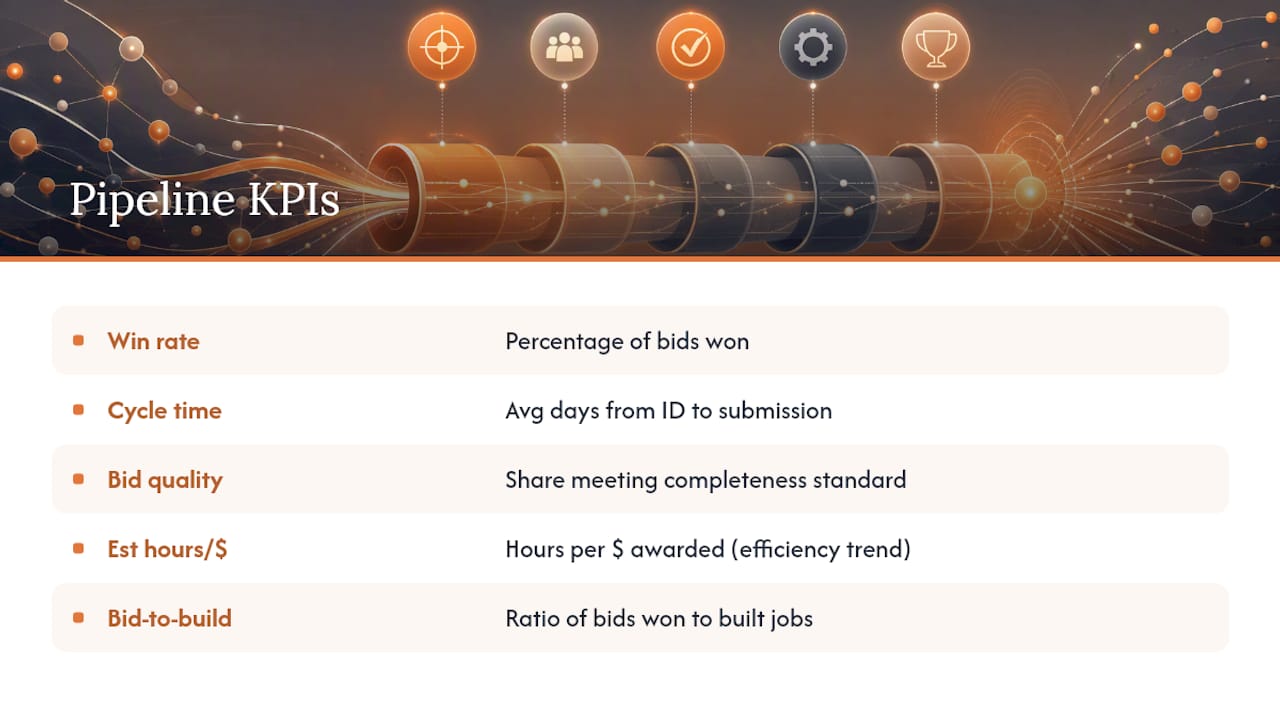
Cycle time measures the average number of days from identified to submitted, broken out by bid type. A negotiated job that takes three weeks to price when your historical average is ten days signals either scope creep in the estimate or a bottleneck in subcontractor pricing that needs addressing before it repeats.
Bid quality score captures whether submissions meet your own internal completeness standard: correct addenda incorporated, subcontractor pricing current, exclusions clearly stated, and required forms attached. Track the percentage of submissions that go out without a last-minute scramble, since rushed proposals correlate with both errors and lost credibility with owners.
Estimating hours per dollar of awarded work shows efficiency trends over time. If this ratio climbs quarter over quarter, your team is spending more effort to win the same revenue, which usually points to either weaker qualification upfront or increased competitive pressure that needs a pricing strategy response.
Together with win rate, bid-to-build ratio, and lead time, these five numbers give leadership a genuinely complete view of pipeline health rather than a single headline metric that can mask real problems underneath.
How Do You Keep Every Team Informed During the Bid Process?
A bid touches more people than the estimator assigned to it: principals making go/no-go calls, subcontractors pricing scope, operations planning for eventual mobilization, and sometimes finance evaluating bonding capacity. Each needs different information at different moments, and a single email thread can’t serve all of them well.
Set a standing weekly pipeline review with a fixed agenda: bids moving stages, upcoming deadlines in the next 10 business days, and any bid flagged for stalled progress. Keep this meeting short and data-driven, pulling directly from the CRM rather than a manually assembled slide deck that’s already outdated by the time someone presents it.

For subcontractors, a standardized solicitation communication with a clear scope breakdown and firm pricing deadline reduces the back-and-forth that eats into your reverse timeline. For leadership, a monthly forecast review translates pipeline-weighted value into staffing and cash flow conversations, separate from the weekly tactical meeting so each audience gets the right altitude of detail.
The handoff to operations after award deserves its own dedicated communication, not a footnote in a status update. A short structured briefing, covering scope clarifications, subcontractor commitments, and client relationship notes, prevents the new project team from re-litigating decisions the bid team already settled.
Author Perspective: Protect Estimating Capacity First
The pipeline data will tell you exactly when to add estimating capacity or bring in subcontractor support, weeks before the deadline crunch hits. Most firms wait for the crisis instead. And one more thing: if your marketing or website imagery only ever shows one type of person running these processes, it doesn’t reflect who’s actually doing this work across the industry. Diversify the photos.
— Rowena
A CRM Built Around How Construction Bids Actually Move
Highlevelcrm-rconstructionsolutions gives contractors a bid pipeline built around the seven-stage model this article describes, instead of a generic sales funnel retrofitted for construction. That distinction matters because most CRMs on the market were built for software sales cycles, not for tracking verbal awards, subcontractor solicitation, or deadline cascades tied to addenda.
The platform comes with automated lead tracking, custom reporting dashboards, and estimating integrations built specifically for how contractors, suppliers, and manufacturers actually operate. If you’re managing bids across residential, commercial, or specialty trade work, the industries served page walks through how the pipeline configuration adapts to your segment. For a full breakdown of features before you commit, the CRM features and FAQ page covers what’s included in setup and ongoing support. The next step is straightforward: book a demo call to see your own bid stages mapped into the system before you decide anything.
Sources
- State of bid management report 2026
- Win 2x More Construction Bids With Automation Guide | US Tech Automations
- RevOps Construction: 7 Proven Bid Stages, Backlog Forecast
- How GCs Track Bids: Pipeline Management for Construction | MeltPlan
- The struggle of bidding jobs — Acuity (2026)

